1
AVM 20
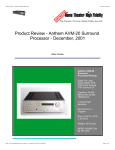
THE AVM 20
It follows therefore that interpretations of what a Surround
Sound Processor (SSP) should be, what it should include, and
what role it should play in a system are as varied as the manufacturers who create them. After having lived with and tested
the Anthem AVM 20, I feel it is a pretty special piece because
it embodies much of our interpretation of SSP art. Witness
the current state of consumer electronics: technologies
are in constant flux and as a result, the mass
market names can’t help but yield short
term investment products, continually
replacing their own models with newer
ones as buzz words and marketing
gimmicks change. On the flip side
are top-shelf names including
Lexicon, Krell, Proceed, Theta, and
our Stacey Spears own favorite:
Meridian. All these portray a
feeling of long term investment
and those who can afford themselves such a tier of product often
do so for that very reason. Take our
editor’s $18,000 Theta Casablanca II:
every process (AC-3, DTS, etc.) is on
a card, cards which can be added and
swapped at will. Stacey’s Meridian, while
featuring card options for input and output,
takes a more PC’esque approach by employing lots
of generic computing power, and then rewriting or updating
software as needed. This is peace of mind at a rather high
price. Can state-of-the-art cost less? Can it still have provision
for the future? Yes! The AVM 20 successfully weaves together
fixed hardware with software processes, delivering an exquisite
statement on the proverbial home theater center piece. Read on.
THE GOODS
I began my affair with the AVM 20, as I do so many, by
unpacking it. The product is well built, solid, and robust. It’s
heavy to the point you’d easily mistake it for a receiver. This
weight is due in part to the beefy chassis whose fit and finish
are like a fine exotic automobile’s, yet some weight comes
from the two, count ’em two, separate transformers. There’s
the main toroid and then a separate El core unit for standby
power and other 12V needs outside of the audio circuit. The
requisite black face is available in addition to the elegant silver
of our review sample.
A word on Inputs and Outputs. Well … maybe a bunch of
words. Just for starters there are 7 basic inputs, each with stereo
analogue audio (single ended), coax digital audio, composite
video, and S-Video. Three of these have complete sets of
analogue audio and video outputs to feed the
record lines on those components. There are
3 Toslink (optical) digital inputs and one
high-end AES/EBU digital input, any
of which can be assigned to any of
the 7 basic inputs. Further, there is
a dedicated two-channel balanced
input and a 6-channel (5.1) single
ended input. A pair of component
video inputs can be assigned to
any audio line. Here’s a kicker:
all inputs can be renamed to
anything you like using letters
and numbers to a maximum of 6
characters. For outputs, complete
7.1 sets are provided in both single
ended and balanced formats. Both
include two jacks for the center and
subwoofer (10 outputs per set total). Stereo
audio, composite, and S-Video outputs are provided for Zone 2 and Zone 3, while a pair of coax digital
audio outputs are available with a variety of formatting options.
Despite the abundance of jacks, and the fact that at first glance
it looks overwhelming, they are actually easy to sort out: All
inputs are on a black background, while outputs are all on a
white background. See photo below.
Finished? Oh no! There are three 12V trigger outputs (1/8˝
jacks), two infrared outputs (also 1/8˝ jacks), and a 12V terminal
strip for IR receivers. A DB-9 RS-232 serial port gets the AVM 20
talking to home environment systems, and although it seems
banal, antenna terminals are there for the built-in radio. The
only spot on the back not populated has been conspicuously
labeled “IEEE-1394/Phast Connection” so even that spot will
get used up when a standard is laid down for it.
2