1
AVM 20
3
“The AVM 20 is a statement piece. A statement about all that is important, useful, and
desirable in a surround sound processor.
It’s also a statement about fair
value. I suppose no preamp/
processor can be all things
to all people, but the
AVM 20 is the only one
I know of that at least
has a shot at it.”
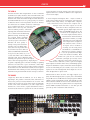
model of chip used by Sonic includes Dolby Digital and DTS software routines in on-chip ROMS. Other processes such as bass
management, time alignment, and all the THX Home Cinema
items are stored in external ROM chips (see ‘DSP Board’ photo
below). This software can be changed and updated using
a computer and a download from Sonic’s website.
THX AND THE AVM 20
The primary, numero uno directive of
THX’s surround sound processor
spec is to account for, compensate
for, and otherwise address the
simple fact that a home theater is
fundamentally a different space
than that of a commercial, 200
seat cinema. A THX Surround
Sound Processor includes several
functions, collectively known as
THX Post Processing, which are
applied to the soundtrack after Pro
Logic, Dolby Digital, or DTS decoding
when “THX Home Cinema” is invoked
by the user.
The AVM 20’s design is a little
like a personal computer in that
it is based on a main board with
various daughter cards. A veritable
highway of audio, everything gets
funneled through the big main board,
so Sonic Frontiers (Anthem’s mother
AVM 20 CONVERTER BOARD
company) spent a great deal of effort in its
design. It is comprised of four layers, with
power and ground each getting their own plane.
“The AVM 20’s sound is refined and
Rather than let a computer draw out the ground plane, Sonic did
exquisite. In what I heard, nothing could
it manually, a process which took months of work, but they feel
it is well worth it for the audible improvements. The main board
be described as incorrect. Never did I
manages all the audio ins and outs, while a completely separate
think ‘if only it was a little more (or less)
board manages the video I/O. Daughter boards which feed
the main board include the DSP board and the
such-and-such’. The sound was
converter board.
intrinsically satisfying.”
Analogue to digital conversion (A/D or
ADC) is done by a set of AK5383
ADCs running at 24 bits/96 kHz.
These are two-channel ADCs, and
you can see the set of three on the
daughter card (see ‘Converter
Board’ photo above). Three are
necessary for digitization of the
6-channel analogue input. The
digital to analogue converters
(DAC) are AK4382s running at
24 bit/192 kHz. Again, these are
two channel units, so four of them
cover a complete 7.1 output, while a fifth
takes care of stereo signals and/or downconverted material being sent to Zones 2 and 3.
AVM 20 DSP BOARD
On the DSP board is the Motorola 56366, a 24 bit process/
datapath DSP chip which handles all the Dolby, DTS, and
THX processing as well as all other digital audio manipulation.
It really is the brains behind the inner workings. Here is where
it’s interesting to make a distinction about hardware vs. software.
The Motorola processor is the hardware, and the particular
The AVM 20 includes all the elements
required for the THX Ultra Surround
Sound Processor designation. THX
post processing is nothing new,
and while we at Secrets are not
warm and fuzzy about everything which falls under the THX
logo, most of us do highly advocate THX post processing and
consider it a requisite element for
an upscale surround sound controller. The AVM 20 uniquely allows
latitude on some THX elements, so a
quick refresher of what THX implies, and
how the AVM 20 executes it, is in order.
Timber Matching alters the sound of the surround
channels, accounting for the fact that sources behind us
sound different from those in front. By making the surrounds
sound more like the fronts, a more seamless sound space is
created. Adaptive Decorrelation was originally created in the
hey-day of Pro Logic. It prevents the mono surround channel