1
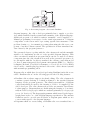
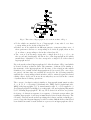
Flowchart
begin(a)
BlockSeq(a,i)
end(i)
Block(a,b)
BlockSeq(b,i)
statement(a,b)
Block(b,c)
statement(b,c)
BlockSeq(c,i)
Block(c,e)
condition(c,d,e)
BlockSeq(e,i)
BlockSeq(d,c)
Block(d,h)
condition(d,f,g)
Block(e,i)
BlockSeq(h,c)
BlockSeq(f,h)
BlockSeq(g,h)
Block(h,c)
Block(f,h)
Block(g,h)
statement(h,c)
statement(f,h)
statement(g,h)
statement(e,i)
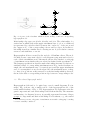
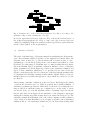
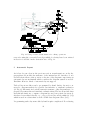
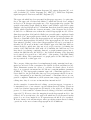
Fig. 8. Derivation tree of the reduced hypergraph model of Fig. 6 according to the
grammar of Fig. 7 when omitting any conn edge.
model are represented as leaves of the tree. Fig. 8 shows the derivation tree of
the reduced hypergraph model of Fig. 6. Any conn edge, however, has been
omitted for simplicity. Edges are written as their edge labels together with the
labels of their visited nodes in parentheses.
3.4 Attribute evaluation
The task of the final step of diagram analysis is translating the diagram into
some data structure which is specific for the application domain where the
diagram editor is used. If, e.g., the flowchart editor is used as part of a programming tool, it should probably create some textual representation of the
flowchart. For that purpose, DiaGen uses a common syntax-directed translation mechanism based on attribute evaluation similar to those of attribute
string grammars [13]: Each hyperedge carries some attributes. Number and
types of these attributes which have to be specified by the editor developer
depend on the hyperedge label. Productions of the hypergraph grammar may
be augmented by attribute evaluation rules which compute values of some attributes that are accessible through those edges which are referred to by the
production.
After parsing, attribute evaluation works as follows: Each hyperedge which
occurs in the derivation tree (or DAG in general) has a distinct number of
attributes; grammar productions which have been used for creating the tree
impose rules how attribute values are computed as soon the value of others
are known. Some (or even all) attribute values of terminal edges are already
known; they have been derived from attributes of the diagram components
during the reducing step (This feature has been omitted in Section 3.2). The
attribute evaluation mechanism of the editor then computes a valid evaluation
order. Please note that DiaGen does not require a specific form of attributed
definition like S- or L-attributed definitions [13]. At least when dealing with
15