1
reduced ones. Instead, the reducer applies all reduction rules to all occurrences
of their left-hand sides in some kind of parallel fashion:
• Patterns frequently overlap. This is so since the meaning of a group of
diagram components and relationships — and this “meaning” is tried to be
represented by the edges of the reduced hypergraph model – often depends
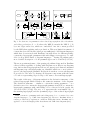
on context which is part of another group. E.g., the last rule of Fig. 5 uses a
flowOut edge as (negative) context which also occurs in the pattern of the
third rule. Applying one rule would change the context of the other one if
regular hypergraph transformations were used. It would be a difficult task
to specify the desired reducing semantics.
• There are in general many different derivation sequences starting at a specific hypergraph which would produce different reduced hypergraphs because of these overlapping patterns. The editor developer had to take measures to avoid this nondeterminism. However, it is a nontrivial task to set
up such confluent sets of transformations [9].
Instead, reduction rules are applied as follows: All possible matches of all rule
patterns are searched first without changing the hypergraph. But only those
matches are selected which satisfy the corresponding application conditions. In
a second step, the corresponding result hypergraphs are instantiated in parallel
for each valid match of the corresponding pattern. All these hypergraphs are
connected by common nodes according to the correspondence between nodes
of the hypergraph model and the reduced one. 3
The reduced hypergraph model now directly represents the structure of the
diagram which is syntactically analyzed by the parser.
3.3 Parsing
The syntactic structure of a diagram is described in terms of its reduced hypergraph model, i.e., a diagram language corresponds to a class of hypergraphs.
In the literature, there exist two main approaches for specifying graph or hypergraph classes. The first one uses a graph schema which is a kind of EntityRelationship diagram that describes how edges and nodes of certain types may
interconnect (e.g., EER [11]). The other one uses some kind of graph or hyper3
In a formal treatment, each reduction rule (P, R) represents a hypergraph morphism P → P ∪R where P ∪R is the union of the pattern with the result hypergraph.
Corresponding nodes of P and R as well as identified nodes of R are identified in
P ∪R. The reduced hypergraph model is computed by first creating the colimes of all
match morphisms of the different patterns into the hypergraph model together with
all these morphisms P → P ∪ R, and then removing the edges and “unnecessary”
nodes of the hypergraph model from the colimes hypergraph [10].
12