1
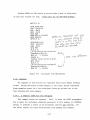
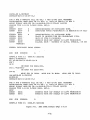
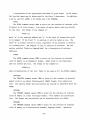
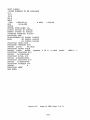
-DISABLED- -BACKUP CANNOT BE READ OR LOAD IN PROGRESS-'An assign will receive
FACILITY REJECTED 400000000100.
See Section 3.8.2.
The user should periodically list the names of all his files, and
delete those no longer needed.
3.9.2.
The @DELETE Statement
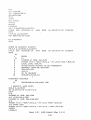
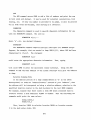
The @DELETE statement may be used to delete files or delete elements of
program.fi1es.
@DELETE
filename
deletes the specified file.
@DELETE,options filename.eltname
deletes element 'e1tname' from program file 'filename'.
Since 'e1tname' may
exist concurrently as symbolic, re10catab1e, and absolute, the 'options'
indicate the type(s) of elements to delete, as follows:
A option - absolute element
R option - re10catab1e element
S option - symbolic element
The user should periodically delete files and elements no longer
needed.
~
/
3.9.3.
The @PACK
~l~
r-t:, .
Stateme~)
71..\--~~~~···~
PACK statement rewrites
an entire program file so as to exclude
deleted elements and release unneeded mass storage.
Remember that in addition
to elements explicitly deleted by the @DELETE statement, elements are
deleted each time an element is updated, recompiled, remapped, or
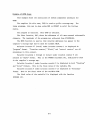
It is important that users pack their program files frequently, for the
computer center typically finds ·thousands of mass storage tracks tied up in
deleted elements.
to exceed its
In addition, failure to pack frequently may cause a file
max~um
size prematurely.
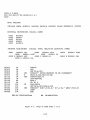
The format of the @PACK statement is
@PACK filename
or
@PACK filename, filename, filename
(etc.)
(As many files as desired may be specified.)
3-16
h' '.__
t3
d
1
~
trDUJ,~
re-inserted. 5ASJ[~
pr~~~'