1
7
MCSCF AND CASSCF CALCULATIONS
16
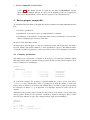
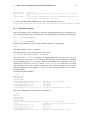
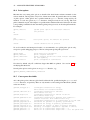
As a rule of thumb, it can be said that if a CASSCF calculation does not converge or converges
very slowly, the active or inactive space is not chosen well.
7.3
State-averaged MCSCF
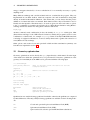
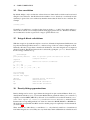
In order to compute excited states it is usually best to optimize the energy average for all states
under consideration. This avoids root-flipping problems during the optimization process and
yields a single set of compromise orbitals for all states.
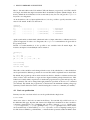
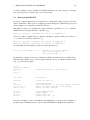
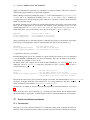
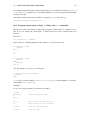
The number of states to be optimized in a given symmetry is specified on a state directive,
which must follow directly after the wf directive, e.g.,
wf,16,1,0;state,2 !optimize two states of symmetry 1
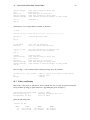
It is also possible to optimize states of different symmetries together. In this case several wf /
state directives can follow each other, e.g.,
wf,16,1,0;state,2 !optimize two states of symmetry 1
wf,16,2,0;state,1 !optimize one states of symmetry 2
etc. Optionally also the weights for each state can be specified, e.g.
wf,16,1,0;state,2;weight,0.2,0.8
!optimize two states of symmetry 1
!first state has weight 0.2,
!second state weight 0.8
By default, the weights of all states are identical, which is normally the most sensible choice.
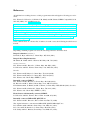
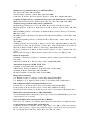
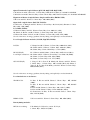
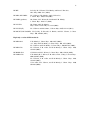
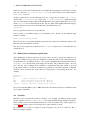
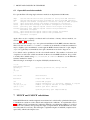
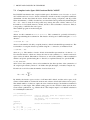
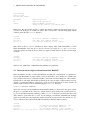
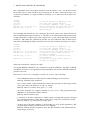
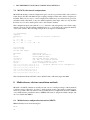
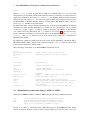
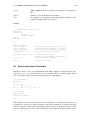
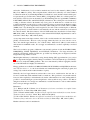
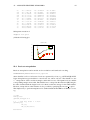
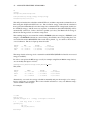
The following example shows a state-averaged calculation for O2 , in which the valence states
1
(3 Σ−
g , ∆g ) are treated together.
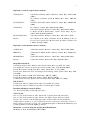
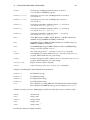
***,O2
print,basis,orbitals
geometry={
o1
o2,o1,r
}
!geometry specification, using z-matrix
r=2.2 bohr
!bond distance
basis=vtz
!triple-zeta basis set
{hf
wf,16,4,2
occ,3,1,1,,2,1,1
open,1.6,1.7}
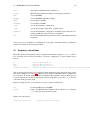
!invoke
!define
!number
!define
{casscf
wf,16,4,2
wf,16,4,0
wf,16,1,0}
!invoke CASSCF program
!triplet Sigma!singlet delta (xy)
!singlet delta (xx - yy)
RHF program
wavefunction: 16 electrons, symmetry 4, triplet
of occupied orbitals in each symmetry
open shell orbitals
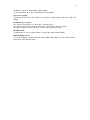
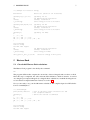
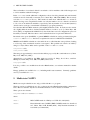
Note that averaging of states with different spin-multiplicity, as in the present examples, is
possible only for CASSCF, but not for more restricted RASSCF or MCSCF, wavefunctions.