1
2.3 Eye-trackers
Two MAGIC 4 pointing techniques where implemented in [30]. The first technique
was called “liberal”, with this technique each new fixation outside a boundary (a
certain distance from the current gaze point) teleports the cursor to the new fixation.
The second technique was called “conservative” and only teleports the cursor if the
manual input device has been actuated. While the “liberal” approach was found
faster in the experiment and overall subjects liked it better for its responsiveness, in
a real life computer setting the over-activeness of the cursor (i.e. teleporting all the
time to the current fixation event without triggering the manual input device) makes
it an unusable approach. An interesting add-on on the “conservative” technique was
the usage of an intelligent biased, instead of teleporting the cursor to center of the
gaze area the cursor position is offset to the intersection of the manual actuation
vector and the boundary of the gaze area but results does not shown a significant
improvement by using the intelligent bias.
2.3.3 Gaze-supported input devices
Studies that compare input devices and their performance in common computer task
like pointing and dragging can be found [19] in the literature. Finding studies that
compare the performance of input devices that are augmented with eye-tracking
capabilities is difficult.
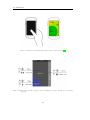
While [24] proposed several interaction techniques that can be implemented in a
hand-held multitouch device (an iPod touch in their experiment) they do not compare
their performance with a mainstream pointing device like the mouse. From the three
types of interaction techniques proposed only two (MAGIC touch and zoom lenses)
are target agnostic (i.e. the pointing is decoupled of the knowledge of the position
of the potential targets). We discarded the zoom lenses approach (a magnifying
lens appears near the point of gaze making the refinement of the cursor position
easier) because it incorporates an intermediate state that increases the time of the
interaction. The technique refereed as MAGIC tab cycles between the targets that
are within a selection mask based on the gaze point, in order to implement this
technique knowledge about the targets needs to be provided making the technique
target aware instead of target agnostic (MAGIC tab works similar to the TAB key
of the keyboard). While more and more operating systems provides ways to expose
and manipulate the widgets of other applications a target agnostic approach makes
the interaction technique suitable for any application without the need to expose
or modify anything. For this reason in this study we are only focusing on pointing
techniques that are target agnostic.
Our main contribution with this work is to compare different input technologies
when they are combined with the gaze information.
4
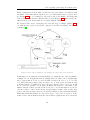
Manual And Gaze Input Cascaded or Manual Acquisition with Gaze Initiated Cursor
21