1
Mass Spectrometer Theory
The mass spectrometer allows you to identify the masses of individual atoms and
molecules that have been converted to ions from a given sample. This technique
is unique in that it provides a fingerprint identification for the structural and
chemical properties of these molecules. The quadrupole mass spectrometer is one
of a specialized subset of mass spectrometers that measure background gases in
an existing vacuum chamber.
A mass spectrometer consists of the following components:
• Sampling System
• Mass Spectrometer Hardware
• Data System
Sampling System
The Sampling System serves as a connection between the outside sample environment and the vacuum environment that the mass spectrometer requires. The
Dycor LC-D can be equipped with a variety of inlet systems. All of these systems
are configured to bring the required number of sample streams into the LC-D at
the specified pressure, while maintaining the high vacuum necessary for proper
mass spectrometry operation.
Mass Spectrometer Hardware
Once the sample reaches the mass spectrometer hardware, three processes take
place:
• Ionization
• Separation
• Detection
Ionization
During ionization, sample molecules are turned into ions which are then focused
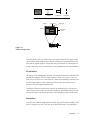
towards the quadrupole to be detected. The process occurs in the ionizer which
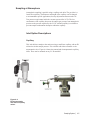
consists of a filament, filament electron repeller, source grid, and focus plate. See
Figure 1-1.
The filament produces electrons. As current flows through the filament, it is
electrically heated to incandescence and emits free electrons. Once the electrons
are free, they are accelerated towards the source grid by the potential difference between the filament and the source grid. As a cloud of electrons accelerates
towards the source grid, the electrons collide with the sample and create ions.
1-2 | Dycor LC-D Series





























![User`s Manual MV2000[SU:M] Ventilator System 0470](http://vs1.manualzilla.com/store/data/005841388_1-c867b5a0773523e6306e353a41d4c56d-150x150.png)