1
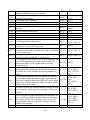
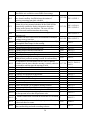
Rationale: NFR23.1 combines with NFR21.1. NFR21.1 refers to evolving data so 'varying'
means gradual change over time. Option 1 & 4 are consistent with evolving data.
Reference: None
2.3.22 Issue Statement [NFR25.1]
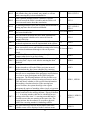
"The system should be easily extensible to accommodate the following typical variations:
Problem: Ambiguity. Easily is not measurable. Typical is general.
Option 1: Rephrase as “The system should allow for the following features to be supported in
future versions:”
Option 2: Rephrase as “The system will have the following features:”
Solution: Option 1
Rationale: This allows the requirements document to describe future features which the current
design and programming teams for the system will not be held responsible for.
Reference: None
2.3.23 Issue Statement [NFR26.1]
"handling of explicit priorities among dates in preference sets;"
Problem: Ambiguity: Who/what explicitly prioritizes dates in preference set.
Option 1: The user may define priority times to meet in his or her preference set.
Option 2: Meeting initiator prioritizes dates in user preference sets
Option 3: Software prioritizes dates in user preference sets
Solution: Option 1
Rationale: User knows best what his/her schedule is and should be the one to prioritize his/her
preferences.
Reference: None
2.3.24 Issue Statement [NFR27.1]
"variations in date formats, address formats, interface language,"
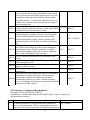
Problem: Ambiguous and unclear. Define specific current and future date formats, address
formats, and interface language.
Option 1: Current and future date formats using subset of International Standard Date Notations
(ISO 8601).
Option 2: Current and future data formats using popular country-specific formats
Option 3: Current and future physical address formats for residents and companies within the
US
Option 4: Current and future physical address formats for residents and companies
Internationally (prioritize by country)
Option 5: Interface language refers to the language the user sees and enters when interacting
with the system.
Option 6. Interface language refers to the language used when the system interacts with the
hardware and or other software.
Solution: Option 1, 4, 5
Rationale: International standards eliminates rework due to implementing local customizations
and then having to transition to international support. Interface language defined as the language
the user speaks allows easy international expansion.
30