1
1. Introduction
This manual is designed to help to install and operate Watt Pilot. This manual is
a part of the product. Please read instructions of installation and operation
carefully, before installing and operating Watt Pilot. Safety instruction must be
read especially careful. If there is any questions about contents of this manual
please contact Altechna. Altechna reserves the right to update contents of the
manual without notification.
1.1. Watt Pilot short description
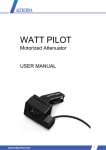
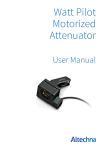
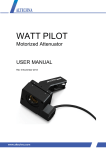
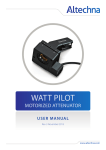
Motorized Watt Pilot is a computer controlled laser beam attenuation device. It
attenuates free space laser beam/pulse continuously without introducing
additional energy fluctuations. Watt Pilot is essential in systems, where stable
laser power adjusting is necessary. User friendly software “ALT-Step” or “SCA”
are recommended to control Watt Pilot via PC.
1.2. General safety requirements
Motorized Watt Pilot is designed to operate in conjunction with laser system. All
applicable rules and regulations for safe operation of lasers must be known and
applied while installing and operating Watt Pilot. The customer is solely
responsible for laser safety while using Watt Pilot as standalone or integrated
into system. The customer must use suitable protective measures.
While assembling or operating Watt Pilot, cannot be stared into direct or
scattered laser beam. All parts of the body must be kept away from the laser
radiation. While adjusting laser beam path through Watt Pilot laser power must
be low as possible. The risk of hazardous laser radiation can increase while
optical components or instruments are used in combination with Watt Pilot.
Appropriate eye protection must be worn at all times.
Electrical safety requirements must be complied while assembling and
operating Watt Pilot.
1.3. Operating and storage conditions
Environmental conditions that must be hold while storing, servicing and
operating are:
Storage temperature should be between -35 °C and +6 0°C. Operating
temperature is 25 °C ± 10 °C. Watt Pilot must be pr otected from humidity, dust
and corrosive vapors to avoid damaging optical components and electronics.
Avoid strong static electricity and electromagnetic fields.
3