1
Kilpatrick Format // Modular Synthesizer // System Manual
• OSCILLATOR - The oscillator generates a waveform, usually a basic waveform like a
sawtooth, pulse wave, etc. but sometimes more complex waves like sampled waves.
The output is generated all the time, the pitch determined by a voltage from the MIDI
interface. In analog synths this voltage is usually decided as something like 1V per
octave. That means for every 1V increase in the pitch voltage, the output frequency
will increase by 1 octave. (double in frequency)
• FILTER - The filter changes the timbre of the sound by applying some kind of frequencydependent transformation on it. The most common filter type is the low-pass filter,
which cuts off high frequency sounds. Usually the cutoff frequency is adjustable by a
voltage.
• LFO - The low-frequency oscillator (LFO) generates a low-frequency signal, usually
a triangle or sine wave. The LFO can usually make signals from about 1 cycle per
minute, up to maybe 40Hz or so. The LFO is used to modulate some parameter of the
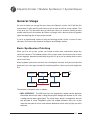
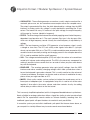
sound to create a constantly evolving and changing sound. In the example above the
LFO is used to modulate the filter cutoff frequency.
• VCA - The voltage-controlled amplifier (VCA) can adjust the volume of a sound from
muted to full volume under voltage control. The VCA is the necessary component for
making it possible to have sounds that turn on and off when you press and release
keys on the keyboard.
• ENVELOPE - The envelope generator takes gate (on/off) voltages from the MIDI
interface and makes smoothly changing voltages which fade up and down when a
key on the keyboard is pressed or released. This is usually used to turn the volume of
a sound up and down. Envelopes can also be used as sources of modulation in many
places where you might consider an LFO.
• MIXER - Most synths contain a mixer section just before the sound comes out to a
line output or headphone jack. In a polyphonic setup this is used to mix all the notes
together. It also adjusts the master volume, and often contains circuitry for adding
reverb, delay or chorus effects to the final sound.
This is an overly simplified explanation, but this is the general idea behind most synthesizers.
Nearly all digital or analog synthesizers follow a signal flow similar to what was described
above. But for experimental sound creation or ultimate flexibility, breaking from this
traditional type of patch will open the doors to a world of sonic possibilities.
In a modular system you can build a traditional synth patch like the one shown above, or
you can patch in a totally different way to create sounds never heard before.
// 3 //