1
Changing Gauges and Alternate
Tunings
EverTune saddles can be set to tensions from 10 - 28 pounds
(4.5 to 12.6KG). Which means they can usually handle 009 sets
to 011 sets and 012 sets with normal bottoms (as opposed
to heavy bottoms) in standard tuning . For higher and lower
tensions, custom saddles are available to order at
EverTune.com. [Please check out evertune.com/setupfaq for a
table showing string sizes, scale lengths, and tunings].
CAUTION: Please note, if the hex key becomes hard to turn STOP
TURNING IT, the tuners may have reached the end of their range.
So if this happens, please contact us at [email protected]. We will
respond promptly.
Checking Tune
EverTune holds the string in tune for the life of the string. In a
studio environment, check the tune once per day. Sometimes
oxidation (rust) of the strings can increase their weight which
can lower the pitch a few cents. This can be adjusted back with
a quick check and minor tuning of the saddle’s tension. This
daily check is only necessary in a studio environment where
every cent counts.
Bending
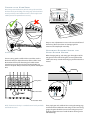
Once the saddle is in Zone 2 and the string is in tune it is
time to set the bend sensitivity. Tighten the tuning peg at the
headstock while plucking the string until the note goes sharp.
Then loosen the tuning peg until the note drops right back into
tune. The point at which the note drops right back into tune is
the transition point between Zone 2 and outside of Zone 2.
�����
�������
������
����������
������
�����������
Maximum Bend Sensitivity
At this point the string bends and tremolos like a conventional
guitar except that the note will always stay in tune after the
bend. This point is maximum bend sensitivity.
When changing string gauges and Tunings the saddle tension
usually has to be adjusted a lot. To go from E to drop D, for
example, will take 15-20 half turns of the hex key. If the string’s
pitch stops changing when we are turning the hex key up or
down a lot to change the pitch, then the saddle has moved out
of Zone 2.
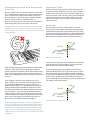
As an example, to tune the Low E string down to a C we
put the saddle in Zone 2 and then start turning the hex key
counterclockwise. Before the note reaches C it may stop
detuning even though we are still turning the hex key in the
tuning hole. What happened? With this much tension drop,
the string contracted and the saddle was pulled on the bend
stop, out of Zone 2. So, we now put the saddle back in Zone
2 by loosening the tuning peg at the headstock and then we
can keep detuning. [For a more in depth discussion on tuning
topics such as string gauges and large tuning changes see
these topics on our page evertune.com/setupfaq.]
NOTE: When going from a higher to a lower string gauge, tune
the strings to about a half step sharp of the desired note with the
tuning pegs at the headstock. Then decrease the saddle tension
with the hex key in the tuning hole behind the saddle until each
string is in tune. This will avoid breaking strings by trying to get
saddles into Zone 2 when the tension is set too high for the smaller
string gauge.
Loosen the tuning peg about an eighth of a turn from the
boundary where the note goes sharp and we come to a point
where bends still happen fast and the intonation and tuning
are preserved even with heavy picking intensity and hard finger
pressure. This is great for people who detune their strings, or
vary their picking intensity and finger pressure, and want to still
be perfectly in tune and intonated.
�����
�������
������
����������
������
�����������
Fast Bends, Maximum Intonation