1
be assigned. This field is initially set to -, indicating
the default "no trigger assigned" condition. This can
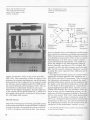
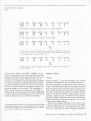
be seen in Fig. lOa. A score can be linked to a particular trigger by pointing at the control field and
typing the trigger nunber. Therefore, as is illustrated
in Fig. lOb, score test 1 can be linked with T9 by
pointing at its control field and typing 9. The second
score, test 2, can then be grouped to the same trigger
simply by pointing at its control field and pressing
cursor button-3 (using the last-typed technique described earlier).
Specifying the trigger number constitutes the,
setup phase. In order for the scores to be started, the
trigger must be fired. In the case of triggers 9 and 10,
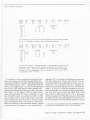
this is done by placing the tracker over the appropriate light-button (T9 or TlO, shown in Fig. lOc),
and depressing the cursor Z-button. All on/off
switches controlled by that trigger will then change
, state. As is indicated in Fig. lOd, this means that if
One score is on and the other is off, and both are
controlled by the same trigger, firing that trigger will
cause the one to switch off and the other to switch
on. Anywhere from zero to eight scores can be con. trolled by any trigger, but only one trigger at a time
can control a particular score. Trigger assignment
may be changed-at any time during performance, and
the trigger control of a particular score can be cleared
by pointing at the control field and depressing the
cursor Z-button (or button-2, the default button).
cycle switch, which is implemented
ger mechanism.)
Groupings of Continuously
using the trig-
Variable Parameters
Groups
Like the on/off switches, continuously
variable parameters can be grouped together and indirectly controlled as a single unit. The approach
taken is conceptually similar to the use of a submaster control in a conventional audio mixer. As with
on/off switches, associated with each variable is a
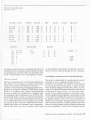
control field that is initialized to -, or ~lUII.This is
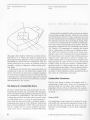
diagrammed in Fig. lla. Any variable can be controlled by anyone of eight group controls, numbered
1 to 8. Group setup takes the form of pointing at the
control field and indicating the group number (either
by typing, or by using the last-typed technique). This
is illustrated in Fig. lIb, where the tempo and articulation of both scores has been assigned to group
2, the octave of test 1 to group 1, and the amplitude
of both scores to group 3.
One task remains to complete the setup phase: a
transducer must be assigned to control each group to
be used. This additional level of indirection is important in that it allows any group to be controlled
by any single transducer and a single transducer to
control more than one group.
Group Control Transducers
There are currently
eight transducers available as group controllers.
They fall into three generic types: sliders (2), the
End-of-scor.e Triggers An important concept that
cursor as "mouse" (x and y), and software ramps. All
we wanted to incorporate into the system was to
allow trigger events to be generated by events in the transducers have one important quality in common:
they are all motion- rather than position-sensitive
music itself. While this feature has not been imdevices. That is, they increment or "delta modulate"
plemented in a general way, one type of event in the
data can generate a trigger. Whenever a playing score the parameters they control. The instantaneous
comes to its end (regardless of whether it is in cycle value (or type) of the individual parameters being
mode or not) it generates a signal that can be used as controlled is irrelevant to the transducer's function.
a trigger. These trigger events are numbered 1 to 8, Values are simply incremented or decremented when
corresponding to the eight scores which may be ac- the transducer moves. Thus any transducer can control many parameters, all with different instantanetive at one time. Score a can trigger score b, and vice
versa. Complex combinations of score material can ous values, without any concern for context. The
"nulling problem" which plagues most automated
thereby be built up, either in sequence or in parallel.
The only constraint is that a trigger is only generated mixdown systems is thereby avoided. The resulting
at the normal end of a score, not when the score is ability to rapidly switch the context of a transducer
results in a maximum of control bandwidth from a
tUrned off midway. (Note that a score can trigger
minimum
number of physical transducers.
itself, although that would be redundant, given the
16
A Microcomputer-based
Conducting
System