1
Appendix A
(cont.)
The second aspect of the SOLOS/CUTER interface is the defined
register usage. Each of the system entry points has specific
register requirements which will be discussed later.
Whenever a program is executed via SOLOS/COTTER the stack
pointer, the stack, and registers HL are defined as follows:
1. The Stack Pointer (register SP) is valid and offers a
useable stack. The size of this stack is not specified
but should be adequate for at least a few calls. The
executed program is expected to establish its own stack;
however, some stack should be available.
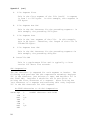
2. The stack itself should be established such that:
(a)
A "REV instruction can be used as an exit by the
executing program.
(b)
The locations at Stack Pointer -1 and -2 in memory
contain the address of the executed program itself.
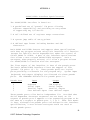
This information can be accessed by machine code
similar to:
LXI
DAD
MOV
H,-1
SP
A,M
A constant minus one.
HL=SP-1 now.
A=our own high address.
Code such as this can be used to allow a routine to
be made self-relocating to a 256 byte boundary.
3. Registers HL contain the address of the SOLOS/CUTER jump
table. Because this jump table may be located at any 256
byte boundary in memory, register L will be zero.
Register H can then be used to alter the executing program
accordingly. As noted later, the jump table also provides
an indication whether the program is executing on a Sol or
other computer.
The third aspect of the SOLOS/CUTER interface is the jump table.
By making all system requests via this jump table, an executed
program can be made compatible between SOLOS, CUTER or other
properly written surrogate. The jump table is described on the
following page. A more complete description is contained in the
SOLOS/CUTER User's Manual.
20