1
D40Z
Safety Precautions
For details, refer to the "Precautions for All Switches" and "Precautions for All Safety Door Switches" on
"Best Component Catalog (Cat.No.Y106)".
For details on Safety Controllers, refer to G9SP Series Catalog (Cat.No.J181) or D40A/G9SX-NS Catalog
(Cat.No.C140).
WARNING
Serious injury may possibly occur due to breakdown
of safety outputs.
Do not connect loads beyond the rated value to the
safety outputs.
Serious injury may possibly occur due to loss of
required safety functions.
Wire the Edge Controller properly so that supply
voltages or voltages for loads do NOT touch the safety
outputs accidentally.
Serious injury may possibly occur due to breakdown
of safety outputs.
Apply protection circuitry against back electromotive
force in case connecting inductive loads to safety
outputs.
Serious injury may possibly occur due to loss of
required safety functions.
Use appropriate devices referring to the following
table.
The machine may start operating and may result in
serious injury or death. Do not put the actuator close
to the switch when the door is open.
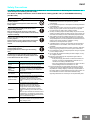
Control device
Requirements
Emergency Stop
Switch
Use approved device with direct opening
mechanism complying with IEC/EN 60947-5-1.
Safety
Door Switch,
Safety
Limit Switch
Use approved device with direct opening
mechanism complying with IEC/EN 60947-5-1
and capable of switching micro loads of 24
VDC, 5 mA.
Non-contact
Door Switch
The G9SX-NS must be used with D40Z Noncontact Door Switches.
Relay with forcibly
guided contacts
Use approved devices with forcibly guided
contacts complying with EN 50205.
For feedback, use devices with contacts
capable of switching micro loads of 24 VDC,
5 mA.
Contactor
Use contactors with forcibly guided
mechanism to input the signal to the
Feedback/Reset input of the G9SX-NS
through the NC contact of the contactor.
For feedback, use devices with contacts
capable of switching micro loads of 24 VDC,
5 mA.
Failure to open contacts of a contactor cannot
be detected by connecting NC contact of the
contactor without a forcibly guided mechanism
to the Feedback/Reset input.
Other devices
Evaluate whether devices used are
appropriate to satisfy the requirements of the
safety category level.
Precautions for Safe Use
1. Disconnect the G9SX-NS from the power supply when wiring the
D40Z.Devices connected to the product may operate
unexpectedly.
2. Do not operate the product in atmospheres containing flammable
or explosive gas.
3. Wire conductors correctly and verify the operation of the product
before using the system in which the product is incorporated.
Incorrect wiring may lead to loss of safety functions.
4. Auxiliary monitoring outputs are NOT safety outputs. Do not use
auxiliary monitoring outputs as safety outputs. Such incorrect use
will cause loss of safety function of D40Z and peripheral devices.
5. After installing the D40Z, qualified personnel must confirm the
installation, and must conduct test operations and maintenance.
The qualified personnel must be qualified and authorized to secure
safety at each phases of design, installation, running,
maintenance, and disposal of the system.
6. A qualified person in charge, who is familiar with the machine in
which the D40Z is to be installed, must conduct and verify the
installation.
7. Be sure to inspect the D40Z daily and every 6 months. Otherwise,
serious injury may possibly occur due to system malfunctions.
8. Do not dismantle, repair, or modify the product. Doing so may lead
to loss of safety functions.
9. Do not apply DC voltages exceeding the rated voltages, nor any
AC voltages to D40Z.
10.Use a DC supply satisfying the requirements given below to
prevent electric shock.
- A DC power supply with double or reinforced insulation, for
example, according to IEC/EN 60950 or EN 50178, or a
transformer according to IEC/EN 61558.
- A DC supply satisfying the requirements for class 2 circuits or
limited voltage/current circuits stated in UL 508.
11.Connect the D40Z to only appropriate components or devices
complying with relevant safety standards corresponding to the
required level of safety category. Conformity to requirements of
the safety category must be determined for the entire system. It is
recommended to consult an authorized certification body
regarding assessment of conformity to the required safety level.
14