1
Operational Safety
The points below are intended to enhance your safety awareness and to draw your
attention to risks which only you, the operator, can prevent. While MicroCal works to ensure
that the instrument is designed and tested to be as safe as possible, proper handling is also
critical. The operators should be responsible people trained in basic laboratory protocol, and
they should be familiar with the possible hazards before operating this instrument. All
instrument modifications should be performed only by personnel trained by MicroCal.
Equipment damage, personal injury or even death may result if this equipment is operated,
altered or maintained by untrained personnel or in an irresponsible or improper manner.
!
Provide proper electrical power to the iTC200. This should be 110 – 240 Volt, 50/60
Hertz alternating current, with a Ground Fault Circuit Interrupter (GFCI). Most power strips,
including those provided by MicroCal, contain a GFCI. All power plugs and cords should be 3prong, grounded cables or outlets.
!
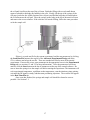
The Washing Module may only be powered by the power supply provided with the
Unit.
!
Intermittent operation of the Washing Module is required so that the valves of
Washing Module are on for a maximum of 20 minutes, then off for 30 minutes. Software
limits the valve on period to 10 minutes before an experiment, so this does not affect normal
operation of the instrument.
!
Replace fuses ONLY with 4.00 Amp 250 Volt Time Delay Fuses. Several spare fuses
are provided with the original shipment.
!
Repairs, alterations or modifications must only be carried out by specialist
personnel, or with explicit directions from a MicroCal technician. Removal or
modification of any cover or component could result in an unsafe or easily damaged
instrument. The MicroCal service department will be happy to answer any questions and
provide parts and service when necessary.
!
A solution can become an electrical conductor when in contact with electricity. Use
caution when using solutions near the instrument. If any liquid is spilled on or around the
instrument, unplug the instrument immediately and wipe it up. Be careful not to overflow the
small reservoirs around the cell access tubes. If there is any possibility that liquid may have
leaked into the instrument case, contact MicroCal immediately. Do not plug the instrument into
any electrical outlet until the problem is resolved.
!
The operator should always follow proper laboratory procedures in handling and
disposing of volatile or hazardous solutions.
!
All solutions in the cells must be cooled down below 40 ºC before removal. Any
higher temperature may cause the syringe to break, and will increase the dangers of most
hazardous solutions.
!
Never allow liquid in the cells to freeze. The expansion of the liquid can distort the
cells and rupture the most critical sensor, causing irreparable damage.
5