1
•
•
•
•
•
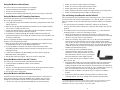
Go! Motion has a pivoting head, which helps you aim the sensor accurately. For
example, if you want to measure the motion of a small toy car on an inclined
plane, you can lay Go! Motion on its back and pivot Go! Motion head so that it
is perpendicular to the plane.
Go! Motion has a Sensitivity Switch, which is
located under the pivoting Go! Motion head. To
access it, simply rotate the detector head away from
the detector body.
Go! Motion has automatic temperature correction,
allowing you to use it indoors at room temperature or outdoors at temperatures
above or below room temperature.
Rubber feet on Go! Motion provide stability when it is placed on its back or
standing up.
A standard camera screw mount can be found on the back of Go! Motion. This
screw mount allows you to use the Motion Detector Clamp (sold separately,
order code MD-CLAMP), which is a universal-mounting clamp, or to use it
with typical tripod-mounting hardware.
Camera Screw Mount
Motion Detector Clamp (sold separately)
Calculator I/O Port
The calculator I/O port on the left side of Go! Motion
allows you to connect any Texas Instruments graphing
calculator through the calculator’s link port. You will
need the proper cable (order code GM-CALC, sold
separately).
DIG/SONIC
On the right side of the case, you will find a port
labeled “DIG/SONIC”. This port allows Go! Motion to
connect to Vernier LabPro or Texas Instruments CBL 2
with the proper cable, which is sold separately (order
code MDC-BTD).
Using the Sensitivity Switch
Slide the Sensitivity Switch to the right to set the switch
to the “normal” setting. This setting is best used for
experiments such as studying the motion of a person
walking back and forth in front of Go! Motion, a ball
being tossed in the air, pendulum motion, and any other
motion involving relatively large distances or with objects
that are poor reflectors, e.g., coffee filters. The other
sensitivity setting, which we call “track”, works well when studying motion of carts
on tracks like the Vernier Dynamics System, or motions in which you want to
eliminate stray reflections from object near to the sensor beam.
Go! Motion and Batteries
Using Go! Motion with a Computer
Go! Motion has a battery compartment located on the bottom of the case. Four AA
batteries can be inserted into the compartment. Please note: batteries are only needed
if Go! Motion is used directly with a calculator. If you are connecting Go! Motion to
the USB port of a computer or LabQuest or the DIG/SONIC port of a data-collection
interface, you do not need to put batteries into the unit.
Through the USB port
This sensor can be used directly with a Macintosh® or PC computer. Before
connecting Go! Motion to your computer, you must install Logger Lite software
version 1.3 or newer or Logger Pro 3.4 software or newer. Once the software is
installed:
1. Connect the square end of the USB cable into the USB port on the left side of
Go! Motion.
2. Connect the other end of the cable into a USB port on your computer.
3. Start the data-collection program, and you are ready to collect data.
Connecting Go! Motion
Go! Motion has three ports that allow it to connect to a variety of devices; a USB
port for computers and calculators, a DIG/SONIC port for data-collection interfaces,
e.g., LabQuest, LabPro, CBL 2 and, a calculator I/O port for TI graphing calculators.
USB Port
The Go! Motion USB port is used when connecting the sensor to a computer or
LabQuest. The USB port can also be used with the TI-84 Plus and TI-84 Plus Silver
Edition calculators, which also have USB ports. To connect Go! Motion to a TI-84
Plus calculator, you will need to purchase a separate cable (order code, GM-MINI).
3
Through the LabPro or LabQuest
This sensor can also be used with the LabPro or LabQuest connected to a computer.
Here is the general procedure for using Go! Motion with a LabPro or LabQuest:
1. Connect Go! Motion to the DIG/SONIC port on the interface.
2. Start the Logger Lite or Logger Pro software on the computer.
3. You may alternately open an experiment file for a motion detector, and you are
ready to collect data.
4