1
1
Introduction
Here we give a brief introduction to the PRISM system based on small examples. For full information about the system, consult the publications [8, 9] and the PRISM web site [7]. Based on
logic programming extended with random variables and parameter learning, PRISM appears as a
powerful modeling environment, which subsumes a variety of statistically based machine learning
approaches such as HMMs, discrete Bayesian networks, stochastic context free grammars, etc., all
embedded in a declarative language.
The system can be downloaded for free and is easy to install as it includes its own underlying
Prolog system. From version 1.11 (29 oct 2007) it is available in versions for Windows, Linux and
Mac OS X.
In section 2, we give an introduction to the basic concepts and mechanisms of PRISM, taken
from a paper describing a bioinformatics application of PRISM, which we also briefly mention.
Section 3 goes into more details showing how to run and train a Bayesian network using PRISM.
2
Basic PRISM concepts
PRISM [8, 9] is a recent logic-statistical modelling system developed by T. Sato and Y. Kameya.
The system is an extension to the Prolog programming language, more specifically the B-Prolog
system [10], with discrete random variables called multi-valued random switches, abbreviated msw’s.
The system is sound with respect to a probabilistic least Herbrand model semantics, provided that
the different msw ’s are independent (see the reference above for details). We illustrate the basic
concepts by a very simple example; full details can be found in the PRISM users manual, available
at the PRISM web site [7].
In the follow PRISM program, we declare by the values declaration a random variable coin,
which may take two different values, head and tail. The following set_sw declaration assigns
probabilities to the different possible values. (An msw can in general be declared to take an arbitrary
number (> 2) of different values.)
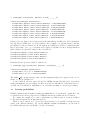
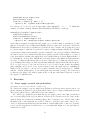
values(coin, [head,tail]).
set_sw(coin,[0.501, 0.499]).
throw(X):- msw(coin,X).
The Prolog rule shows how an msw can be used by the call msw(coin,X); when such a call is
executed, the variable X will achieve one of the possible values, which may be different from time
to time, but in the long run reflection the indicated probabilities. The predicate throw/1 is called
a probabilistic predicate as it depends on msw’s.
If a program execution contains more than one call of the same msw, the calls should be
though of as different event with different and independent random variables (but with the same
probabilities). So for example, the fragment
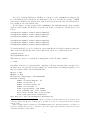
..., msw(coin,X), msw(coin,Y), ...
may indicate an experiment where two coins are thrown, so that the value of hX, Yi represents the
outcome of that experiment. The following is not good PRISM code,
..., msw(coin,X), msw(coin,X), ...
2