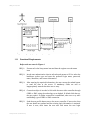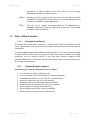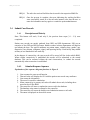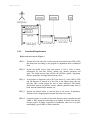
1
SRS for mS-cube
1
Introduction
1.1
Purpose
Version 1.0
The purpose is to address the user requirement derived from the close analysis of the current
Sentinel Site Surveillance (S3) in Sri Lanka [1] and [2]. The three main weaknesses deduced from
the business analysis are [3]:
1) The existing system purely thrives on a set of known diseases, labeled as notifiable diseases
and not on detecting emerging diseases or other adverse health events
2) The time taken in delivering the vital health information both upstream and downstream
through paper, phone, and fax based system is greater than 10 days
3) Present disease surveillance and notification system in Sri Lanka is costly labor and paper
intensive process
Summarized user requirements, in the efforts to address the three weaknesses:
1) design a comprehensive system to detect all adverse public health events; thus, collect all
patient health information for analysis and dissemination in a timely manner
2) design a system that can directly communicate health information from the point of care to
the key decision makers and provision for access to information by all authorized personnel
at any time from any place
Based on the business study, we have proposed a “Mobile-based Sentinel Site Surveillance” (mScube). It is a set of mobile interfaces to be used by healthcare workers in managing S3 standard
operating procedures. The suite of mS-cube applications would be developed using the JavaRosa
framework [4]. The Sahana Disaster Management Software System's Biosurveillance Module will
support the back-end relational database schema for data warehousing [5]. However, the mS-cube
should not be limited to Sahana but should be standardized to interconnect with other eHealth
computer systems.
To begin with, we recommend that developers concentrate on the following set of S3 application
that would provide a rich data set to reliably detecting public health events.
• Outpatient (OPD) and Inpatient (IPD) case records
• Special Diseases with investigations (SDIs)
• Immunization programs
• Laboratory results
However, version 1.0 of the mS-cube SRS only discusses the specifications for OPD, IPD, and
SDI. These three S3 programs share a common schema and processes.
1.2
Intended Audience and Reading Suggestions
The document is intended for (but not exclusive to)
• Software developers and domain experts
• Immediate beneficiaries are LIRNEasia, OpenRosa and Dimagi
Waidyanatha (LIRNEasia)
Page 1 of 32