1
1.0 Introduction
A typical embedded system application makes use of a small processor that coordinates
execution and processing of data between peripherals. Program code is usually stored in
on-chip flash memory, while data is stored and retrieved from on-chip RAM [1].
A System-on-Chip (SOC)-based embedded system is one which uses configurable
hardware surrounding a soft or hard processor core [2]. The purpose of this report is to
study the architecture of Programmable System-on-Chip (PSoC) from Cypress
Semiconductor and compare it to the more conventional FPGA-based SoC architecture.
Next section provides a background on FPGA-based SoC and Cypress PSoC
architectures. The third section studies the configurable digital components of the PSoC
architecture in detail. The fourth section talks about Cypress Programmable Radio-onChip (PRoC) technology and discusses how it could be used to enable wireless
communication between PSoC devices. The fifth section Details the use of PSoC
Designer, an integrated IDE used to design PSoC applications. The sixth section
demonstrates two applications: one PSoC application which demonstrates the concept of
dynamic re-configurability of PSoC devices, and another PRoC application which
establishes a remote control channel between two PRoC devices.
2.0 Background
Conventional FPGA-based SoC architecture consists of configurable logic blocks
(CLB’s), configurable I/O blocks, programmable interconnect, and a soft or hard
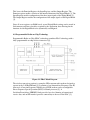
processor core [2], as shown in Figure 1 below.
Figure 1: FPGA-based SoC Architecture