1
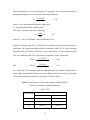
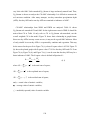
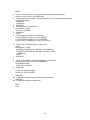
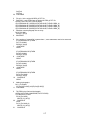
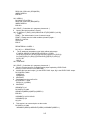
by some type of flow regime. An equation similar in form to the Manning’s equation can
be used to calculate the flow velocity.
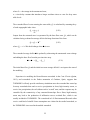
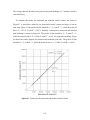
V = K ⋅ S 1/ 2
(7.3)
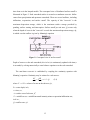
where V = flow velocity (ft/s);
K = coefficient based on the flow type;
S = slope in percent.
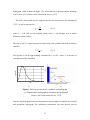
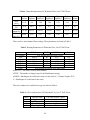
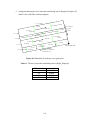
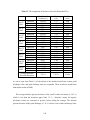
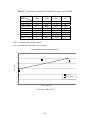
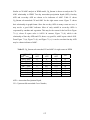
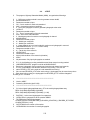
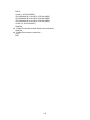
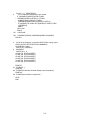
McCuen (1989) and SCS (1972) provided values of K for several flow situations, which
are listed in Table 10. With different velocities in different segments, Tc can be obtained.
Table 10. Coefficients of velocity (ft/s) versus slope (%) relationship for estimating
travel velocities
(McCuen 1989; SCS 1972)
K
Land Use / Flow Regime
0.25 Forest with heavy ground litter, hay meadow (overland flow)
Trash fallow or minimum tillage cultivation; contour or strip cropped; woodland
0.5
(overland flow)
0.7 Short grass pasture (overland flow)
0.9 Cultivated straight row (overland flow)
Nearly bare and untilled (overland flow); alluvial fans in western mountain
1
regions
1.5 Grassed waterway
2
Paved area (sheet flow); small upland gullies
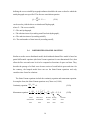
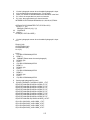
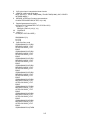
For different land uses and slopes, the water flow velocity ranges from 0.025 ft/sec to
0.894 ft/sec.
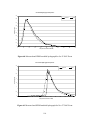
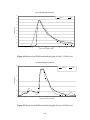
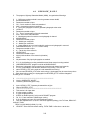
LEUH is better than SCS unit hydrograph method in that it can describe different subwatersheds response using different DUHs. For example, some watersheds starts to
produce runoff quite quickly, but the recession time is very long. While some watersheds
start to produce runoff very slowly, but the recession time is short. This can be modeled
and controlled by Tr and Kr, but can not be described in SCS UH.
99