1
Robbie the Robot User Manual
version 2001.08.31
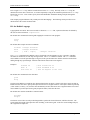
RL includes two miscellaneous commands:
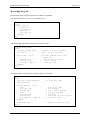
beep
pause
<time>
<time>
<frequency>
The first causes Robbie to emit a sound for the specified time (in milliseconds) at the specified frequency (in Hertz).
The second causes Robbie to pause all activities for the specified time.
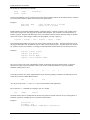
Examples:
beep 2000
pause 500
4000
; beep at 4000 Hz for 2 seconds
; pause for 0.5 seconds
Robbie includes an essentially unlimited number of internal registers, or memory locations, each of which can be
used to store a single value. RL programs can include named variables, each of which is associated with one of
Robbie’s registers. Registers can hold integer values, real numbers (decimal values), character strings, or Boolean
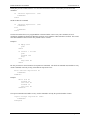
values (true or false). Before using a variable in an RL program, you must “register” it:
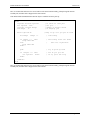
register [ integer | real | boolean | string ] <name>
The command causes Robbie to associate one of his registers with the given name. The name can then be used in
the program and Robbie will automatically store its value in the associated register. Variable names may consist of
any sequence of letters and numbers; it is strongly recommended that variable names NOT be entirely lower case.
Examples:
register
register
register
register
integer Counter
real NetPay
boolean Empty
string CompetitorName
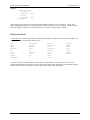
RL uses several reserved words, and arithmetic symbols, for Boolean expressions and operations. A Boolean
expression is simply an expression whose value is true or false, rather than numerical. Any of the standard
arithmetic symbols may be used:
+
–
/
*
<
<=
>
>=
=
The usual precedence rules apply, and parentheses may be used for grouping. In addition, the following reserved
words may be used to combine Boolean terms:
and
or
not
Also, the reserved words true and false may be used with their usual significance.
RL provides the set command for assigning a value to a variable:
set
<name>
<value>
The name must be that of a variable that has already been registered, and the value may be any valid algebraic or
arithmetic expression, including the use of registered variable names.
Examples:
set Counter 0
set Empty true
set CompetitorName
“ACME Robot Corporation”
Page 3 of 7