1
Appendix 4. Alecsis assembler
199
A4.1. Operands in assembler instructions
The cycle of the virtual processor divides into two phases: fetching of operands and execution of
instructions. Some conventions regulate what can be an assembler operand. Primary (basic) operands refer to a part
of memory called resource in Alecsis. That is an internal table containing the base addresses off all regions the
potential operands can come from. Operation fetch comes down to two additions: one when indexing resource
tables; and the other for addition of the address obtained in that way and the operand offset. The position in the
table is set using mnemonics pointing the type of the source, while offset is given by a number. Virtual processor
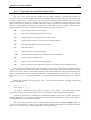
supports the following resource mnemonics (mnemonic always goes after the character '%').
%dn
- general purpose registers (min. 64 bytes)
%vn
- local memory (allocated using instruction link)
%fn
- formal parameter (or action parameter, inside a process)
%mn
- object passed to a function or a process (if it fits the declaration)
%an
- general purpose address registers (min. 64 bytes)
%sn
- local static memory
%_id
- identifier id (name with external linking)
(%an)
- content of memory pointed to by the address register (dereferencing)
%bn
- register pointing to resource vector
%en
- memory of the n-th element (if it has parameters)
%nn
- memory of the value of the signal at the position n (in processes) in the current time instant
The last two operands can appear in processes only, since they refer to object that can be declared only in
modules. All elements are indexed by the order of declaration, with the index 0 being the first element. Operand
points to the pointer to memory of action parameters, if the component has them. The last operand points to the
memory containing the value of the signal with the index n (formal parameters are indexed as 0, 1, 2,.., while the
local ones as -1, -2, -3, ...). To get the real address you need to multiply the index and the length of every signal in
bytes.
Beside these operands, all expressions of AleC++ can be found in instructions, including constants and
variables. For example:
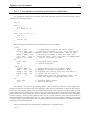
int i, j = 2;
asm movq.l i, j;
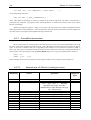
The previous command copies the content of variable j into variable i. You should avoid complex
expressions, since they can use some registers in the way that creates a conflict with the current instruction.
Operand of instructions for conditional or unconditional branching can be name of a label, which can be
inside an asm region or even outside it, but within the original function or a process. The instruction itself can
have label using the syntax explained in Chapter 3.
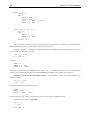
The names of functions in the code are created using the mechanism known as name mangling (Chapter 4).
You can see how this name is created if you compile the file containing the definition of the function using the
option '-S', and read its name from the assembler file. For example, function: