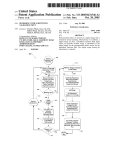
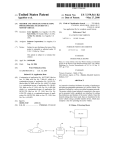
1
USOO7886235B2
(12)
United States Patent
Bornstein et al.
(54)
INTERACTIVE DOCUMENT
SUMMARIZATION
5,483,468 A *
5,544,354 A *
5,555,369 A *
5,576,954 A
5,619,709 A
(75) Inventors: Jeremy J. Bornstein, Menlo Park, CA
(US); Douglass R. Cutting, Oakland,
5,675,819 A
5,794,178 A
5,802,493 A
5,832,470 A
(73) Assignee: Apple Inc., Cupertino, CA (US)
Notice:
5,838,323
5,867,164
5,924,108
5,963,205
Subject to any disclaimer, the term of this
patent is extended or adjusted under 35
U.S.C. 154(b) by 1555 days.
(21) App1.No.: 10/200,806
(22)
Filed:
Jul. 22, 2002
(65)
Prior Publication Data
US 2006/0059442 A1
(52)
(58)
7/1997
3/1998
2/2000 Capps et al.
6,081,804 A *
6,112,201 A *
6/2000
8/2000
6,243,724 B1
6/2001 Mander et a1.
6,424,362 B1 *
7,372,473 B2*
7/2002
5/2008
04348460 A
Smith .......................... .. 707/5
Wical
.............. .. 707/5
Bornstein et a1. ......... .. 715/854
Venolia .................... .. 345/661
* 12/1992
1-810-11,1995.*
715/706,
(Continued)
Primary ExamineriSteven P Sax
See application ?le for complete search history.
(74) Attorney, Agent, or FirmiBlakely, Sokoloff, Taylor &
References Cited
Zafman LLP
U.S. PATENT DOCUMENTS
(57)
5,047,868 A *
9/1991
Takeda et a1. ............. .. 386/109
5,168,533 A *
5,278,980 A *
12/1992
Kato et al. ...... ..
352/54
Pedersen et al. .......... .. 395/600
ABSTRACT
A real-time interactive document summarization system
Which allows the user to continuously control the amount of
detail to be included in a document summary.
4/1994 Colwell et al.
1/1995 Withgott et a1.
5,477,451 A *
12/1995
15 Claims, 9 Drawing Sheets
Brown et al. .............. .. 364/419
2M
EU
Pioneer TO License M3003 E
E
203
' .
Detall.
One
|
(I
?
||
|
I
Half
I
I
I
I
I
I
I
All
I
I)
|
Pioneer Electronics Corporation announced today that it has reached an
agreement with Apple Computer, Inc. to license the Mac OS for use in
Pioneer's new line of personal computers.
The flexibility and power of the Macintosh operating system enables
Pioneer to provide complete home entertainment solutions to today's
multimediaecentric personal computer customer "
"The announcement is great news for consumers as Pioneer is adeptly
equipped to offer unique, personalized computing solutions to the home
entertainment market, said Seiji Sanda, president, Apple Japan.
Personal Computer MPCeGXl: New prototype desktop A/V personal
computer equipped with highequality 3D speaker and 4.4 x speed CDe ROM
drive; CPU:
RlSC—based 66MHZ PowerPC 60l, high performance for
e
Personal Computer MPCeLXlOO:
processing sound and digital video
New prototype desktop A/V personal computer equipped with highequality 3D
speaker and 4.4 x speed CDeROM drive; CPU: 33MHZ Motorola 68LCO40, good
price/performance
707/531
345/357
345/349
715/236
Trafton, User’s Manual f. ED SearchiDesktop Edition, 1995, pp.
715/854; 715/802
715/707, 708e712, 853e855, 786, 832e833,
715/802; 707/7, 10, 11, 530
5,384,703 A
Rose et a1. ................ ..
Bornstein et al. ......... ..
Fein et a1. ................. ..
Sotomayor ................ ..
OTHER PUBLICATIONS
Field of Classi?cation Search
5,303,361 A
................. .. 707/1
FOREIGN PATENT DOCUMENTS
Mar. 16, 2006
U.S. Cl. ..................................... ..
1/1994
Umen et a1.
8/1998 Caid et a1.
9/1998 She?ott et a1.
11/1998 Morita et a1.
6,021,218 A
(2006.01)
(56)
Sites ........................ .. 717/144
11/1998
2/1999
7/1999
10/1999
Int. Cl.
G06F 17/00
Chen et a1. ........... .. 364/551.01
May et a1. .................... .. 707/4
MenendeZ et al. ........ .. 715/762
*
*
*
*
JP
(51)
A
A
A
A
1/1996
8/1996
9/1996
10/1997 Schuetze
5,734,883 A *
CA (US)
Feb. 8, 2011
11/1996 Driscoll
4/1997 Caid et a1.
5,652,889 A *
CA (US); John D. Hatton, Mt. Hermon,
CA (US); Daniel E. Rose, Cupertino,
(*)
US 7,886,235 B2
(10) Patent N0.:
(45) Date of Patent:
1
N505
US 7,886,235 B2
Page 2
OTHER PUBLICATIONS
Gerald Salton, entitled “The Smart Retrieval System, Experiments in
Automatic Document Processing,” Copyright 1971, Prentice-Hall,
Inc. , pp. 144-156.
Salton & McGill, “The Smart and Sire Experimental Retrieval Sys
tems”, 1983, pp. 120-123.
Salton & Buckley; “Term-Weighting Approaches in Automatic Text
Retrieval”, Information Processing & Management, vol. 24, No. 5,
Edmundson, “Problems in Automatic Abstracting”, Communica
tions ofthe ACM, vol. 7, No.4, 1964, pp. 259-263.
Edmundson, “Automatic Abstracting and Indexing Survey and Rec
ommendations”, Communications of the ACM, vol. 4, No. 5, 1961,
pp. 226-234.
Rose, et al., “Content Awareness in a File System Interface: Imple
menting the ‘Pile’ Metaphor for Organizing Information”, ACM
Press SIGIR ’93, pp. 260-269.
pp. 513-523.
Mander, et al., “A ‘Pile’ Metaphor for Supporting Casual Organiza
Witten, Moffat & Bell, “Managing Gigabytes, Compressing and
tion of Information”, CHI ’92 Conference Proceedings, ACM
PressiHuman Factors in Computing Systems, 1992 pp. 627-634.
Kupiec, et al., “A Trainable Document Summarizer”, ACM
PressiProceeding of the 18th Annual International ACM SIGIR
Conference on Research and Development in Information Retrieval,
1995, pp. 68-73.
Indexing Documents and Images”, 1994, pp. 141-148.
Frakes and Baeza-Yates, “Information Retrieval, Data Structures &
Algorithms”, 1992, pp. 363-392.
Salvador and Zamora, “Automatic Abstracting and Indexing. II. Pro
duction of Indicative Abstracts by Application of Contextual Infer
ence and Syntactic Coherence Criteria”, Journal of American Society
for Information Science, 1971, pp. 260-274.
Edmundson, “New Methods in Automatic Extracting” Journal of the
Association for Computing Machinery, vol. 16, No. 2, 1969, pp.
264-285.
“Inside Architext”, The Herring Reporter, 1995, pp. 45-47.
“Inside Macintosh, Macintosh Toolbox Essentials,” Apple Computer,
Inc., Addison-Wesley Publishing Company, 1992, pp. 7-1 to 7-78.
* cited by examiner
US. Patent
Feb. 8, 2011
US 7,886,235 B2
Sheet 1 0f 9
DISPLAY
Q
CPU
MEMORY
16
FIG. 1
US. Patent
.QEw
Feb.8,2011
Sheet 4 0f 9
US 7,886,235 B2
US. Patent
Feb. 8, 2011
US 7,886,235 B2
Sheet 5 0f 9
INPUT DOCUMENT TO BE SUMMARIZED
@
I
FIND SENTENCE BREAKS IN DOCUMENT
@
I
BUILD INDEX DATABASE FOR DOCUMENT
5L5
I
QUERY INDEX TO COMPUTE SIMILARITY
SCORES BETWEEN EACH SENTENCE AND
ENTIRE DOCUMENT
504
I
PREPARE RELEVANCE RANKED LIST OF
ALL SENTENCES IN THE DOCUMENT
@
I
DISPLAY DESIRED NUMBER OF
SENTENCES BASED ON SLIDER POSITION
m
HAS SLIDER
POSITION CHANGED?
YES
m
FIG. 5
US. Patent
Feb.8,2011
US 7,886,235 B2
Sheet 8 0f 9
i
mpcwaov
.QEm
25£251%asE- :5£2iE65E- mi52:@Ng555-
Eo2sm6z:§5<w
EQ3a@ES$323 2
Um wsmz
US 7,886,235 B2
1
2
INTERACTIVE DOCUMENT
SUMMARIZATION
is that the system or mechanism can never know for certain
whether the user is receiving as much or as little of an abstract
as they would like. In other words, no matter how well the
mechanism can determine which portions of the document to
A portion of the disclosure of this patent document con
tains material which is subject to copyright protection. The
include in the summary or abstract, the mechanism can never
copyright owner has no objection to the facsimile reproduc
tion by anyone of the patent document or the patent disclo
sure, as it appears in the Patent and Trademark Of?ce patent
?le or records, but otherwise reserves all copyright rights.
automatically include just the right amount of abstract to
always please the user. This can be due to different users’
interest levels, different user’s reasons for reviewing the
document, and even time or situation varying interests of the
same user. As such, what is needed is not necessarily a better
abstracting algorithm as much as a mechanism which allows
REFERENCES TO RELATED APPLICATIONS
the user to interactively specify whether the present abstract is
The present application is related to co -pending US. patent
suf?cient or, instead, whether more or less of the original
document should be included in the abstract or summary.
The present invention utilizes an interactive control which
allows the user to specify whether more or less of the original
document should be included in the document summary.
application Ser. No. 08/536,903, ?led on the same day as the
present application, assigned to the same assignee and having
the same inventive entity.
FIELD OF THE INVENTION
The present invention relates to the ?eld of document sum
marization which is otherwise known as automatic abstract
ing wherein an extract of a document (i.e., a selection of
20
as well as review of up to the entire document in the case of
great user interest. Furthermore, such interactive control
allows the user to expand and contract summarized docu
sentences from the document) can serve as an abstract.
BACKGROUND OF THE INVENTION
Allowing the user to interactively control how much of the
original document sets included in the summary facilitates
rapid review of documents in which the user has little interest
25
The advent of the personal computer and modern telecom
ments at will, thus freeing the user to focus on the content of
the summarized document rather than on trying to determine
what amount or percentage is suf?cient or how the underlying
abstracting mechanism operates.
munications has resulted in millions of computer users com
municating with each other around the globe. One of the
primary uses of such computers by such users is accessing the
BRIEF DESCRIPTION OF THE DRAWINGS
30
vast store of digital information which has been created over
the last several decades. Further, additional digital informa
tion is created daily due to both the conversion of information
previously unavailable digitally and the large amount of new
information created by an ever increasing computer user
35
population.
One concern with this vast, ever increasing amount of
digital information is the time it takes to read even a small
portion of it. Whether one is reviewing a previously arranged
set of documents, as in the case of reading an on-line news
40
paper or magazine, reviewing the results of an electronic
search, or scanning documents stored on a large hard disk
drive of a personal computer, it can still take considerable
The present invention is illustrated by way of example and
not limitation in the ?gures of the accompanying drawings, in
which like references indicate similar elements, and in which:
FIG. 1 is a diagram of a typical computer system as might
be used with the present invention;
FIG. 2 is a sample summary document window according
to one implementation of the present invention wherein “All”
of the original document to be summarized is displayable;
FIG. 3 is a sample summary document window according
to one implementation of the present invention wherein one
eighth of the original document to be summarized is display
able;
summary or abstract of each document. Having a summary of
each document allows the reader to determine whether that
FIG. 4 is a sample summary document window according
to one implementation of the present invention wherein
“One” mo st representative sentence of the original document
to be summarized is displayable;
FIG. 5 is a ?owchart of the document summarization meth
document is of interest, and hence, reading more of the docu
ment might be desirable. Conversely, reading the summary of
invention;
time to read more than a minimal amount.
What is needed, therefore, is a facility which provides a
a document could suf?ce to suf?ciently inform the reader
about the document or instead, could indicate to the reader
that the particular document is not of interest. No matter the
45
odology according to one implementation of the present
50
FIG. 7 is a sample user interface display showing the “top
result, a good document abstract mechanism could be quite
valuable in the modern digital world.
However, a good document abstract mechanism means
more than merely providing an automatic summary of a docu
ment. Prior approaches to document summarization or “Auto
matic Sentence Extraction”, as discussed on pages 87-89 of
sentence” of a document in a comments ?eld of an informa
55
60
ence in its entirety, have yet to yield abstracts “in a readable
even when overcoming many of the natural language barriers,
listing of documents in a computer system user interface; and,
FIG. 9 is a sample user interface display showing the “top
sentence” of a document in an open dialog box in a computer
system user interface.
SUMMARY AND OBJECTS OF THE
INVENTION
extracts are obtainable without excessive dif?culties, but per
One dif?culty with prior document abstract mechanisms,
interface;
FIG. 8 is a sample user interface display showing the “top
natural language context” which “obey normal stylistic con
straints.” Salton and McGill further state that “[r]eadable
fection cannot be expected within the foreseeable future.”
tional window of the document in a computer system user
sentence” of a document in a pop-up area of a display line or
the “Introduction to Modern Information Retrieval” by Salton
and McGill, Copyright 1983, incorporated herein by refer
FIG. 6 is a sample user interface display showing some or
all of the “top sentence” of each document in a display line or
listing of documents in a computer system user interface;
65
It is an object of the present invention to provide an inter
active document summarization system.
US 7,886,235 B2
4
3
However, again, regardless of the sophistication of the
It is a further object of the present invention to provide an
interactive document summarization system wherein the user
summarization mechanism (and note that the present inven
of the system can control the amount of the document sum
mary.
tion is equally applicable to document summarization using
It is a still further object of the present invention to provide
a ?le listing containing document summary information.
later developed), it is highly unlikely that any particular sum
marization mechanism will always generate the degree of
It is an even further object of the present invention to
provide document summary information about a document in
a variety of contexts.
provides the user with a control mechanism to vary the degree
of summary detail so as to suit the particular user’s tastes and
The foregoing and other advantages are provided by a
interests at that point in time and for that particular purpose.
In the preferred embodiment of the present invention a
any reasonable summarization mechanism now known or
detail desired by the user. As such, the present invention
method for a user to display a summary of a document on an
“summarization engine” (again, any reasonable summariza
electronic display, the document comprising one or more
tion mechanism would work with the present invention) run
ning on a personal computer is used to rank all of the sen
sentences, said method comprising the steps of (i) separating
the one or more sentences of the document, (ii) ranking the
tences in a document from most to least representative. The
relevance of the separate one or more sentences of the docu
user interacts with the system by adjusting a slider control
displayed in a graphical user interface of the computer sys
ment to the document as a whole, (iii) displaying an initial
number of said separate one or more sentences of said docu
ment based upon the relevance ranking of said one or more
tem. As the user moves the slider to a given position, the
engine returns the top n sentences, where n is based on the
sentences of said document, and (iv) repeatedly specifying a
subsequent number of said separate one or more sentences of 20 slider’ s position. The sentences’ original order and paragraph
structure are maintained in the preferred embodiment of the
said document by user control of a user control means and
present invention as a summary consisting of those n sen
displaying said subsequent number of said ranked separate
tences is displayed in a window on the computer screen.
one or more sentences of said document.
The effect of the present invention is that as the user moves
The foregoing and other advantages are also provided by a
computer system for displaying a summary of a document
comprising (i) a document containing one or more separate
sentences, (ii) a relevance ranking means for ranking the
relevance of the one or more separate sentences to the docu
ment as a whole, (iii) a continuously variable control means
for specifying an amount of the document to be included in
25
summary with more or less detail and in the same order as the
original document. Thus, as the user moves the slider to ask
for more detail the summarized document appears to grow
30
Other objects, features and advantages of the present
invention will be apparent from the accompanying drawings
and from the detailed description which follows.
DETAILED DESCRIPTION OF THE INVENTION
with the ever-increasing number of sentences instantly
appearing in their original order and paragraph structure
(with the upper limit being the entire original document). And
the summary, and (iv) a display means for displaying the
summary of the document based upon the speci?ed document
summary amount and the ranked relevance of the one or more
sentences.
the slider, the window instantaneously updates to display a
as the user moves the slider to ask for less detail the summa
rized document appears to shrink with the sentences instantly
35
disappearing and the remaining sentences within each
remaining paragraph collapsing to form new summary para
graphs (with the lower limit being the one sentence most
characteristic of the entire document according to the sum
marization mechanism). And again, the interface mechanism
of the preferred embodiment of the present invention operates
40
as simply as having the user manipulate a cursor control
device such as a mouse, trackball or trackpad, to move a slider
The present invention can be implemented on all kinds of
control on the computer display to indicate that more or less
computer systems. Regardless of the manner in which the
present invention is implemented, the basic operation of a
summary information is desired.
Referring now to FIG. 2, a sample screen from the system
computer system embodying the present invention, including
45
the software and electronics which allow it to be performed,
can be described with reference to the block diagram of FIG.
1, wherein numeral 10 indicates a central processing unit
wherein the slider 203 is set to “All,” indicating that all of the
sentences in the original document are to be shown. The scroll
bar 205 on the right hand side of the window, a standard
(CPU) which controls the overall operations of the computer
system, numeral 12 indicates a standard display device such
50
as a CRT or LCD, numeral 14 indicates an input device which
usually includes both a standard keyboard and a pointer
controlling device such as a mouse, and numeral 16 indicates
a memory device which stores programs according to which
the CPU 30 carries out various prede?ned tasks. The interac
tive document summarization program according to the
before it has summarized the document can be seen. In the
?gure, a document summary window 201 can be seen
feature of the standard Macintosh Finder user interface envi
ronment, indicates that there is more of the document that
exists than can ?t within the window 201 displayed on the
screen (in other words, while the “All” setting allows viewing
55
of the entire document, not all of the document may be dis
playable at a given point in time due to display screen and/or
window size constraints). In this example, the original docu
present invention, for example, is generally also stored in this
ment contains 32 sentences and, with this window size, would
memory 16 to be referenced by the CPU 10.
As stated above, the process of document summarization
or automatic abstracting is well known in the art. A variety of
?ll several screens of text.
Referring now to FIG. 3, the user has moved the slider 203,
60
typically via a cursor control device such as a mouse, track
different mechanisms, used singly and in combination, have
ball, or trackpad, to indicate that he only wants a summary
been tried to automatically create document summaries or
one-eighth the size of the original document (note that pre
determined summarization settings, wherein the system auto
abstracts. Such mechanisms typically start with determining
the signi?cance of particular words and/ or sentences, usually
by focusing on position in the document, semantic relation
ships, and term frequencies. Further criteria may include
contextual inference and/ or syntactic coherence.
65
matically generates a preset amount of summarization
according to previously set system or user values, are equally
supportable with the present invention) to be displayed within
the document summary window 201. The summary now ?ts
US 7,886,235 B2
5
6
within the window 201, as indicated by the empty scroll bar
205 on the right hand side of the summary window.
mary, the user still has the option of decreasing the ?nal
amount of summary information. This has the added bene?t
of providing the reader with as much information as desired
Referring now to FIG. 4, the user has now moved the slider
203 to indicate that he only wants a summary which shows the
one sentence deemed by the summarization engine to be most
while still facilitating minimal document summaries which
might then be used in other ways (e.g., see below regarding
“View by Sentence” and “comment window” applications).
A general overview of the summarization engine of the
present invention will now be explained. Note ?rst, however,
that any of a large variety of well-known summarization
techniques are equally applicable to the present invention. In
representative of the document’s content to be displayed
within the document summary window 201.
It is important to note here that the examples of FIGS. 2-4
are merely static points in time and that the user has the
?exibility to continuously alter the sliderposition. In this way,
the user might ?rst see the summary window as it appears in
many prior art document retrieval systems a “vector model”
approach has been taken where each record or document is
FIG. 3, wherein one-eighth of the document is displayed.
Then, the user might continuously move the slider towards
the “All” setting thus requesting more and more of the docu
ment be displayed in the summary window until he reaches
the summary window as it appears in FIG. 2, wherein all of
represented by a vector representative of the distribution of
terms in the document. A particular search query is then
represented as a vector such that the retrieval of a particular
record or document then depends upon the magnitude of a
similarity computation between the particular document’s
the original document is available for viewing. Then, the user
might decide that less of the document is desired to be viewed
representative vector and the query’s representative vector.
and thus move the sliderback towards the “One” setting, such
that the system is continuously showing less and less of the
original document. Finally, the user might end up moving the
slider all the way down to the “One” setting, wherein only the
20
mechanisms (see Salton and McGill, Introduction to Modern
Information Retrieval, 1983, pages 120-123, Salton and
one most indicative sentence is displayed in the document
summary window as it appears in FIG. 4.
As just explained, a signi?cant advantage of the present
25
invention lies in the use of the slider or knob user interface
control. Just as in the case of a dimmer switch to control room
lighting, which provides direct-feedback by having the light
get brighter or dimmer as the user moves the slider or knob
control as well as having an essentially in?nite number of
Suf?ce it to say that the vector model of document compari
son is well known in the art of computer search and retrieval
30
Buckley, “Term-Weighting Approaches in Automatic Text
Retrieval” Information Processing & Management, Vol. 24,
No. 5, pp. 513-523, Witten, Moffat, and Bell, Managing
Gigabytes, Compressing and Indexing Documents and
Images, 1994, pp. 141-148, and Frakes and Baeza-Yates,
Information Retrieval, Data Structures & Algorithms, 1992,
pp. 363-392, all incorporated herein by reference in their
entirety).
settings, using a slider or knob control in the present invention
has greater intuitiveness and utility than would mere up and
down buttons having discrete, quantized levels. A slider con
documents, one or more documents which are most similar to
trol combined with immediate display feedback (immedi
a single query which may itself be a document. Instead, the
ately displaying greater or fewer sentences in the document
Typical prior art search and retrieval mechanisms, how
ever, attempt to ?nd, out of a corpus comprised of multiple
35
being summarized as the user moves the slider) means the
user only has to be concerned about whether the amount of
summarized information being displayed is of the desired
quantity.
And the present invention has clear advantages over requir
40
ing the user to specify actual summary values or percentages.
Just as in the case ofa light dimmer switch where the user only
knows that they want more or less light (rather than, say,
knowing that what they want is 15% more light or 22% less
light), the slider control of the present invention avoids plac
in the document being summarized. Then, depending upon
45
ing on the user the additional cognitive load of ?rst estimating
enough but that 58% is suf?cient or to try a series of static up
and down clicks until the desired amount is obtained. The
more intuitive interaction mechanism of the present invention
allows the user to interactively operate a continuously vari
50
55
term-weighting components are as follows:
tf?he number of times a term (word) occurs in a sentence
or in a document as a whole;
N?he number of sentences in the document; and,
60
alluded to above, is that the user has the option of continu
ously changing the amount of summary information being
after the user has read the desired amount of document sum
Furthermore, the present invention, as is common in the art,
uses term weighting to provide distinctions between the vari
ous terms or, in the present invention, words in a document.
The present invention utilizes a well known term weighting
formula (see, e.g., page 518 of Salton and Buckley in the
“Term-Weighting Approaches in Automatic Text Retrieval”
article referred to above and incorporated herein) wherein the
the greater or lesser information until the user determines that
displayed which thus facilitates the user requesting more and
more of the original document as the greater and greater
summary amount further piques the user’ s interest. And then,
either a preset value n or the user speci?ed slider setting n,
only those sentences above the ranking or value score of n get
displayed in the document summary.
able control while providing immediate display feedback of
the appropriate amount of information is displayed.
Thus, another advantage of the present invention, as
lent to an entire document, and thus the set of all of the
sentences of the document can be treated as the corpus of
documents to be searched. Then, the present invention treats
the text of the original document as the query to be applied to
the corpus. In this way, a determination can be made as to how
similar each sentence in the document is to the document as a
whole. The result is a ranking or value score for each sentence
the new amount desired. In other words, after the user deter
mined that more or less summary information was desired, if
the interface mechanism required specifying a summary per
centage or utilizing up and down buttons then the user would
have to be concerned with exactly how much or less informa
tion is truly desired. It is less intuitive to require the user
desiring more information to ?rst determine that 49% isn’t
preferred embodiment of the present invention treats each
sentence in the document to be summarized as being equiva
65
n?he number of sentences in the document which contain
a given term.
The term-weighting formula is applied to both document and
query vector terms and is tfc where t is replaced by log (tf+ l)
to better normalize long documents and to keep things posi
tive, f is replaced with log(N/n)+l to permit a search for a
word that occurs in every sentence to in fact ?nd every sen
tence, and c is unaltered, i.e., each weight in a vector is
US 7,886,235 B2
7
8
divided by the square root of the sum of all the squares of the
more rapid review of a corpus of documents. The present
invention is equally useful within an electronic mail context
unnormalized weights for the vector.
Referring now to FIG. 5, the process of the present inven
where the user can view a summary of the electronic mail
received and can then determine whether more or less of the
tion will now be described. When a document is to be sum
contents of the entire electronic mail message(s) is desired.
Another useful application of the present invention is
marized 501 with the present invention, it must ?rst be deter
mined 503 where the sentence breaks are in the document.
Note that the sentence break determination approach of the
preferred embodiment of the present invention is shown in the
C++ programming language format in Appendix A to the
within the user interface of a modern computer system, such
as the Apple Macintosh Finder, where stored documents (ei
ther locally stored, e.g., on a hard disk drive of the computer,
present speci?cation.
or remotely stored, e.g., across a network or even across the
The next step is to determine the sentence ranking within
internet) can be displayed by name, application type, date
the document being summarized. This is accomplished by
created, etc. When using such an interface, a user is often
times faced with a window displaying a long list of such
stored documents without much hint as to what the docu
?rst 505 building an index which is a database representing
the contents of the sentences in the document in the form of
statistics about the words in those sentences, a process which
is well known in the art. Then, 507 the entire original docu
ments actually contain. While documents or ?les are often
given a particular name in order to provide a hint of their
content or subject matter, the user is still often left wondering
what a particular document or documents contain. As such,
ment is treated as a query to the corpus of individual sentences
in the document in accordance with the standard vector model
approach. The result is a score indicating how well each
sentence matches the query of the entire document and,
hence, the output of the queries is a rank ordered list by score
of all the sentences in the document 509.
Then, the desired number of sentences to include in the
document summary display is determined 511, once a ranked
list of each sentence in the original document is obtained, by
examining either a preset value or the slider position value
which thus indicates how far down the ranked list to go.
Again, the markers on the slider could be represented as a
proportional amount of the entire document, as a numeric
value of the number of sentences of the total document, or
using the summarization engine of the present invention, the
system could provide a “show top sentence” option. This
20
ment.
Such display could take the form of a portion of the display
25
30
even as a non-linear value indicator of the total document.
listing of documents when the user positioned a pointer over
the document name or icon, when in a particular expanded
35
40
less information, the appropriate amount of summary infor
mation based on the new slider position 511 can be displayed.
45
many sentences will be displayed, every sentence in the docu
ment gets a ranking 509. Then, whenever the sliderposition is
changed 513, displaying the larger or smaller summary is a
relatively simple matter of merely displaying the more or less
sentences as dictated by the previously generated relevance
ranked list. In other words, by precomputing the relevance
50
ranking, displaying more or less detail can be accomplished
quickly without an additional query to be performed for each
55
60
similarly to the standard Macintosh Finder Balloon Help
feature) or when depressing a particular keyboard key and/or
mouse button combination. A large variety of display options
is thus possible with the approach of the present invention
depending upon such factors as display size and resolution,
user preferences, and system capabilities.
In the foregoing speci?cation, the present invention has
however, be evident that various modi?cations and changes
may be made thereto without departing from the broader
down whenever the user asks for more or less detail.
Note that the present invention has numerous applications.
be displayed. In other words, while the default setting of a
graphical user interface which displayed the “show top sen
tence” option might typically be to show only the one top
sentence, the user could have the option of displaying a
greater number of representative sentences from the summa
rized document. Such additional sentences might simply
wrap onto the next line of the display or, instead, might only
been described with reference to a speci?c exemplary
embodiment and alternative embodiments thereof. It will,
tences instantly inserted or deleted in place rather than having
the entire document summary appear to scroll from the top
A more clear application would be as part of a document
browser or within a document retrieval context thus allowing
sentence of a textual document, a summary comprised of a
top sentence or sentences could be displayed, as is shown in
FIG. 9.
An additional feature of the user interface document sum
mary mechanism is the option, as in the more general docu
ment summary invention described above, for the user to
control whether more or less of the document summary is to
be displayed when the user positioned a pointer over the
document name or icon when in a particular mode (e.g.,
change in the slider position.
Further, in the preferred embodiment of the present inven
tion, displaying more or less detail is done using an offscreen
bitmap, a technique well known in the computer art. Using an
offscreen bitmap makes the display appear to have the sen
display mode, or when depressing a particular keyboard key
and/or mouse button combination, as is shown in FIG. 8. Still
further, such display could also take the form of an open
dialog box where, instead of displaying a thumbnail minia
ture image of a graphic image document or merely the ?rst
summary content rather than on some more obscure summary
It is important to note a performance advantage in the
process just described. In the preferred embodiment of the
present invention, because the query 507 asked for all of the
sentences in the document before concerning itself with how
the form of being displayed in a comments ?eld of an infor
mational window about the document in a computer system
user interface as is shown in FIG. 7. Such display could also
take the form of being an expanded display in a display line or
present invention frees the user to focus on the displayed
percentage or value. As such, a non-linear slider may provide
even greater utility to the user of the present invention.
Lastly, the slider position is monitored 513 so that if the
user changes its position, thus indicating a desire for more or
line or listing of documents in a computer system user inter
face as in a Finder folder window of the Macintosh computer
system as is shown in FIG. 6 wherein the amount of the top
sentence displayed is limited by the amount of window dis
play space allotted to this ?eld. Such display could also take
While this last form may not sound as intuitive as the former
ones, it is important to note that studies have shown that most
of the content of a document can be understood by only
reading a relatively small amount of the entire document (e. g.,
20-25%). Further, remember that the user interface of the
option would display to the user the one sentence of a docu
ment which is most indicative of the contents of that docu
65
spirit and scope of the invention as set forth in the appended
claims. The speci?cations and drawings are, accordingly, to
be regarded in an illustrative rather than a restrictive sense.
US 7,886,235 B2
APPENDIX A
//
// ?ndinextisentence
On return, startiofisent will be > buf if ?rst chars encountered
are whitespace.
Normally returns length of sentence, starting from returned value
of startiofisent
If it returns 0, then it ran out of buffer before ?nding
a sentence. The caller will typically copy the remaining
text to the beginning of a buffer, ?ll up the buffer,
and then call this again. The case Where a complete
sentence does not ?t in the buffer should be checked
by the caller.
Can’t handle “see LP. there?” or “call A. Morgan’s”
Handles Mr., Mrs., Ms., Dr., and i.e.
int ?ndinextisentence(char* buf, uint32 length, char** startiofisent,
bool *ranioutiofibuffer, bool *?rstiiniparagraph,
bool rernoveireturns)
*?rstiiniparagraph = False;
// chew up leading whitespace
char* lastilociofibuffer = buf + length — 1;
// identify if this is the start of a paragraph
bool lastiwasireturn = False;
while (isspace(*buf) && (buf<=lastilociofibuffer))
switch (* buf)
case ‘\r’:
case ‘\n’:
if(lastiwasireturn)
// return followed by return
* ?rstiiniparagraph = True;
else
lastiwasireturn = True;
break;
case ‘\t’:
if (lastiwasireturn)
// return followed by tab
* ?rst_4,-n_paragraph = True;
else
lastiwasireturn = False;
// sornething came after the preceding
// return other than a return or tab
// break;
case ‘ ’:
if (lastiwasireturn && isspace(* (buf+1)))
// return followed by
// more than one
// white space
* ?rstiiniparagraph = True;
else
lastiwasireturn = False;
// sornething came after the preceding
// return other than a return or tab
break;
default:
break;
++buf;
*startiofisent = buf;
*ranioutiofibuffer = True;
if(buf>lastilociofibuffer)
*startiofisent = 0;
return 0;
// note that past this point, we’ll return *suIn* length,
// even if we hit end of the buffer before concluding a sent.
// Now we start looking for the end ofthe sentence.
*startiofisent = buf;
bool conclusiveisentence = False;
bool abrev = False;
char* lookahead;
do
// we’re going to repeat a big loop until we ?nd a sentence break or
// run out of characters in the buffer.
switch(*buf)
case
// Consider the current character in the buffer.
“": if(*(buf—1)== ‘.’)
// handle {Suzanne said “I love you.” }
// If it’s a quotation rnark preceded by a period,
// we found a sentence break.
conclusiveisentence = True;
break;
case ‘.’ :
lookahead = buf+1;
if(*lookahead == ‘.’)
// If it’s a period, consider next character.
// handle elipses
// prart ofan ellipsis (...), consider
// the character after the last period.
US 7,886,235 B2
11
12
APPENDIX A-continued
while ( (*lookahead == ‘.’) &&
lookahead <= lastilociofibuffer)
++lookahead;
if(lookahead > lastilociofibuffer)
{
// no more characters
buf= lookahead; break; }
// rule out some abbreviations by checking for
// space followed by capital letter
bool wasispaceiafteriperiod = False;
while( isspace(*lookahead) &&
// skip white space
// Was there a space after the
// period? If so, it might be a
// sentence break.
lookahead <= lastilociofibuffer)
++lookahead;
was space afteriperiod = True;
if(lookahead > lastilociofibuffer)
{
buf= lookahead; break; }
if (lwasispaceiafteriperiod)
break;
// things a sentence can start with here
// If we have a quote, bullet, or dash after the
// space, we’ll treat this as a sentence break.
if( *lookahead == “" ll *lookahead == "’ ll *lookahead == ‘i’)
{conclusiveisentence = True;
else if(!isupper(*lookahead))
break; }
break;
// If lowercase letter after period, it’s not a sentence break.
// otherwise, check if it was just an abbreviation
// now we check for ‘Mr.’, “Mrs.” etc.
// currently handles {Dr. Mr. Mrs. Ms. i.e.}
if(buf— *startiofisent >= 2)
{
switch(* (buf— 1))
*(buf—3) == ‘M’)
abrev = True;
// special case: ifa period is immediately followed by a double quote
// count the quote as part of the sentence.
//if(!abrev && *(buf+1)== “")
//
++buff;
conclusiveisentence labrev;
// if we get here its the
// simple case of end of
// sentence.
break;
// that is “hello there. Go away now.”
// catch & separate list items here (expensive)
// back to our initial character. If it wasn’t a quote or period, what was it?
case ‘\r’ :
// This section is trying to separate lists of items (e. g., bullets) that may not
// use punctuation to separate the items.
case ‘\n’ : if(removeireturns)
*buf=‘ ’;
// replace the return with a space
lookahead = buf+1;
while((*lookahead == ‘ ’) &&
// skip space that might be
// between two returns
lookahead <= lastilociofibuffer)
++lookahead;
if(lookahead > lastilociofibuffer)
{
buf = lookahead; break; }
// detect list items (lacking sentence punctuation clues)
// Ifthe newline followed by another, or a tab, or 3 or more
// spaces, it’s a sentence break.
if(
*lookahead == ‘\n’ H *lookahead == ‘\r’ //two returns,
ll
*lookahead -- ‘\t’ //return followed by a tab
US 7,886,235 B2
14
APPENDIX A-continued
// ——> paragraph delimiter
ll
(*lookahead == ‘ ’ //return followed by 3 or more spaces
&& *(lookahead+1) ==‘ ’&& *lookahead+2) ==‘ ’))
{
conclusiveisentence = True;
break;
while( isspace(*lookahead) &&
// skip white space
lookahead <= lastilociofibuffer)
++lookahead;
if(lookahead > lastilociofibuffer)
{
buf = lookahead; break; }
// Ditto if followed by a bullet or two hpyhens.
if(*lookahead == "’ ll (*lookahead == ‘i’ && *(lookahead+1) == ‘i’))
{
conclusiveisentence = True; break; }
break;
// Back to our initial character. If a question mark or exclamation point,
// it’s a break.
case ‘7’ :
case ‘1’ :
conclusiveisentence = True;
// ifa period, ‘1’, or ‘7’ is immediately followed by a double quote
// count the quote as part of the sentence.
if(*(buf+1)== “")
buf++;
break;
default: break;
}
buf++;
}
while (
lconclusiveisentence && (buf<=lastilociofibuffer));
*ranioutiofibuffer = lconclusiveisentence;
// return the length you conclusiveisentence, even if we ran out of buffer
before
// determining conclusively whether it’s a sent or not.
// ranioutiofibuffer gives that indicator.
return
buf — *start_of_sent
35
We claim:
4. A method as in claim 1, wherein each of the different
portions correspond to different sentences of the document.
5. A method as in claim 1, wherein the portions selected for
1. A method to process a document on a data processing
system, the method comprising:
receiving a ?rst input indicating a change in a position of a
user interface element against a displayed scale rendered
by the data processing system; and
inclusion in the ?rst document summary is in a same order as
40
portion of the document.
generating a ?rst document summary for the document
according to a current position of the user interface
element against the scale in response to the ?rst input,
the ?rst document summary providing a synopsis of the
document’s content, the ?rst document summary’s
amount of text established by the current position of the
user interface element against the scale, the generating
of the ?rst document summary including:
i) generating a respective score for different portions of
the document that measures the respective portions
6. A non-transitory machine readable storage medium con
taining stored executable computer program instructions
45
receiving a ?rst input indicating a change in a position of a
user interface element against a displayed scale rendered
by the data processing system; and
50
ability to describe the document’s contents as a
ii) selecting for inclusion in the ?rst document summary
55
to other portions and not selecting for inclusion in the
?rst document summary portions having weaker
scores relative to other portions, wherein, the number
of portions selected for inclusion in the ?rst document
summary is determined from the current position of
which when executed by a data processing system cause said
system to perform a method to process a document, the
method comprising:
whole;
one or more portions having stronger scores relative
the portions in the document but do not produce a continuous
60
the user interface element.
generating a ?rst document summary for the document
according to a current position of the user interface
element against the scale in response to the ?rst input,
the ?rst document summary providing a synopsis of the
document’s content, the ?rst document summary’s
amount of text established by the current position of the
user interface element against the scale, the generating
of the ?rst document summary including:
i) generating a respective score for different portions of
the document that measures the respective portions
ability to describe the document’s contents as a
whole;
2. A method as in claim 1, wherein the ?rst document
ii) selecting for inclusion in the ?rst document summary
summary is displayed.
one or more portions having stronger scores relative
3. A method as in claim 1, wherein the user interface
element comprises one of:
to other portions and not selecting for inclusion in the
a) a slider;
b) a rotating knob.
65
?rst document summary portions having weaker
scores relative to other portions, wherein, the number
of portions selected for inclusion in the ?rst document
US 7,886,235 B2
15
16
summary is determined from the current position of
i) means for generating a respective score for different
portions of the document that measures the respective
the user interface element.
portions ability to describe the document’s contents
7. A medium as in claim 6, Wherein the ?rst document
summary is displayed.
as a Whole;
ii) means for selecting for inclusion in the ?rst document
8. A medium as in claim 6
Wherein the user interface element comprises one of:
summary one or more portions having stronger scores
relative to other portions and not selecting for inclu
sion in the ?rst document summary portions having
weaker scores relative to other portions, Wherein, the
number of portions selected for inclusion in the ?rst
a) a slider;
b) a rotating knob.
9. A medium as in claim 6, Wherein each of the different
portions correspond to different sentences of the document.
10. A medium as in claim 6, Wherein the portions selected
document summary is determined from the current
position of the user interface element.
12. A data processing system as in claim 11, Wherein the
for inclusion in the ?rst document summary is in a same order
as the portions in the document but do not produce a continu
?rst document summary is displayed.
ous portion of the document.
13. A data processing system as in claim 11 Wherein the
11. A data processing system to display a document, the
data processing system comprising:
user interface element comprises one of:
means for receiving ?rst input indicating a change in a
position of a user interface element against a displayed
scale rendered by the data processing system; and
means for generating a ?rst document summary for the
document according to a current position of the user
20
the document.
15. A data processing system as in claim 11, Wherein the
portions selected for inclusion in the ?rst document summary
interface element against the scale in response to the ?rst
input, the ?rst document summary providing a synopsis
of the document’s content, the ?rst document summa
ry’ s amount of text established by the current position of
the user interface element against the scale, the means
for generating the ?rst document summary including:
a) a slider;
b) a rotating knob.
14. A data processing system as in claim 11, Wherein each
of the different portions correspond to different sentences of
is in a same order as the portions in the document but do not
25
produce a continuous portion of the document.
*
*
*
*
*
UNITED STATES PATENT AND TRADEMARK OFFICE
CERTIFICATE OF CORRECTION
PATENT No.
: 7,886,235 B2
APPLICATION NO.
: 10/200806
DATED
INVENTOR(S)
: February 8, 2011
: Jeremy J. Bornstein et a1.
Page 1 of 1
It is certified that error appears in the above-identi?ed patent and that said Letters Patent is hereby corrected as shown below:
In column 2, line 19, delete “sets” and insert -- gets --, therefor.
Signed and Sealed this
Eighth Day of November, 2011
David J. Kappos
Director 0fthe United States Patent and Trademark O?ice