1
Functional Specification for a Wireless Home Phone-operated Assistant
Executive Summary
Many people are unable to independently operate and monitor standard home appliances and
equipment without the assistance. Many of these people are physically disabled suffering from
paralysis, leg amputation, arthritis, and other such debilitating conditions. Though conventional
home control systems are a solution, most people are unable to enjoy the comfort and efficiency
that these systems provide. Most individuals cannot afford a versatile remote control system
because of the excessive cost involved, along with the extensive and sophisticated installation
required. Seniors and younger children may also be challenged by the complexity of
familiarizing themselves with conventional system controllers.
Trax Technologies is committed to developing a Wireless Home Phone-operated Assistant
(HomePA), which will allow individuals to remotely control and monitor the current operating
status of home appliances or open/close doors and windows via a phone call. This device will
provide paraplegics, seniors, and even the general public the convenience of remotely operating
and monitoring home appliances and facilities.
The functional specifications describe the performance parameters, interface requirements, and
physical limitations of each component of the HomePA, ensuring a smooth transition between
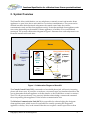
concept and development. The HomePA is comprised of three subsystems: the central control
unit, the wireless communication unit, and the client appliance unit. The central control unit
will be connected to the household phone line and will receive and process a touch-tone
command sent by an individual’s phone call. When an individual phones his or her own home,
after a predetermined number of rings the system will automatically switch to a voice-menu
interface run by the central control unit. The user will be required to enter an access code, which
will lead the user to the voice menu. Here, the user can control the system through a series of
touch tone commands. The control unit will acknowledge and control the corresponding client
appliance unit through the wireless communication unit based on the phone command received
directly through the phone line. The client appliance unit sequentially controls the designated
appliance.
Each subsystem has its own defined requirements in terms of its interface, system operation and
physical size. These requirements represent the specifications that the finished HomePA should
follow. A test plan has also been prepared to assure that our final prototype at least satisfies the
various minimum requirements mentioned in this document.
Copyright © 2004 Trax Technologies Inc.
ii