1
7. The peristaltic tube
9. Clamping the peristaltic tube
The peristaltic tube is made from Santoprene and the connectors are Nylon (PA). Please
make sure the reagents you intend to use are compatible with these materials
(See compatibility chart).
The pump controller is delivered with a
IDØ3mm Santoprene tube. In order to
reduce deformation caused by clamping
the pressure lever(1) is supplied in the open
position .
8. The choice of tubing
Before use ensure you turn the lever down
to the fully clamped position.
The unit can work either with fixed length tubing such as the supplied tube within the tube
clamp, or with continuous tubing which in effect does not have any length restriction. In both
cases, the correct tube clamps have to be installed in the clamp.
For fixed tube length you can choose between Silicone and Santoprene in 3 tube sizes. All
tube options are listed under the Accessories heading.
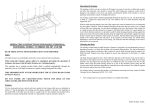
The pressure lever moves the pump cover
towards the rollers and thus clamps the
tube between the cover and the rollers.
For the continuous tubing there are three sizes of clamps.
10. Releasing the peristaltic tube when
you have finished
1.
2.
3.
Whenever the pump is not in use for long
periods of time it is important to release the
pressure off the tube. This will reduce the
possibility of the tube’s permanent
deformation and ensure that accuracy/
precision is maximised.
Marked ‘1’ for ID1.0mm tube
Marked ‘2’ for ID 2.0mm tube
Marked ‘3’ for ID 3.0mm tube
Release the pressure by lifting the pressure
lever
11. Replacing the tube
For work in small volumes use the
IDØ1.0mm tube which is available as an
accessory.
Lift the lever and remove the pump’s cover.
Pull out both tube holders and remove from
the cover. Replace with a new tube.
When using continuous tubing, make
sure that the tube is fitted so that it is in
contact with the inner surface of the
tube clamp.
The easiest roller position for tube
replacement is when one roller is at the top
of the pump. You can turn the roller wheel
with your fingers until you reach this
positioning.
Chemical compatibility chart
Chloroacetic acid
Linseed Oil
Potassium salts
Acetic acid
Chronic acid
Magnesium salt
Silver salts
The operational life of the tubes is a function of the speed, load and materials being
dispensed.
Acetic Anhydride
Chromium salts
Maleic acid
Soap solutions
Acrylonitrile
Copper salts
Manganese salts
Sodium salts
Aluminum Chloride
Ethylene glycol
Mercury salts
Sodium hydroxide
Aluminum sulfate
Ferric salts
Methanol
Ammonia
Fluoborate salts
Natural gas
Sodium hypochlorite
Stearic acid
Ammonium salts
Fluoboric acid
Nickel salts
Sulfur dioxide
Ammonium
hydroxide
Amyl acetate
Fluosilicic acid
Nitric acid-10%
Sulfuric acid, dil.
Formaldehyde
Nitroethane
Sulfurous acid
Antimony salts
Formamide
Nitrogen oxides
Tannic acid
Arsenic salts
Formic acid
Nitrous acid
Tanning extracts
Barium salts
Glucose
Oils, animal
Benzoic acid
Glycerins
Oils. mineral
Trisodium phosphate
Urea
Avoid running the tubes dry for longer than a few minutes.
Check the peristaltic tubes weekly for signs of excessive wear and replace if required.
Pump tubes which remain clamped in the pump will deform with time. Therefore, rotate the
tube clip at the top of the pump to ‘open’ position in order to relieve the pressure whenever
the pump is not being used for long periods or overnight.
13. Exclusion
If the equipment is used in a manner not specified by the manufacturer, the protection
provided by the equipment might be impaired.
This unit is NOT suitable for use in explosion hazard environments.
14. FAQ
Bleaching liquor
Hydrochloric acid
Oils. vegetable
Uric acid
Q. Why does the pump stalls or runs slower than expected when new tubing is
installed?
A. A new Santoprene tube is stiff when new so has to be shaped for some time before it
gains it’s elasticity. Run the pump in continuous mode for a total of approx 5 minutes with
the clamp lever half open to start with, gradually moving the clamp lever to fully closed
position.
Boric acid
Hydrocyanic acid
Oxalic acid
Water
Bromine
Hydrogen peroxide
Oxygen
Water (brine)
Butyric acid
Hydrogen sulfide
Phosphoric acid
Water (stoam)
Calcium salts
Iodine and solutions
Phthalic acid
Zinc salts
Carbon Dioxide
Lactic acid
Phosphoric acid
Q. What is the life of the tube?
A. The life of a peristaltic tube depends on many variants such as speed, the reagent it is
pumping and temperature. In general you should expect approximately 800 hours
operation from one tube.
Chlorine (wet/dry)
Lead salts
Plating solutions
Acetates
Butane
Me Et Ketone
Skydrol 500-B4
Q. Why can’t I set slower dispense speed ?
A. The motor’s speed is controlled via the voltage supply to the motor. Too low voltage and
the pump’s motor will stall, in particular when the tubing is new and the resulting load on
the motor is higher. Please note that slow speed in continuous operation will cause the
motor temperature to rise.
Acetone
Butanol
Nitric acid-30%
Sulfuric acid-90%
Alcohols
Essential Oils
Nitrobenzene
Tetrahydrofuran
Amyl alcohol
Ethers
Oleic acid
Turpentine
Aniline
Ethanol
Phenol
Q. Can I dispense hot reagents using the dispenser?
A. Yes, the dispenser to works safely with media temperatures of up to 100°C. Be aware
that the internal electronics could be damaged by any ingress of fluids or steam vapours.
Benzaldehyde
Furfural
Propanol
Benzyl alcohol
Lithium grease
Pyridine
Benzene
Cyclohexane
Kerosene
Nitric acid- 70%
Carbon tetrachloride
Ethyl chloride
Trichloroethylene
Perchloroethylene
Chlorobenzene
Chloroform
Freon
Gasoline, unleaded
Lacquer
Naphtha
Toluene
Xylene
Moderate
Acetaldehyde
Severe
The control unit is maintenance free. The peristaltic tubes however require replacement as
soon as excessive wear or a large variation in dispense volumes are noticed.
Little or no effect on Satoprene
12. Care & maintenance