1
Best Practices for Using Probes
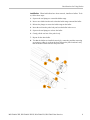
You need to follow these precautions when you solder the tips:
For best soldering results, use a microscope to examine the quality of the
solder joints.
Use a low-wattage, temperature-controlled soldering iron and a small-mass
soldering iron tip. The soldering iron temperature should be set as low as
possible, while still providing a reliable solder joint.
Use SAC305 solder (included with the P7500 wire replacement kit) to attach
the tip wires to the DUT.
When replacing tip wires or axial-lead resistors, use solder wick to remove
the excess solder from the probe tip circuit board via holes. Be careful not to
overheat the via and damage the board.
The attachment wires should be bent symmetrically to vary the interconnect
spacing. Use care when you solder a tip to a DUT to avoid inadvertently
desoldering either the attachment wires or the damping resistor.
For optimum performance and signal integrity, keep the lead length between
the DUT and the tip as short as possible, and the lead lengths the same length.
Precautions When
Handling Probe Cables
Tektronix P7600, P6700, P7300, and P7500 Series probes are quality measurement
tools and should be treated with care to avoid damage or performance degradation
due to mishandling.
Be sure to follow these precautions when handling any probe cables:
Do not excessively pull or twist the probe cables when positioning the probe
for measurements.
Never crush the cable, as might occur when you run over the probe with a
chair wheel or drop something heavy on the cable.
To maximize probe life, limit the amount of cable twist relative to the probe
control box to ±180 degrees. Always uncoil a probe cable gently before
applying the twisting forces needed to orient the probe head for connection
to the probe tip.
MSO70000C/DX, DPO70000C/D/DX, DSA70000C/D, DPO7000C Best Practices
7