1
Color constancy is a part of the visual perception system which allows people to perceive color in a variety of conditions,
and to see some consistency in the color. An apple which is red in the bright morning sunlight will also appear red
under candlelight and in the late afternoon, when the wavelengths of the light available are actually very different.
Likewise, if the apple is partially in the sun and partially in the shade, an observer will read the entire apple as red. This
allows someone to recognize the apple even though the conditions have changed, with the eyes perceiving the color
as relatively constant.
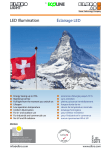
Figure 6.1.4:
Color consistency:
The colors of a hot air balloon
are recognized as being
the same in sun and shade
MacAdam set up an experiment in which a trained observer viewed two different colors, at a fixed luminance of about
48 cd/m2. One of the colors (the “test” color) was fixed, but the other was adjustable by the observer, and the observer
was asked to adjust that color until it matched the test color. This match was, of course, not perfect, since the human
eye, like any other instrument, has limited accuracy. It was found by MacAdam, however, that all of the matches made
by the observer fell into an ellipse on the CIE 1931 chromaticity diagram. The measurements were made at 25 points
on the chromaticity diagram, and it was found that the size and orientation of the ellipses on the diagram varied widely
depending on the test color. These 25 ellipses measured by MacAdam, for a particular observer are shown on the
chromaticity diagram.
OMS LED CALCULATOR
Color consistency / MacAdam ellipses
Figure 5.1.5:
MacAdam ellipses for one of
MacAdam’s test participants,
Perley G. Nutting Jr. (observer
“PGN”), plotted on the CIE 1931
xy chromaticity diagram.
The ellipses are ten times their
actual size, as depicted in
MacAdam’s paper.
Unified glare rating (UGR)
The UGR method (Unified Glare Rating) is an international index presented by CIE in publication 117 and is used to
evaluate and limit the psychological direct glare from luminaires. Contrary to previous methods where the glare was
rated using the luminance values of a single luminaire, this method calculates the glare of the entire lighting installation
at a defined observer position. According to DIN EN 12464, the UGR reference value is provided for a standard room.
An exact calculation of the UGR value at a defined observer position in a room is possible with modern lighting design
programs. The lower the UGR value, the lower the glare. Where the luminance is < 1500 cd/m2, additional data is
provided on the elevation angle, either 65°. This is the critical angle above which the luminaire should not exceed 1500
cd/ m2.
Efficacy
Efficacy is the ratio of lamp lumens to the electrical power (watts) consumed. Usually it is expressed in lumens per watt.
System efficiency includes ballast losses.
Lamp lumen maintenance factor
The lamp lumen maintenance factor LLMF takes into account the reduction of luminous flux due to the ageing of the
lamp. It signifies the ratio of the lamp lumens at a specific time and the new value. The current data provided by the
lamp manufacturers must be taken into account here.
Lumen maintenance curves
for various
Commercial light type OS
% Rated Lumen Output
Figure 5.1.5:
Burning Hours
243