1
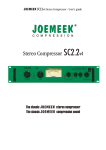
SC4 M&S DAD Stereo Compressor - User's guide
TIE JOEMEEK COMPRESSOR
WHY IT SOUNDS THE WAY IT DOES
Conventional compressors used to be called 'levelling amplifiers'. They were
designed originally to reduce the dynamic range of all program material so that
it would record properly onto media that had limited range such as optical film
and vinyl disc. As an engineering tool the compressor had to work in as linear a
manner as possible and to be as unobtrusive as possible, so the attack
characteristic (that is the way the changes in volume take place) had to be
smooth, and the release (how the gain recovered when the audio signal was
removed) needed to be long. While experimenting with levelling amplifiers,
engineers found that the application of compression had an effect on the
perceived sound of music. The changes were subtle but definite. Equipment
manufacturers over the years have tried to combine the requirements of
engineers and produce compression devices which are both usable as levelling
amplifiers and as effects units. This has been a completely wrong approach and
has only served to create bad reputations for a number of products because,
although they behave beautifully as engineering devices, they actually sound
unmusical.
The JOEMEEK compressor is the first device commercially available to have
been designed purely as an effects compressor. Its purpose is to change the
way the ear perceives the sound; its action changes the clarity, balance and
even rhythmic feel of music.
DYNAMICS
The human ear has a fantastic dynamic range; it hears and can interpret
sounds from as low as a pin dropping, up to being next to a pneumatic drill. In
fact, there are mechanisms in hearing which act as 'levelling amplifiers' and
allow us to be able to hear and interpret this extreme range. When very loud
music is heard, there are two main mechanisms that allow us to make sense of
the sounds. These are real biological compressors; the first one in 'software'
affecting the way the brain interprets signals from the inner ear, the second is
'hardware' in the way the electrochemical impulses are passed from the inner
ear. First there is a 'software compressor' in the brain that softens the effect of
the loud sounds. This effect is fast acting and not long lasting. It acts over the
whole frequency range and its effect is to soften the very loud peaks of noise or
sound, if the sound is removed or stopped suddenly, then your 'ears' (actually
your brain) recovers in just a couple of seconds to full sensitivity. Because we
all live with the effect all our lives, it is rarely noticed.
SC4
6