1
2
yacc
File Format
Your input file is organized as follows (note the intentional similarities to lex):
%{
Declarations
%}
Definitions
%%
Productions
%%
User subroutines
The optional Declarations and User subroutines sections are used for ordinary C code
that you want copied verbatim to the generated C file, declarations are copied to the top
of the file, user subroutines to the bottom. The optional Definitions section is where you
configure various parser features such as defining token codes, establishing operator
precedence and associativity, and setting up the global variables used to communicate
between the scanner and parser. The required Productions section is where you specify
the grammar rules. As in lex, you can associate an action with each pattern (this time a
production), which allows you to do whatever processing is needed as you reduce using
that production.
Example
Let's look at a simple, but complete, specification to get our bearings. Here is a yacc
input file for a simple calculator that recognizes and evaluates binary postfix expressions
using a stack.
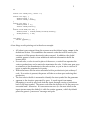
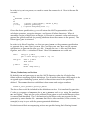
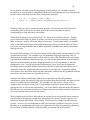
%{
#include <stdio.h>
#include <assert.h>
static int Pop();
static int Top();
static void Push(int val);
%}
%token T_Int
%%
S
:
|
;
S E '\n' { printf("= %d\n", Top()); }
E
:
|
|
|
|
;
E E '+'
E E '-'
E E '*'
E E '/'
T_Int
{
{
{
{
{
Push(Pop() + Pop()); }
int op2 = Pop(); Push(Pop() - op2); }
Push(Pop() * Pop()); }
int op2 = Pop(); Push(Pop() / op2); }
Push(yylval); }