1
9
Error handling
When a yacc-generated parser encounters an error (i.e. the next input token cannot be
shifted given the sequence of things so far on the stack), it calls the default yyerror
routine to print a generic "parse error" message and halt parsing. However, quitting in
response to the very first error is not particularly helpful!
supports a form of error re-synchronization that allows you to define where in the
stream to give up on an unsuccessful parse and how far to scan ahead and try to cleanup
to allow the parse to restart. The special error token can be used in the right side of a
production to mark a context in which to attempt error recovery. The usual use is to
add the error token possibly followed by a sequence of one or more synchronizing
tokens, which tell the parser to discard any tokens until it sees that "familiar" sequence
that allows the parser to continue. A simple and useful strategy might be simply to skip
the rest of the current input line or current statement when an error is detected.
When an error is encountered (and reported via yyerror,) the parser will discard any
partially parsed rules (i.e. pop stacks from the parse stack) until it finds one in which it
can shift an error token. It then reads and discards input tokens until it finds one that
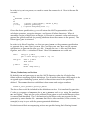
can follow the error token in that production. For example:
yacc
Var
:
|
;
Modifiers Type IdentifierList ';'
error ';'
The second production allows for handling errors encountered when trying to recognize
Var by accepting the alternate sequence error followed by a semicolon. What happens
if the parser in the in the middle of processing the IdentifierList when it encounters
an error? The error recovery rule, interpreted strictly, applies to the precise sequence of
an error and a semicolon. If an error occurs in the middle of an IdentifierList,
there are Modifiers and a Type and what not on the stack, which doesn't seem to fit
the pattern. However, yacc can force the situation to fit the rule, by discarding the
partially processed rules (i.e. popping states from the stack) until it gets back to a state in
which the error token is acceptable (i.e. all the way back to the state at which it started
before matching the Modifiers). At this point the error token can be shifted. Then, if
the lookahead token couldn’t possibly be shifted, the parser reads tokens, discarding
them until it finds a token that is acceptable. In this example, yacc reads and discards
input until the next semi-colon so that the error rule can apply. It then reduces that to
Var, and continues on from there. This basically allowed for a mangled variable
declaration to be ignored up to the terminating semicolon, which was a reasonable
attempt at getting the parser back on track. Note that if a specific token follows the error
symbol it will discard until it finds that token, otherwise it will discard until it finds any
token in the lookahead set for the nonterminal (for example, anything that can follow
Var in the example above).