1
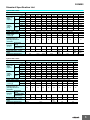
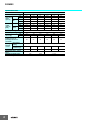
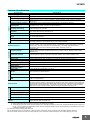
3G3MX2 Common Specifications Function name Control Enclosure ratings *1 Specifications Open type (IP20) Control method Phase-to-phase sinusoidal modulation PWM Output frequency range *2 0.10 to 400 Hz (or 1,000 Hz in the high-frequency mode; restrictions apply) Frequency precision *3 Digital command: 0.01% of the max. frequency, Analog command: 0.2% of the max. frequency (25C10C) Frequency setting resolution Digital setting: 0.01 Hz, Analog setting: One-thousandth of the maximum frequency Voltage/Frequency characteristics V/f characteristics (constant/reduced torque) Sensorless vector control, V/f control with speed feedback Overload current rating Heavy load rating (CT): 150%/60 s Light load rating (VT): 120%/60 s Instantaneous overcurrent protection 200% of the value of heavy load rating (CT) Acceleration/Deceleration time 0.01 to 3600 s (linear/curve selection), acceleration/deceleration 2 setting available Carrier frequency adjustment range 2 to 15 kHz (with derating) Starting torque 200%/0.5 Hz (sensorless vector control) External DC injection braking Starts at a frequency lower than that in deceleration via the STOP command, at a value set lower than that during operation, or via an external input. (Level and time settable). Communications Output signal Input signal Protective functions Frequency settings Digital Operator External analog input signal: Variable resistance/0 to 10 VDC/4 to 20 mA, Modbus communication (Modbus-RTU) RUN/STOP command Digital Operator External digital input signal (3-wire input supported), Modbus communication (Modbus-RTU) Multi-function input 7 points (Selectable from 59 functions) Analog input 2 points (Voltage FV terminal: 10 bits/0 to 10 V, Current FI terminal: 10 bits/4 to 20 mA) Pulse input 1 point (RP terminal: 32 kHz max., 5 to 24 VDC) Multi-function output 2 points (P1/EDM, P2; selectable from 43 functions) Relay output 1 point (1c contact: MC, MA, MB; selectable from 43 functions) Analog output (Frequency monitor) 1 point (AM terminal: Voltage 10 bits/0 to 10 V) (Frequency, current selectable) Pulse output 1 point (MP terminal: 32 kHz max., 0 to 10 V) RS-422 RJ45 connector (for Digital Operator) RS-485 Control circuit terminal block, Modbus communication (Modbus-RTU) USB USB1.1, mini-B connector Other functions General specifications Overcurrent, overvoltage, undervoltage, electronic thermal, temperature error, ground fault overcurrent at power-on status, rush current prevention circuit, overload limit, incoming overvoltage, external trip, memory error, CPU error, USP error, communication error, overvoltage suppression during deceleration, protection upon momentary power outage, emergency cutoff, etc. AVR function, V/f characteristics switching, upper/lower limit, 16-step speeds, starting frequency adjustment, jogging operation, carrier frequency adjustment, PID control, frequency jump, analog gain/ bias adjustment, S shape acceleration/deceleration, electronic thermal characteristics, level adjustment, restart function, torque boost function, fault monitor, soft lock function, frequency conversion display, USP function, motor 2 control function, UP/DWN, overcurrent suppression function, etc. Ambient temperature -10 to 50C (However, derating is required). Ambient storage temperature -20C to 65C (short-time temperature during transport) Humidity 20% to 90% RH (with no condensation) Vibration 5.9 m/s2 (0.6G), 10 to 55 Hz Location At a maximum altitude of 1,000 m; indoors (without corrosive gases or dust) DC reactor, AC reactor, radio noise filter, input noise filter, output noise filter, regenerative braking unit, Braking Resistor, EMC noise filter, etc. Note: 1. The applicable motor is a 3-phase standard motor. For using any other type, be sure that the rated current does not exceed that of the Inverter. 2. Output voltage decreases according to the level of the power supply voltage. 3. The braking torque at the time of capacitor feedback is an average deceleration torque at the shortest deceleration (when it stops from 50 Hz). It is not a continuous regeneration torque. Also, the average deceleration torque varies depending on the motor loss. The value is reduced in operation over 50 Hz. *1. Protection method complies with JEM 1030. *2. To operate the motor at over 50/60 Hz, contact the motor manufacturer to find out the maximum allowable speed of revolution. *3. For the stable control of the motor, the output frequency may exceed the maximum frequency set in A004 (A204) by 2 Hz max. Options 5