1
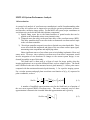
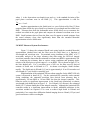
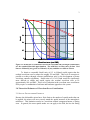
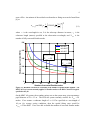
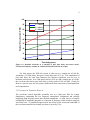
2 where is the observation wavelength in nm and nm is the standard deviation of the pupil plane wavefront error in nm RMS [1]. This approximation is valid for 2 nm 1 rad . Another approximation to the Strehl ratio is a curve-fit derived by Hart [2] from empirical data which also gives Strehl as a function of wavelength and wavefront error RMS. Telemetry data from the deformable mirror (DM) allows us to reconstruct the residual wavefront in the pupil plane and compute an estimated wavefront error in nm RMS. Strehl estimates derived from the Hart curve-fit appear to match estimates from the actual telemetry slope data significantly better than the extended Marechal approximation at lower Strehl ratios. 2.0 MMT Measured System Performance Figure 2.1 shows the estimated Strehl ratio using both the extended Marechal approximation (dashed lines) and the Hart curve-fit (solid lines) as a function of wavelength and wavefront error. For nominal seeing conditions at the MMT of 0.77 arcseconds, analysis of the slope telemetry data when using the NGS-AO integral wavefront controller shows that the estimated wavefront error RMS is approximately 450 nm. Analyzing the telemetry data at various seeing conditions and pointing angles relative to the wind gives a typical range of 75 nm RMS. This is shown in figure 2.1 as the blue shaded area. For a wavefront error of 450 nm, the Hart curve-fit derived estimate of Strehl ratio in M-band is 0.75. At shorter wavelengths, Strehl declines rapidly. The Strehl ratio in H-band (1.65 µm) is approximately 0.18 at 450 nm and at red wavelengths (0.7 µm) Strehl is essentially zero. Implementation of the optimized PID wavefront controller for the MMT NGS-AO system is discussed in detail in [3]. For the optimized PID controller under nominal seeing conditions, the estimated wavefront error derived from telemetry data is approximately 340 nm RMS or 110 nm RMS less than the integral controller. This behavior results in significant improvement in the Strehl ratio particularly at shorter wavelengths (red shaded area in figure 2.1). For H-band (1.65 microns), the estimated Strehl is 0.33, almost double that of the integral controller. Although the optimized PID controller results in a significant improvement in Strehl, additional reductions in the wavefront residual are required if we want to achieve high Strehl in H-band and particularly if we want to have diffraction limited imaging down to J-band (1.25 µm) and good correction at visible wavelengths.