1
Different wavelengths diffract off the grating at different angles. However, only
one wavelength leaves the grating in a direction that is exactly perpendicular
to the surface of the tuning mirror forming the resonant laser cavity. This is
the lasing wavelength, because it’s the only one that will survive for many cavity round trips. It follows then, that we can tune the laser by changing the angle
of the tuning mirror.
There is one very important innovation that gives us true continuous tuning
with a minimum of mode hops. In order to stay in one mode as we tune the
laser, the number of waves in the cavity must be kept constant (even though
the wavelength of the light in the cavity is changing).
The number of waves in the cavity is maintained by having the tuning mirror
rotate around a specific pivot point. The pivot point creates a relationship
between the cavity length and the laser wavelength. The laser wavelength is
set by the standard law for diffraction of light off a grating:
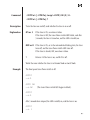
λ = Λ( sinθ i + sinθ d ) .
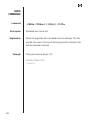
Λ is the spacing between grooves in the grating while θ i and θ d refer to the
incident and diffracted angles of the laser beam measured from a line normal
to the surface of the grating.
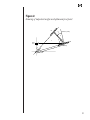
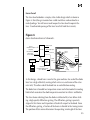
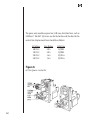
The length, D, of the cavity can be broken into two parts l1 and l2 . (See
Figure 2). If we call the distance from the pivot point to the place where the
beam strikes the grating L, we can see from the figure that:
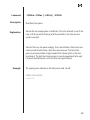
l1 = L sinθ i and, l2 = L sinθ d .
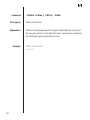
Therefore, the total cavity length is L( sinθ i + sinθ d ). Dividing the total cavity
length by the wavelength, shows that the total number of waves in the cavity
is L/Λ which is a constant. This translates into a tunable laser with no mode
hops. That’s the basic theory behind the cavity design. In the next section
we’ll show how the theory is put into practice by describing the components of
the 6265 series laser system.
8