1
Marathon-ReadyTM cDNA User Manual
VII. Characterization of RACE Products continued
1.Repeat the RACE reactions and examine the products on an agarose/
EtBr gel.
2.Photograph the gel, then transfer the DNA to a nylon membrane using
standard blotting procedures.
3.Prepare a hybridization probe that does not have sequences in common
with GSP1 (or 2). The probe can be end-labeled NGSP1 (or 2).
Alternatively, if your GSPs define overlapping 5' and 3' fragments, GSP2
can be used as a probe to characterize your 5'-RACE products, and
GSP1 can be used as a probe to characterize your 3'-RACE products.
Nick-translated or random-primed internal restriction fragments (from
a previously cloned partial cDNA) can also be used.
4. Hybridize the probe to the Southern blot, wash under moderateto-high stringency conditions, and expose x-ray film.
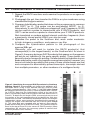
5.Compare the hybridization pattern to the photograph of the agarose/EtBr gel.
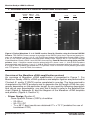
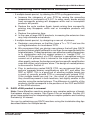
Generally, you will want to isolate the RACE product(s) that
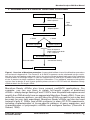
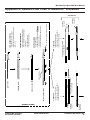
correspond(s) to the largest band(s) on the Southern blot. As seen in
Figure 5, there may be larger RACE products that appear on the agarose
gel but do not hybridize to the gene-specific probe. These bands are
generally due to nonspecific priming. Smaller bands that hybridize to your
probe may be the result of incomplete reverse transcription; however, you
cannot exclude the possibility that some of these shorter bands are real
and correspond to alternatively spliced transcripts, transcripts derived
from multiple promoters, or other members of a multigene family.
A
B
C
12
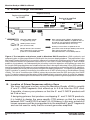
Figure 5. Identifying the correct RACE products by Southern
blotting. Panel A: Agarose/EtBr gel showing the products of 5'
Marathon RACE using a GSP derived from the ILGFR2 cDNA
(Lane 2; expected product ~3 kb). Lane 1: 1-kb DNA ladder. Panel
B: Southern blot of the gel seen in Panel A probed with a NGSP
for ILGFR2. Note that the hybridization signal at the top of the
blot is considerably lower than the top of the DNA smear seen in
Panel A. To obtain the full-length cDNA, a second gel was run and
the portion of the gel corresponding to just below the 3-kb size
marker was excised. The DNA was eluted and cloned, and multiple
independent clones were tested as described in the protocol to
identify the largest insert derived from the ILGFR2 gene. Panel
C. The same blot was reprobed with an internal gene-specific
probe derived from the 5'-end of the cDNA. This confirms that the
band at the top of Panel B is the correct 5'-RACE product. (Most
researchers will not have the necessary probe to confirm their
5'-RACE product in this manner.)
3
2
1.6
1
Protocol No. PT1156-1
www.clontech.com
Clontech Laboratories, Inc.
Version No. PR1573623