Download User Manual

Transcript
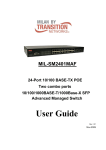
MIL-SM8002TG
9 Port 10/100/1000BASE-T
Two Combo 1000BASE-X SFP
Ports
Advanced Managed Switch
User Guide
Rev.A1
18-SEPT-2006
Regulatory Approval
- FCC Class A
- UL 1950
- CSA C22.2 No. 950
- EN60950
- CE
- EN55022 Class A
- EN55024
Canadian EMI Notice
This Class A digital apparatus meets all the requirements of the Canadian Interference-Causing Equipment Regulations.
Cet appareil numerique de la classe A respecte toutes les exigences du Reglement sur le materiel brouilleur du Canada.
European Notice
Products with the CE Marking comply with both the EMC Directive (89/336/EEC) and the Low Voltage Directive (73/23/EEC) issued by
the Commission of the European Community Compliance with these directives imply conformity to the following European Norms:
EN55022 (CISPR 22) - Radio Frequency Interference
EN61000-X - Electromagnetic Immunity
EN60950 (IEC950) - Product Safety
Five-Year Limited Warranty
Transition Networks warrants to the original consumer or purchaser that each of it's products,
and all components thereof, will be free from defects in material and/or workmanship for a
period of five years from the original factory shipment date. Any warranty hereunder is
extended to the original consumer or purchaser and is not assignable.
Transition Networks makes no express or implied warranties including, but not limited to, any
implied warranty of merchantability or fitness for a particular purpose, except as expressly set
forth in this warranty. In no event shall Transition Networks be liable for incidental or
consequential damages, costs, or expenses arising out of or in connection with the
performance of the product delivered hereunder. Transition Networks will in no case cover
damages arising out of the product being used in a negligent fashion or manner.
Trademarks
The MiLAN logo Transition Networks trademarks are registered trademarks of Transition Networks in the
United States and/or other countries.
To Contact Transition Networks
For prompt response when calling for service information, have the following information ready:
- Product serial number and revision
- Date of purchase
- Vendor or place of purchase
You can reach Transition Networks technical support at:
E-mail: [email protected]
Telephone: +1.800.260.1312 x 200 Fax: +1.952.941.2322
Transition Networks
6475 City West Parkway
Eden Prairie, MN 55344
United States of America
Telephone: +1.800.526.9267
Fax: : +1.952.941.2322
http://www.milan.com
info@ Transition.com
© Copyright 2006
Transition Networks
Content
Introduction............................................................................................................. 1
Features ............................................................................................................................1
Software Features .............................................................................................................2
Package Contents .............................................................................................................5
Hardware Description............................................................................................. 6
Physical Dimension ...........................................................................................................6
Front Panel ........................................................................................................................6
LED Indicators ...................................................................................................................7
Rear Panel.........................................................................................................................8
Desktop Installation ...........................................................................................................8
Power On...........................................................................................................................8
Network Application ............................................................................................... 9
Desktop Application ...........................................................................................................9
Indoor & Protected Outdoor Application ............................................................................9
Console Management............................................................................................. 9
Console Management........................................................................................... 10
Connecting to the Console Port.......................................................................................10
Login in the Console Interface .........................................................................................10
CLI Management .............................................................................................................13
Commands Level......................................................................................................13
Commands Set List........................................................................................................14
System Commands Set ...........................................................................................14
Port Commands Set................................................................................................16
Trunk Commands Set..............................................................................................20
VLAN Commands Set..............................................................................................21
Spanning Tree Commands Set ..................................................................................23
QOS Commands Set...............................................................................................26
IGMP Commands Set..............................................................................................28
Mac / Filter Table Commands Set...............................................................................29
SNMP Commands Set.............................................................................................30
Port Mirroring Commands Set....................................................................................31
Stacking Commands Set ..........................................................................................32
802.1x Commands Set ............................................................................................33
TFTP Commands Set ..............................................................................................35
Main Menu.......................................................................................................................36
System Configuration ......................................................................................................37
System Information...................................................................................................38
IP Configuration........................................................................................................39
DHCP Configuration .................................................................................................41
DHCP Server Configuration ..............................................................................41
DHCP Client Entries..........................................................................................43
Port and IP Bindings..........................................................................................44
Firmware Update ......................................................................................................45
System Event Log ....................................................................................................46
System Log Configuration .................................................................................47
Event Configuration...........................................................................................48
Email Alert Configuration..........................................................................................49
SMTP Configuration ..........................................................................................50
Recipient’s email Configuration .........................................................................51
Security Manager ..............................................................................................52
Port Configuration............................................................................................................54
Port Counters ...........................................................................................................54
Port Control Configuration ........................................................................................55
Trunk Configuration ..................................................................................................56
Aggregator setting .............................................................................................57
Aggregator Information......................................................................................58
State Activity......................................................................................................59
Port Mirroring Configuration .....................................................................................60
Rate Limiting....................................................................................................................61
Protocol Configuration .....................................................................................................63
VLAN Configuration..................................................................................................63
Port Base VLAN Configure................................................................................64
Group Add..................................................................................................65
Group Remove...........................................................................................66
Group List...................................................................................................67
802.1Q VLAN Configure....................................................................................68
GVRP Setting.............................................................................................69
Configure VLAN by Port .............................................................................70
VLAN List ...................................................................................................71
Rapid Spanning Tree................................................................................................72
RSTP System Configuration..............................................................................73
RSTP Per Port Configuration ............................................................................74
SNMP Configuration.................................................................................................76
System Options .................................................................................................77
Community Strings ............................................................................................78
Trap Managers ..................................................................................................79
SNMP V 3 Configuration ...................................................................................80
Context Table.............................................................................................81
User Table..................................................................................................82
Group Table ...............................................................................................83
Access Table..............................................................................................84
MIBview Table............................................................................................87
QoS Configuration ....................................................................................................90
QoS Policy and Priority Type.............................................................................91
Default Port Priority ...........................................................................................92
COS Configuration ............................................................................................93
TOS Configuration.............................................................................................94
SNTP Configuration..................................................................................................95
IGMP Configuration ..................................................................................................98
IGMP Configuration...........................................................................................99
IGMP Status ....................................................................................................100
Super ring ......................................................................................................................100
Security Configuration ...................................................................................................102
Security Configuration ...................................................................................................103
802.1X/ Radius Configuration.................................................................................103
System Configuration ......................................................................................104
802.1x Per Port Configuration .........................................................................105
Misc Configuration...........................................................................................106
Port Security ...........................................................................................................107
Static MAC Address ........................................................................................108
Filtering MAC Address.....................................................................................109
All MAC Address .............................................................................................110
Load Factory Default Setting .........................................................................................111
Save All Configuration ...................................................................................................112
Reboot System ..............................................................................................................113
Web-Based Management ................................................................................... 115
Preparing for Web Management....................................................................................115
System Login .................................................................................................................115
System Information........................................................................................................116
IP Address .....................................................................................................................117
DHCP Configuration ......................................................................................................118
DHCP Server Configuration ...................................................................................119
DHCP Client Entries ...............................................................................................120
Port and IP Bindings...............................................................................................120
Update Firmware ...........................................................................................................121
Restore Configuration....................................................................................................122
Backup Configuration ....................................................................................................122
System Log Configuration .............................................................................................123
Event Configuration .......................................................................................................124
SMTP Configuration ......................................................................................................126
Security Manager...........................................................................................................127
Port Statistics.................................................................................................................128
Port Control ...................................................................................................................128
View the Single Port Information ............................................................................129
Port Trunk......................................................................................................................130
Aggregator setting ..................................................................................................130
Aggregator Information...........................................................................................131
State Activity...........................................................................................................132
Port Mirroring .................................................................................................................133
Rate Limiting..................................................................................................................134
VLAN configuration........................................................................................................135
Port-based VLAN....................................................................................................136
802.1Q VLAN .........................................................................................................138
802.1Q Configuration ......................................................................................140
Group Configuration ........................................................................................140
Rapid Spanning Tree.....................................................................................................142
RSTP System Configuration...................................................................................142
RSTP Per Port Configuration..................................................................................144
SNMP Configuration ......................................................................................................145
System Configuration .............................................................................................145
Trap Managers .......................................................................................................147
SNMPV3 Configuration ..........................................................................................148
Context Table...........................................................................................148
User Table................................................................................................148
Group Table .............................................................................................150
Access Table............................................................................................151
MIBview Table..........................................................................................151
QoS Configuration .........................................................................................................152
QoS Policy and Priority Type..................................................................................152
Port Base Priority....................................................................................................153
COS Configuration .................................................................................................154
TOS Configuration..................................................................................................154
SNTP Configuration.......................................................................................................154
IGMP Configuration .......................................................................................................157
Super ring ......................................................................................................................159
Security Configuration ...................................................................................................161
802.1X Configuration..............................................................................................161
System Configuration ......................................................................................161
802.1x Per Port Configuration .........................................................................162
Misc Configuration...........................................................................................163
Port Security ...........................................................................................................164
Static MAC Address ........................................................................................164
Filtering MAC Address.....................................................................................166
All MAC Address .............................................................................................167
Factory Default ..............................................................................................................167
Save Configuration ........................................................................................................168
System Reboot ..............................................................................................................168
Troubleshooting ................................................................................................. 169
Incorrect connections.....................................................................................................169
Faulty or loose cables .....................................................................................169
Non-standard cables .......................................................................................169
Improper Network Topologies .........................................................................170
Diagnosing LED Indicators ............................................................................................170
Technical Specifications.................................................................................... 171
Introduction
The product is a multi-port switch that can be used to build high-performance switched
indoor or protected outdoor networks. It provides wire-speed, Gigabit Ethernet switching
function that allows high-performance, low-cost connection. The Switch features a
store-and-forward switching and it can automatically learn and store source address in an
8K-entry MAC address table.
Features
Nine ports of 10/100/1000BASE-T
Two SFP 1000BASE-X transceiver slots
IEEE802.3 10BASE-T, 802.3u 100BASE-TX, 802.3z Gigabit fiber and IEEE 802.3ab
1000Base-T
IGMP snooping and Query mode support for Multi-Media application
18Gbps switch fabric
26.7Mpps throughput
802.1p CoS, per port 4 queues
IEEE802.3x Flow control
Flow control for full duplex
Back pressure for half duplex
Port Based VLAN /802 .1Q VLAN
IEEE802.3ad Port trunk with LACP
Spanning tree protocol
Rapid STP
QoS:
Port based / Tag based
IPv4 ToS/ Ipv4, IPv6 DiffServe
Port mirroring and bandwidth control
IEEE 802.1x user authentication
GVRP and MVR
1
Broadcast storm filter
DHCP Client, Relay, Server
Per port band width control
SNTP and SMTP support
Management IP address security
MAC address security
System log
SNMP Trap support
Configuration up-load and down-load
TFTP firmware update
Web/SNMP/Telnet/CLI /RMON management
Software Features
SNMP v1, SNMP v2c, SNMP v3, Telnet,
Management
Console (Command line interface), Web
management and RMON 1(1,2, 3,9)
RFC2233 MIBII, RFC 1157 SNMP MIB, RFC
1493 Bridge MIB, RFC 2674 VLAN MIB, RFC
RFC standard
2665 Ethernet like MIB, RFC1215 Trap MIB,
RFC 2819 RMON MIB, Private MIB, RFC2030
SNTP, RFC 2821 SMTP, RFC 1757 RMON1
MIB
SNMP Trap
Software Upgrade
Cold start, warm start, link down, link up,
authorization fail, Trap station up to 3.
TFTP firmware upgradeable.
2
Support IEEE802.3ad with LACP function. Up
Port Trunk
to 3 trunk groups and maximum group
member up to 8 ports.
Spanning Tree
IEEE802.1d Spanning tree
IEEE802.1w Rapid spanning tree
Port based VLAN
Double Tag VLAN for management
IEEE802.1Q Tag VLAN.
VLAN
The static VLAN groups up to 256 and
dynamic VLAN groups up to 2048, the VLAN
ID can be assigned from 1 to 4094.
GVRP function supports 256 groups.
Per port supports 4 queues.
Class of Service
Wnine round ratio (WRR): High: Mid-High:
Mid-Low: Low (8:4:2:1)
Quality of service
IGMP
Port Security
Port based, Tag based, IPv4 Type of service,
IPv4/IPv6 Different service.
IGMP v1 and v2 compliance and also supports
256 IGMP groups and support query mode.
It supports ingress and egress MAC address
filter and static source MAC address lock.
Global system supports 3 mirroring types:
Port Mirror
“RX, TX and Both packet”. The maximum of
port mirror entries is up to 8.
Bandwidth Control
Ingress rate limiting packet type: all of frames,
broadcast, multicast, unknown unicast and
3
broadcast packet.
Egress rate shaping supports all of packet.
Rate limiting levels: 64kbps to 64Mbits or up to
256Mbits for Gigabit port.
Support IEEE802.1x User-Authentication and
can report to RADIUS server.
User
Reject
Authentication
Accept
Authorize
Disable
System login
Provide IP management security function and
security
provide 4 accounts.
DHCP Client, DHCP relay and DHCP Server.
DHCP
DHCP server provides port based and system
based IP pool.
Packet filter
System log
DNS
NTP
SMTP
Broadcast storm packet filter by 5%, 10%,
15% and 25%.
Provide 1000 log entries and support remote
storage function.
Support DNS client function.
Support RFC2030 Simple Network Time
Protocol and up to 5 NTP server.
Up to 6 mail accounts.
4
Configuration
upload and
download
Support binary format configuration file for
system quick configuration.
Package Contents
Unpack the contents of the switch and verify them against the checklist below.
Managed Switch unit
Power Cord
Four Rubber Feet
RS-232 cable
User Manual
If any item is missing or damaged, please contact your local dealer for service.
5
Hardware Description
Physical Dimension
The physical dimensions of the switch is 217mm(W) x 140mm(D) x 43mm(H)
Front Panel
The Front Panel of the switch consist of 9x auto-sensing 10/100/1000Mbps Ethernet
RJ-45 ports (automatic MDI/MDIX), 2 SFP copper combo ports, and the LED indicators
are also located on the frond panel of the switch.
Front Panel of the switch
RJ-45 Ports (Auto MDI/MDIX): Nine 10/100/1000 auto- sensing for 10Base-T or
100Base-TX or 1000Base-T connections.
In general, MDI means connecting to another Hub or Switch while MDIX means
connecting to a workstation or PC. Therefore, Auto MDI/MDIX means that you can
connect to another Switch or workstation without changing non-crossover or
crossover cabling.
2 SFP/Giga copper combo port: 2 auto detect Giga port—UTP or fiber. Giga fiber is
the SFP module that is optional.
6
LED Indicators
The following table provides descriptions of the LED statuses and meaning. They provide
a real-time indication of systematic operation status.
LED
Status
Power
Green
Yellow
1000M
Orange
Off
Green
LNK / ACT
Blinks
Off
Green
LNK / ACT
(SFP)
Blinks
Off
Description
Power On
The port is operating at the speed of
1000Mbps.
The port is operating at the speed of
100Mbps.
The port is operating at the speed of
10Mbps or no device attached
The port is successfully connecting
with the device.
The port is receiving or transmitting
data.
No device attached.
The port is successfully connecting
with the device.
The port is receiving or transmitting
data.
No device attached.
7
Rear Panel
The 3-pronged power plug are located at the Rear Panel of the switch as shown in figure.
The Switches will work with AC in the range 90-240V AC, 50-60Hz.
Rear Panel of the switch
Desktop Installation
Set the switch on a sufficiently large flat space with a power outlet nearby. The surface
where you put your Switch should be clean, smooth, level, and sturdy. Make sure there is
enough clearance around the Switch to allow attachment of cables, power cord and air
circulation.
Attaching Rubber Feet
1.
Make sure mounting surface on the bottom of the Switch is grease and dust free.
2.
Remove adhesive backing from your Rubber Feet.
3.
Apply the Rubber Feet to each corner on the bottom of the Switch. These footpads
can prevent the Switch from shock/vibration.
Power On
Connect the power cord to the power socket on the rear panel of the Switch. The other
side of power cord connects to the power outlet. The internal power works with AC in the
voltage range 90-240VAC, frequency 50~60Hz. Check the power indicator on the front
panel to see if power is properly supplied.
8
Network Application
Desktop Application
The switch is designed to be a desktop size switch that is an ideal solution for small
workgroup. The Switch can be used as a standalone switch to which personal computers,
server, printer server are directly connected to form small workgroup.
Indoor & Protected Outdoor Application
IP based technologies start dominating outdoor applications, that have been historically
reserved for serial connectivity. Gigabit switches gradually leave traditional LANs and
become a backbone for infrastructure connectivity and management. MIL-SM8002TG
switches can interconnect IP-based Traffic control lights, Traffic Cameras and message
boards.
9
Console Management
Connecting to the Console Port
Use the supplied RS-232 cable to connect a terminal or PC to the console port. The
terminal or PC to be connected must support the terminal emulation program.
Connecting the switch to a terminal via RS-232 cable
Login in the Console Interface
When the connection between Switch and PC is ready, turn on the PC and run a terminal
emulation program or Hyper Terminal and configure its communication parameters to
match the following default characteristics of the console port:
Baud Rate: 9600 bps
Data Bits: 8
Parity: none
Stop Bit: 1
Flow control: None
10
The settings of communication parameters
After finished the parameter settings, click “OK“. When the blank screen shows up, press
Enter key to bring out the login prompt. Key in the “root“(default value) for the both User
name and Password (use Enter key to switch), then press Enter key and the Main Menu
of console management appears. Please see below figure for login screen.
11
Console login interface
12
CLI Management
The system supports two types of console management – CLI command and Menu
selection. After you login to the system, you will see a command prompt. To enter CLI
management interface, enter “enable” command. The following table lists the CLI
commands and description.
Commands Level
Modes
Access Method
Prompt
Exit Method
About This Mode1
The user commands available at
the user level are a subset of
User EXEC
Begin a session with
your switch.
switch>
Enter logout or
quit.
those available at the privileged
level.
Use this mode to
• Perform basic tests.
• Display system information.
The privileged command is
Privileged
EXEC
Enter the enable
command while in
switch#
user EXEC mode.
Enter disable to
exit.
advance mode
Privileged this mode to
• Display advance function status
• Save configures
Global Configuration
Enter the configure
To exit to
command while in
privileged EXEC
privileged EXEC
switch (config)#
mode.
or end
Enter the vlan
VLAN database
database command
while in privileged
mode, enter exit
To exit to user
switch (vlan)#
EXEC mode,
enter exit.
EXEC mode.
Enter the interface
To exit to global
Interface
command (with a
switch
configuration
configuration
specific interface)
(config-if)#
mode, enter exit.
while in global
To exist to
13
Use this mode to configure
parameters that apply to your
switch as a whole.
Use this mode to configure
VLAN-specific parameters.
Use this mode to configure
parameters for the switch and
Ethernet ports.
configuration mode
privileged EXEC
mode, or end.
Commands Set List
System Commands Set
Commands
Command Level
Description
Defaults
Example
system name
Global
[systemname]
configuration mode
system location
Global
[system location]
configuration mode
system description
Global
Set switch system description
Switch (config)# system
[systemdescription]
configuration mode
string
description xxx
system contact
Global
Set switch system contact
Switch (config)# system
[systemcontact]
configuration mode
window string
contact John
Set switch system name string
Set switch system location string
Switch (config)# system
name xxx
Switch (config)# system
location LA
Use the ip address interface
ip address
configuration command to set an
Switch (config)# ip
[ip-address]
Global
IP address for a switch. Use the
address 192.168.1.77
[subnet-mask ]
configuration mode
no form of this command to
255.255.255.0
remove an IP address or to
192.168.1.254
[ gateway]
disable IP processing.
14
reload
default
username [user-name]
password [password]
Global
Halt and perform a cold restart
Switch (config)# reload
Restore to default
Switch (config)# Default
Global
Changes a login username.
Switch (config)#
configuration mode
(maximum 10 words)
username xxxxxx
Global
Specifies a password (maximum
configuration mode
10 words)
configuration mode
Global
configuration mode
Switch (config)#
Password xxxxxx
Switch> show system
info
Name: switch1
show system info
User EXEC
Show system information
location: lab
Description: layer2 switch
Contact: somewhere
Serial NO: 1.00
Switch# show ip
Address ip: 192.168.1.77
show ip
Privileged
EXEC
Show ip information
Address subnet:
255.255.255.0
Address gateway:
192.168.1.254
15
show accounting
show version
Privileged
EXEC
User EXEC
Switch# show accounting
Username: root
Show username & password
Password: root
Use the show version user EXEC
Switch> show version
command to display version
Firmware version: 1.0
information for the hardware and
Hardware version: 3.0
firmware.
Kernel version: 1.10
Switch (config)# show
terminal
show terminal
Privileged
EXEC
Baud rate (bits/sec):
Use the show terminal command
9600
to display console information for
Data Bits: 8
the switch
Parity Check: none
Stop Bits: 1
Flow Control: none
Port Commands Set
Commands
interface [FastEthernet
/module Ethernet] [slot
id] [id]
Command Level
Description
Defaults
Example
Use the fast Ethernet interface
Switch (config)# interface
configuration command
fastEthernet 0/1
Interface
configuration mode
Use the module Ethernet
interface configuration
command
16
Switch (config)# interface
moduleEthernet 1/1
Use the duplex configuration
command to specify the duplex
mode of operation for Fast
Switch (config)# interface
Auto
Switch (config-if)# duplex full
Ethernet.
duplex [full | half| auto]
fastEthernet 0/1
Interface
configuration mode
Use the duplex configuration
command to specify the duplex
mode of operation for module
Switch (config)# interface
Auto
Switch (config-if)# duplex full
Ethernet.
Use the speed configuration
speed
Interface
command to specify the speed
[10 | 100 | 1000 | auto]
configuration mode
mode of operation for Fast
Ethernet.
moduleEthernet 1/1
Switch (config)# interface
Auto
fastEthernet 0/1
Switch (config-if)# speed 10
Use the speed configuration
command to specify the speed
mode of operation for module
speed [10| 100 | 1000 |
Interface
auto]
configuration mode
Ethernet.
(The 100Base-FX module only
supported for speed 100)
(The 1000Base-FX module
only supported for speed 1000
& auto)
17
Switch (config)# interface
fastEthernet 1/2
Switch (config-if)# speed
1000
Use the flow control
configuration command on
flowcontrol on or no
Interface
flowcontrol
configuration mode
Switch (config)# interface
Ethernet ports to control traffic
rates during congestion.
On
Use the no form of this
fastEthernet 0/1
Switch (config-if)# flowcontrol
on
command to disable security on
the port.
Use the security configuration
security on or no
Interface
security
configuration mode
Switch (config)# interface
command on Ethernet ports.
Use the no form of this
Disable
command to disable security on
Use the priority configuration
Interface
no priority
configuration mode
Switch (config)# interface
command on Ethernet ports.
Use the no form of this
Disable
command to disable security on
Set bandwidth in or out rate.
Interface
The value rage is (0~999), and
[value]
configuration mode
zero of the value is disable
(The module can’t be setting)
18
fastEthernet 0/1
Switch (config-if)# priority on
hi
the port.
Bandwidth [in | out]
Switch (config-if)# security
on
the port.
priority on [hi | low] or
fastEthernet 0/1
Switch (config)# interface
Disable
fastEthernet 0/1
Switch (config-if)# bandwidth
in 50
Use the state interface
configuration command to
State [Enable | Disable]
Interface
specify the state mode of
configuration mode
operation for Ethernet ports.
Use the disable form of this
Switch (config)# interface
Enable
fastEthernet 0/1
Switch (config-if)# state
disable
command to disable the port.
Switch (config)# interface
show interface
Interface
show interface configuration
fastEthernet 0/1
configuration
configuration mode
status
Switch (config-if)# show
interface configuration
Switch (config)# interface
show interface status
Interface
configuration mode
show interface actual status
fastEthernet 0/1
Switch (config-if)# show
interface status
Switch (config)# interface
show interface
Interface
accounting
configuration mode
show interface statistic counter
fastEthernet 0/1
Switch (config-if)# show
interface accounting
19
Switch (config)# interface
show bandwidth
Interface
Display the bandwidth of the
fastEthernet 0/1
configuration mode
values
Switch (config-if)# Show
bandwidth
Trunk Commands Set
Commands
Command Level
Description
Defaults
LACP:
port group
Switch (config)# port group 1
[group-number]
[port-list] lacp [on | off]
workp [work ports]
Example
1-4
Add trunking group.
Global
Use the no form of this
configuration mode
command to delete trunking
no port group
group.
lacp on
workp 2
Disable
Trunk without LACP:
Switch (config)# port group 1
[group-number] lacp [on
1-4
| off] workp [work ports]
lacp off
workp 4
Switch # show group 1
Display trunk group
show group [group-ID]
Group Trunk.1:
Privileged EXEC
information. If there is no
Ports: 02 03 04
mode
group-number in put,
Priority: 0001
display all trunk groups.
Lacp: Enable
Work ports: 0
port group
[group-number]
activityport [port-list]
Switch (config)# port group 3
Global
Set trunking group port
configuration mode
active
activityport 2-4
Trunk.1 Lacp: Enable
20
Check OK!
NEW: 2 4
Update finished!!
VLAN Commands Set
Commands
Vlan datatbase
Command Level
Description
Defaults
Example
Privileged EXEC
To enter the VLAN
Switch# vlan database
mode
configuration interface
Switch(vlan)#
To set switch VLAN
vlanmode [disable|
VLAN database
mode .Use the no form of this
portbase| 802.1q | gvrp]
mode
command to restore to
Disable
Switch (vlan)# vlanmode
802.1q
default.
Port Base VLAN
vlan [Group Name]
grpid [Group ID] port
[Port Number]
VLAN database
mode
Add new Port Base VLAN
Switch (vlan)# vlan v2 grpid 2
port 1-4
no vlan Group Name]
VLAN database
Delete port base VLAN
[Group ID]
mode
group
show vlan [GroupName]
VLAN database
Show VLAN of Group Name
[GroupID] or show vlan
mode
or Group ID information
VLAN database
Set the port of some port
Switch (vlan)# vlan v2 add 5
mode
group tagged or untagged
tagged
vlan [Group name]
VLAN database
Remove the port from it’s
Switch (vlan)# vlan v2 delete
delete [port Number]
mode
port group.
5
vlan [Group name] add
[port Number] [tagged |
untagged]
Switch (vlan)# no vlan v2 2
Switch (vlan)# Show vlan v2 2
802.1Q | 802.1Q with GVRP VLAN mode
Add new 802.1Q VLAN
vlan [Group name]
[VLAN name]:
vlanid [Vlan ID] port
VLAN database
VLAN name
[port Number] tag
mode
[VLAN ID]: 1 ~ 4094
[port Number]
[port ID]:
Switch(vlan)# vlan v2 vlanid 2
port 1-4
tag 2-4
port members 1~9
no vlan
VLAN database
Delete 802.1Q VLAN group
21
Switch (vlan)# no vlan v2
[Group name] or [VLAN
mode
Switch (vlan)# no vlan v2 2
ID]
Add protocol vlan
[Group name]: vlan group
name [protocol value] IP-ip ,
ARP-arp,
Appletalk_AARP-app_arp ,
Novell_IPX-ipx ,
Banyan_vines-banyan_c4,
Banyan_vines-banyan_c5,
vlan protocol [Group
name] [protocol value]
vlanid [VLAN ID] port
[portNumber] tag [port
Banyan_vines-banyan_ad,
VLAN database
Decent_mop_01-decent_01,
mode
Decent_mop_02-decent_02,
6510,6526
Switch (vlan)# vlan protocol
v3 ip vlanid 2 port 5-8 tag 6,8
Decent_dpr-decent_dpr,
Number]
Decent_LAT-decent_lat,
Decent_LAVC-decent_larc,
IBM SNA-ibm, X.75
internet-x75, X.25
Layer3-x25
[VLAN ID]: 1 ~ 4094
[port Number]:
port Number 1~24
Set VLAN ID range
[1~255] range 0
[256~511] range 1
[512~767] range 2
[768~1023] range 3
[1024~1279] range 4
vlanidrange
VLAN database
[VLANidrange]
mode
[1280~1535] range 5
[1536~1791] range 6
[1792~2047] range 7
[2048~2303] range 8
[2304~2559] range 9
[2560~2815] range 10
[2816~3071] range 11
[3072~3327] range 12
[3328~3583] range 13
22
Switch (vlan)# vlanidrange 2
OLD: 0
NEW: 2
[3584~3839] range 14
[3840~4094] range 15
VLAN protocol
[Groupname] add
VLAN database
Set the port of some port
Switch (vlan)# vlan protocol
[portNumber] [tagged |
mode
group tagged or untagged
v2 add 5 tagged
VLAN database
Remove the port from its port
Switch (vlan)# vlan protocol
mode
group.
v2 delete 5
untagged]
VLAN protocol
[Groupname] delete
[portNumber]
show vlan [Groupname]
VLAN database
[GroupID] or show vlan
mode
Show VLAN of Group Name
Switch (vlan)# show vlan v2 2
or VLAN ID information
vlanid: 1 ~ 4094
show protocol vlan
VLAN database
show vlan protocol
mode
Protocol
Switch (vlan)# show vlan
ip
protocol
ipx
netbios
port [port ID] pvid [port
VID] ingressfilter1
[on
VLAN database
| off] ingressfilter2
[on
mode
| off]
Set Port PVID and Ingress
Switch (vlan)# port 2 pvid 2
Filter Rules1 & Ingress Filter
ingressfilter1 off ingressfilter2
Rules2
on
Switch (vlan)# show port 2
show port [port ID]
VLAN database
mode
show Port PVID and Ingress
Port ID: 2
Filter Rules1 & Ingress Filter
Port Vid: 2
Rules2
Ingress 1 Filter: Disable
Ingress 2 Filter: Enable
Spanning Tree Commands Set
Commands
Command Level
Description
Defaults
Example
Switch> show spanning-tree
System:
show spanning-tree
User EXEC mode
Display a summary of the
Priority: 32768
spanning-tree states.
Max Age: 20
Hello Time: 2
Forward Delay: 15
23
Priority: 32768
Mac Address: 004063800030
Root_Path_Cost: 0
Root Port: we are root
Max Age: 20
Hello Time: 2
Forward Delay: 15
Use the spanning-tree global
configuration command to
spanning-tree [on / off]
Global
enable Spanning Tree
or no spanning-tree
configuration mode
Protocol (STP). Use the no
Disable
Switch (config)# spanning-tree
on
form of the command to
restore to default
Use the spanning-tree
max-age global configuration
command to change the
spanning-tree priority
Global
[number]
configuration mode
priority.
32768
Switch (config)# spanning-tree
priority 32767
Use the no form of this
command to return to the
default interval.
Use the spanning-tree
max-age global configuration
command to change the
spanning-tree max-age
Global
interval between messages
[seconds]
configuration mode
the spanning tree receives
from the root switch. If a
switch does not receive a
bridge protocol
24
20 sec
Switch (config)# spanning-tree
max-age 15
data unit (BPDU) message
from the root switch within
this interval, it recomputes
the Spanning Tree Protocol
(STP) topology. Use the no
form of this command to
return to the default interval.
Use the spanning-tree
hello-time global
configuration command to
spanning-tree hello-time
Global
[seconds]
configuration mode
specify the interval between
hello
2 sec.
bridge protocol data units
Switch (config)# spanning-tree
hello-time 3
(BPDUs). Use the no form of
this command to return to the
default interval.
Use the spanning-tree cost
interface configuration
command to set the path
cost for Spanning Tree
Protocol (STP) calculations.
stp-path-cost [PortCost]
Interface
In the event of a loop,
configuration mode
spanning tree considers the
path cost when selecting an
interface to place into the
10 Mbps
– 100
100 Mbps
– 10
Switch (config)# interface
fastEthernet 0/2
Switch (config-if)#
stp-path-cost 20
forwarding state. Use the no
form of this command to
return to the default value.
Use the spanning-tree
forward-time global
configuration command to
spanning-tree
Global
set the forwarding-time for
forward-time [seconds]
configuration mode
the specified spanning-tree
instances. The forwarding
time determines how long
each of the listening and
25
15 sec.
Switch (config)# spanning-tree
forward-time 20
learning states last before
the port begins forwarding.
Use the no form of this
command to return to the
default value.
Use the spanning-tree
port-priority interface
configuration command to
stp-path-priority [Port
Interface
Priority]
configuration mode
Switch (config)# interface
configure a port priority that
is used when two switches
128
tie for position as the root
fastEthernet 0/2
Switch (config-if)#
stp-path-priority 127
switch. Use the no form of
this command to return to the
default value.
QOS Commands Set
Commands
qos storm-control
[5|10|15|20|25| off (%)]
or no storm-control
Command Level
Description
Defaults
Example
Enable/Disable broadcast
Global
storm control. Use the no form
configuration mode
of this command to restore to
OFF
Switch (config)# qos
storm-control 5
default.
qos
Enable/Disable low priority
low-priority-delay-bound
Global
delay board.
[on|off] [sec.] or no qos
configuration mode
Use the no form of this
low-priority-delay-bound
Switch (config)# qos
OFF
1
command to restore to default.
qos level [priority]
Global
enable
configuration mode
[Priority] 0~7
26
low-priority-delay-bound on
0~3 LOW
Switch (config)# qos level
4~7 HI
2,3 enable
no qos level [priority]
Global
configuration mode
[Priority] 0~7
0~3 LOW
Switch (config)# no qos
4~7 HI
level 0-7
WRR:
Switch (config)# qos
queuepolicy wrr hi 7 low 1
[Policy]:fcfs: first in and first out
qos queuepolicy [Policy]
Global
wrr: wnine round robin
hi [Priority] low [Priority]
configuration mode
sp: all high before low.
[Priority] Hi:1~7 Low:1
WRR
First Come First Served:
Hi 2
Switch (config)# qos
Low 1
queuepolicy fcfs
All High before Low:
Switch (config)# qos
queuepolicy sp
qos bridge-delay-bound
[number] .
Global
no qos
configuration mode
bridge-delay-bound
Set qos bridge delay bound
Use the no form of this
command to restore to default.
OFF
Switch (config)# qos
bridge-delay-bound 1
Switch (config)# show qos
show qos storm-control
Global
configuration mode
Show broadcast storm control.
storm-control
QOS storm control mode:
ENABLE
27
Switch (config)# show qos
show qos
Privileged EXEC
low-priority-delay-bound
mode
low-priority-delay-bound
Show low priority delay board.
Qos low priority delay
bound: 1
show qos policy
Privileged EXEC
mode
show qos
Privileged EXEC
bridge-delay-bound
mode
Switch (config)# show qos
policy
Show qos policy
Qos Mode: WRR
Switch (config)# show qos
bridge-delay-bound
Show bridge delay bound
bridge-delay-bound 5
IGMP Commands Set
Commands
Command Level
Global
igmp [on | off]
configuration
mode
Igmp-query
[auto |enable | disable]
show ip igmp profile
Description
Enable /Disable IGMP
snooping function
Defaults
Off
Global
configuration
Modify IGMP query mode
mode
Privileged EXEC
Displays the details of an IGMP
mode
profile entry.
28
Disable
Example
Switch (config)# igmp on
Switch (config)# Igmp-query
enable
Switch# show ip igmp profile
IP
Port 224.1.1.1
VID
10
1,2,6
Mac / Filter Table Commands Set
Commands
Command Level
Description
Defaults
Example
(Enable)
Switch (config)#
mac-address-table aging-time
Use the mac-address-table
on
aging-time global
mac-address-table
configuration command to set
aging-time [on | off]
the length of time that a
mac-address-table
aging-time [sec.]
Global
configuration mode
Switch (config)#
mac-address-table aging-time
dynamic entry remains in the
MAC address table after the
300 secs
entry is used or updated.
or no mac-address-table
Use the no form of this
aging-time
command to use the default
333
(Disable)
Switch (config)#
mac-address-table aging-time
aging-time interval. The aging
off
time applies to all VLANs.
Or
Switch(config)# no
mac-address-table aging-time
Use the mac-address-table
mac-address-table table
[static | filter] hwaddr
Interface
[MAC address] vlanid
configuration mode
[VLAN-ID]
address table. Use the no
form of this command to
remove static entries from the
Use the no
no mac-address-table
[static | filter] hwaddr
Interface
[MAC address] vlanid
configuration mode
fastEthernet 0/2
addresses to the MAC
MAC address table.
[VLAN-ID]
Switch (config)# interface
static to add static | filter
mac-address-table privileged
EXEC command to delete
entries from the MAC
address table.
29
N/A
Switch (config-if)#
mac-address-table static
hwaddr 004063112233 vlanid
10
Switch (config)# interface
fastEthernet 0/2
Switch (config-if)# no
mac-address-table static
hwaddr 004063112233 vlanid
10
Use the show
show
mac-address-table
[static | filter]
Privileged EXEC
mac-address-table user
Switch (config)# show
mode
EXEC command to display
mac-address-table static
the MAC address table.
show
mac-address-table
aging-time
Use the show
Switch (config)# show
Privileged EXEC
mac-address-table user
mac-address-table aging-time
mode
EXEC command to display
300
the MAC address table.
MAC Address aging-time: 300
SNMP Commands Set
Commands
Command Level
Description
snmp system-name
Global
Set Snmp agent system
[SystemName]
configuration mode
name
snmp system-location
Global
Set Snmp agent system
[SystemLocation]
configuration mode
location
snmp system-contact
Global
Set Snmp agent system
[SystemContact]
configuration mode
contact
Defaults
N/A
N/A
N/A
Example
Switch (config)# snmp
system-name l2switch
Switch (config)# snmp
system-location lab
Switch (config)# snmp
system-contact where
snmp community-strings
[Community]
right [RO |
RW]
Or
no snmp
community-strings
Add snmp community
Global
string. Use the no form of
configuration mode
this command to remove
the specified community.
[Community]
30
Switch (config)# snmp
PUBLIC RO
community-strings public right
RW
Port Mirroring Commands Set
Commands
Command Level
Description
Defaults
Example
Use the port monitor
interface configuration
port monitor
[RX|TX|Both |Disable]
PortList
Or
command to enable Switch
Interface
Port Analyzer (SPAN) port
configuration mode
monitoring on a port. Use
the no form of this
no port monitor
Switch (config)# Interface
N/A
fastEthernet 0/8
Switch (config-if)# port monitor
both 3
command to return the port
to its default value.
Switch (config-if)# show port
monitor
State: ENABLE
AnalysisPortId: 8
Port 1 Rx: Monitor
show port monitor
Port 1 Rx:
Use the show port monitor
Monitor
privileged EXEC command
Port 2 Rx:
Port 2 Rx:
Interface
to display the ports for
Port 3 Rx: Monitor
Port 3 Rx:
configuration mode
which Switched Port
Monitor
Analyzer (SPAN) port
Port 4 Rx:
Port 4 Rx:
monitoring is enabled.
Port 5 Rx:
Port 5 Rx:
Port 6 Rx:
Port 6 Rx:
Port 7 Rx:
Port 7 Rx:
Port 8 Rx: Analysis
Port 8 Tx:
Analysis
Port 9 Rx:
31
Port 9 Rx:
Stacking Commands Set
Commands
Command
Level
Description
Defaults
Example
Switch>show stackinglist
show stackinglist
User EXEC
Show IP stacking List
MAC = 00:22:33:44:55:66 [Master]
No Slave!
Switch>show stackinginfo
00.22.33.44.55.66
show stackinginfo
[MAC address]
User EXEC
Show the stack
information
GroupID: 3000
Stacking Mode: Disable
System Information: test
stacking
[MAC
address]
set idmode [ID]
[mode]
User EXEC
Stacking Mode
Change to stacking
mode
Switch>stacking 00.22.33.44.55.66
Switch(stacking-00.22.33.44.55.66)#
Set the stack ID and
Switch(stacking-00.22.33.44.55.66)#
mode
set idmode 3000 0
ID range: 0~65535
Mode: 0 = Disable, 1 =
Setting GroupID: 3000, stacking Mode
Master, 2 = Slave
= Disable
Switch(stacking-00.22.33.44.55.66)#
set information
[name]
Stacking Mode
Set the information of
set information test
the Stack
Setting System Information: test
32
802.1x Commands Set
Commands
show 8021x
Command
Level
User EXEC mode
Description
Defaults
Display a summary of the 802.1x
Example
Switch> show 8021x
properties and also the port sates.
Use the 802.1x global configuration
8021x [on | off]
Global
command to enable 802.1x
configuration mode
protocols. Use the no form of the
Disable
Switch (config)# 8021x on
command to restore to default
Use the 802.1x system radius IP
8021x system radiusip
[RadiusServerIP]
Or
no 8021x system
global configuration command to
Global
configuration mode
Use the no form of this command to
radiusip
or
no 8021x system
system radiusip
192.168.1.254
Use the 802.1x system sharekey
global configuration command to
Global
change the shared key value.
configuration mode
Switch (config)# 8021x
system sharekey 123456
Use the no form of this command to
sharekey
8021x misc quietperiod
Switch (config)# 8021x
return to the default interval.
8021x system sharekey
[Sharekey]
change the radius server IP.
return to the default interval.
Global
Use the 802.1x misc quiet period
33
Switch (config)# 8021x
[quietperiod value]
configuration mode
global configuration command to
Or
specify the quiet period value of the
no 8021x misc
switch.
misc quietperiod 10
quietperiod
Use the no form of this command to
return to the default interval.
Use the 802.1x misc TX period
8021x misc txperiod
[TXPeriod value]
Global
Or
configuration mode
no 8021x txperiod
global configuration command to
set the TX period.
Use the no form of this command
Switch (config)# 8021x
misc txperiod 5
to return to the default value.
8021x misc supptimeout
[SEC]
Global
Or
configuration mode
no 8021x supptimeout
8021x misc
servertimeout [SEC]
Global
Or
configuration mode
no 8021x servertimeout
8021x misc maxrequest
Set the period of time the switch
wait for a supplicant response to
an EAP request.
Set the period of time the switch
wait for a server response to an
authentication request.
Switch(config)# 8021x
misc supptimeout 30
Switch(config)# 8021x
misc servertimeout 50
Set the number of authentication
[Number]
Global
that must time-out before
Switch(config)# 8021x
Or
configuration mode
authentication fails and the
misc maxrequest 2
no 8021x maxrequest
authentication session ends.
8021x misc
reauthperiod [SEC]
Global
Or
configuration mode
no 8021x reauthperiod
Set the period of time after which
clients connected must be
re-authenticated..
Switch(config)# 8021x
misc reauthperiod 20
Use the 802.1x port state interface
configuration command to set the
state of the selected port.
8021x prostate [reject |
Interface
accept | authorize |
configuration
disable]
mode
Reject: the specified port is
Switch (config)# interface
required to be held in the
fastethernet 0/3
unauthorized state.
Switch (config-if)# 8021x
Accept: the specified port is
portstate accept
required to be held in the
Authorized state.
Authorized: the specified port is
34
set to the Authorized or
Unauthorized state in
accordance with the outcome of
an authentication exchange
between the Supplicant and the
authentication server.
Disable: The specified port is
required to be held in the
Authorized state.
TFTP Commands Set
Commands
copy flash:config.text
tftp [TFTP IP address]
[file name]
tftp:config.text flash
[TFTP IP address] [file
name]
tftp:firmware flash
[TFTP IP address]
[file name]
Command
Level
Description
Defaults
Example
Switch (config)# copy
Global configuration
Backup configure file
flash:config.text tftp
mode
command
>192.168.1.1
>backup.dat
Switch(config)#
Global configuration
Restore configure file
Tftp:config.text flash
mode
command
>192.168.1.1
>restore.dat
Switch (config)# Tftp:firmware
Global configuration
mode
Update firmware command
flash
>192.168.1.1
>image.bin
35
Main Menu
There are five selections as follow.
System Configuration: Configure system information, IP, DHCP, login security,
event logs and firmware update.
Port Configuration: Display port statistics. Configure the port control, trunk, rate
limiting and mirroring.
Protocol Configuration: Configure VLAN, RST, SNMP, QoS, SNTP, IGMP, and
Super Ring function.
Security Configuration: Configure 802.1X, IP, and Port security function.
Load Factory Default: Reset switch to default configuration.
Save All Configuration: Save the configuration that user had made in the switch
system.
Reboot the Device: Reboot the switch system without reset to the default value.
Logout: Exit the menu line program.
36
Main menu line interface
Control Key description:
The control keys provided in all menus:
Tab: Move the vernier to next item.
Backspace: Move the vernier to previous item.
Enter: Select item.
Space: Toggle selected item to next configure or change the value.
Esc: to exit the current action mode.
System Configuration
In System Configuration, you can configure system event log, SMTP, system description,
IP, DHCP, login security and firmware update. You can press the “Tab” or “Backspace” to
37
choose the item, and press “Enter” key to select the item.
Status and Counters main configuration interface
System Information
You can configure the name, description, location, contact of the system. Also, you can
view the version of firmware, hardware, kernel and MAC address.
1.
Name: the name of device.
2.
Description: the name of device type.
3.
Location: where the device is located.
4.
Contact: the contact person or information.
5.
Firmware Version: the switch’s firmware version.
6.
Hardware Version: the switch’s Hardware version.
7.
Kernel Version: the system kernel software version.
38
8.
MAC Address: The unique hardware address assigned by manufacturer.
System Description interface
IP Configuration
You can configure the IP for the switch. The system has the default IP address. You can
re-configure or use the default value.
1. DHCP: disable or enable the DHCP client function. When DHCP function is enabling,
you don’t need to assign the IP address and subnet mask. The system will be
assigned the IP address from the local DHCP server.
2. IP Address: assign the switch IP address. The default IP is 192.168.1.77
3. Subnet Mask: assign the switch IP subnet mask.
4. Gateway: assign the switch gateway. The default value is 192.168.1.254
5. DNS1: Short for Domain Name Server an Internet service that translates domain
39
name into IP addresses. Because domain name are alphabetic, they're easier to
remember. The Internet is based on IP address. Every time you use a domain
name , therefore, a DNS service must translate the name into the corresponding IP
address. For example, the domain name www.net.com might translate to
192.168.1.1.
6. DNS2: The backup for DNS1. When the DNS1 cannot function, the DNS2 can replace
DNS1 immediately.
7. Select <Save> action to save the configuration.
[NOTE] Always restart the switch after finished the setup.
IP Configuration interface
40
DHCP Configuration
It short for Dynamic Host Configuration Protocol that is a protocol for assigning dynamic
IP addresses to devices on a network. With dynamic addressing, a device can have a
different IP address every time it connects to the network. In some systems, the device's
IP address can even change while it is still connected. DHCP also supports a mix of static
and dynamic IP addresses. Dynamic addressing simplifies network administration
because the software keeps track of IP addresses rather than requiring an administrator
to manage the task. This means that a new computer can be added to a network without
the hassle of manually assigning it a unique IP address.
DHCP Configuration interface
DHCP Server Configuration
41
The system provides the DHCP server function. Enable the DHCP server function, the
switch system will be a DHCP server.
DHCP Server: Enable or Disable the DHCP Server function. Enable – the switch will
be the DHCP server on your local network.
Low IP Address: the dynamic IP assign range. Low IP address is the beginning of
the dynamic IP assigns range. For example: dynamic IP assign range is from
192.169.1.0 ~ 192.168.1.30. 192.168.1.0 will be the Low IP address.
High IP Address: the dynamic IP assign range. High IP address is the end of the
dynamic IP assigns range. For example: dynamic IP assign range is from
192.169.1.0 ~ 192.168.1.30. 192.168.1.30 will be the High IP address.
Subnet Mask: the dynamic IP assign range subnet mask.
Gateway: the gateway in your network.
DNS: Domain Name Server IP Address in your network.
Lease Time (sec): It is the time period that system will reset the dynamic IP
assignment to ensure the dynamic IP will not been occupied for a long time or the
server doesn’t know that the dynamic IP is idle.
42
DHCP Server Configuration interface
DHCP Client Entries
When the DHCP server function is active, the system will collect the DHCP client
information and display in here.
43
DHCP Client Entries interface
Port and IP Bindings
You can assign the specific IP address that is the IP in dynamic IP assign range to the
specific port. When the device is connecting to the port and asks for dynamic IP assigning,
the system will assign the IP address that has been assigned before to the connected
device.
44
Port and IP Bindings interface
Firmware Update
It provides user to update firmware or restore EEPROM value or backup current EEPROM
value.
1. Start the TFTP server, and copy new firmware version image file to the TFTP server.
2. TFTP Server IP: type the IP of TFTP server.
3. Function: the system provides three functions – update, restore, and backup.
Update: update the firmware.
Restore: restore EEPROM value, which saved in TFTP server, from TFTP
server.
Backup: save current EEPROM value to TFTP server as backup. The backup
file can be restore from TFTP server when you need.
45
4. File Name: type the image file name.
5. Press “ESC” to back to action line.
6. “Save” the configuration.
Firmware Update interface
System Event Log
You can configure the switch as the system log client that can view the system log
information that from the system log server that you have assigned.
46
System Log Configuration interface
System Log Configuration
Configuring the system event mode that want to be collected and system log server
IP.
1. Collection Mode: select the system log mode – client only, server only, or both S/C.
2. System Log Server IP Address: assigned the system log server IP.
47
System Log Configuration interface
Event Configuration
You can select the system log and SMTP events. When selected events occur, the system
will send out the log information or alert.
Device cold start: when the device executes cold start action, the system will
produce a log event.
Device warm start: when the device executes warm start, the system will produce a
log event.
Authentication Failure: when the SNMP authentication fails, the system will
produce a log event.
Super Ring topology change: when the Super ring topology has changed, the
system will produce a log event.
48
Email Alert Configuration
When the specific events occur, the system will send the alert to the email account that is
assigned by user.
49
Email Alert Configuration interface
SMTP Configuration
You can set up the mail server IP, mail account, and account password.
1.
Email Alert: enable or disable the email alert function.
2.
SMTP Server IP: set up the mail server IP address.
3.
Authentication: mark the check box to enable and configure the email account and
password for authentication.
4.
Mail
Account:
set
up
the
email
account
to
receive
the
alert.
Ex:
[email protected]. The email account must exist on the mail server, which you
had set up in SMTP Server IP Address column.
5.
Password: The email account password.
6.
Confirm Password: reconfirm the password.
50
SMTP Configuration interface
Recipient’s email Configuration
Assign the forwarded email account for receiving the event alert.
Rcpt E-mail Address 1 ~ 6: you can assign up to 6 e-mail accounts also to receive
the alert.
51
Recipient’s email Configuration interface
Security Manager
You can change the console and web management login user name and password for the
security issue.
1.
User Name: Enter the new user name. The default user name is “root”.
2.
New Password: enter the new password. The default password is “root”
3.
Confirm Password: reenter the new password for confirmation.
52
Security Manager interface
53
Port Configuration
In this section, you can view port counter information; configure port control, mirroring,
trunk, and rate limiting.
Port Configuration main interface
Port Counters
It displays the current port counter information. Select the <Refresh>action to get newest
port counter information. Select the <Clear> action to set the port counter information
back to 0.
54
Port Counter interface
Port Control Configuration
You can set up every port status.
1.
Use “Tab” key to move between items.
2.
Port: select the port that wants to be configured.
3.
State: Current port status. The port can be set to disable or enable mode. If the port
setting is disable then will not receive or transmit any packet.
4.
Neg: set auto negotiation status of port.
5.
Speed: set the port link speed.
6.
Duplex: set full-duplex or half-duplex mode of the port.
7.
Flow Control: enable or disable Flow control function (Flow control is for full duplex
link mode).
8.
Select the <Save>.
55
9.
To view the State of Ports, select <Refresh> to get the current ports state
information.
Port Control Configuration interface
Trunk Configuration
The Link Aggregation Control Protocol (LACP) provides a standardized means for
exchanging information between Partner Systems on a link to allow their Link Aggregation
Control instances to reach agreement on the identity of the Link Aggregation Group to
which the link belongs, move the link to that Link Aggregation Group, and enable its
transmission and reception functions in an orderly manner. Link aggregation lets you
group up to nine consecutive ports into a single dedicated connection. This feature can
expand bandwidth to a device on the network. LACP operation requires full-duplex
56
mode, more detail information refers to IEEE 802.3ad.
Aggregator setting
1.
System Priority: a value used to identify the active LACP. The switch with the lowest
value has the highest priority and is selected as the active LACP.
2.
LACP Configuration: If enable, the group is LACP static trunk group. If disable, the
group is local static trunk group. All ports support LACP dynamic trunk group. If
connecting to the device that also supports LACP, the LACP dynamic trunk group will
be created automatically.
Trunk Group: there are three-trunk group – trunk 1, 2, and 3. You can select the
trunk group and enable the LACP or disable it.
Work ports: select a work port number for the trunk group. The LACP static
trunk group work port number cannot be 0.
Port Configuration: to assign the port to the trunk group.
3.
Select the ports to join the trunk group.
4.
Select the <Save> to save the configuration.
5.
You can view the setting information in summary frame.
57
Trunk Configuration — Aggregator Setting interface
Aggregator Information
When you had setup the LACP aggregator, you will see relate information in here.
58
Trunk Configuration – Aggregator Information interface
State Activity
When you had setup the LACP aggregator, you can configure port state activity. You can
change the port state activity to Active or Passive.
1.
Active: The port automatically sends LACP protocol packets.
2.
Passive: The port does not automatically send LACP protocol packets, and responds
only if it receives LACP protocol packets from the opposite device.
[NOTE]
a.
A link having either two active LACP ports or one active port can perform dynamic
LACP trunking.
b.
A link has two passive LACP ports will not perform dynamic LACP trunking
because both ports are waiting for and LACP protocol packet from the opposite
device.
59
c.
If you are active LACP’s actor, when you are select trunking port, the active
status will be created automatically.
Trunk Configuration
State Activity
Port Mirroring Configuration
The port mirroring is a method for monitor traffic of switched networks. The specific port
can monitor traffic through the mirror ports. The monitored ports in or out traffic will be
duplicated into monitoring port.
1.
Analysis Port (TX): It’s mean mirror port can be used to see all monitor port traffic.
You can connect mirror port to LAN analyzer or Netxray.
2.
Analysis Port (RX): Set the destination port of mirroring packet. All of the packets of
mirroring port will be duplicated and sent to Analysis port.
60
3.
Source Port (TX/RX): select the monitor mode of each port. You can choose which
port wants to monitor in only one mirror mode.
RX: RX packet only
TX: TX packet only
Both: RX and TX packet
Port Mirroring interface
Rate Limiting
You can set up every port’s bandwidth rate and packet limitation type.
Ingress Limit Packet type: select the packet type that want to filter. The packet
types
have
all
broadcast/multicast
type
packet,
packet,
broadcast/multicast/unknown
and
61
broadcast
packet
unicast
only.
packet,
The
broadcast/multicast/unknown unicast packet, broadcast/multicast packet, and
broadcast packet only are only for ingress packet. The egress rate only supports all
type packet.
All the ports support port ingress and egress rate control. For example, assume port 1
is 10Mbps, users can set it’s effective egress rate is 1Mbps, ingress rate is 500Kbps.
The switch performs the ingress rate by packet counter to meet the specified rate.
Ingress: enter the port effective ingress rate. The default value is “0”.
Egress: enter the port effective ingress rate. The default value is “0”.
Rate Limiting interface
62
Protocol Configuration
In this section, you can configure VLAN, RST, SNMP, SNTP, QoS, IGMP, and Super ring.
Protocol Configuration interface
VLAN Configuration
The VLAN Configuration provides two VLAN modes – Port Base and 802.1Q. You need to
select the VLAN mode for the VLAN detail configuration. Use Space key to switch the
VLAN mode selection. After select the VLAN mode, save the selection. Press ESC key to
exit the VLAN Mode Selection interface.
63
VLAN Mode Selection interface
Port Base VLAN Configure
Add VLAN group, remove VLAN group, and view the VLAN group list. Use Tab key to
move between the configure items.
64
Group Add
1.
Group Name: Type a name for the new VLAN, ex: VLAN01.
2.
VID: Type the VLAN group ID. The group ID rang is from 1 to 4094.
a. Member Ports: Press”Space” key to change the port status. Mark the port to be
the member..
3.
Select <Save> to save the configuration.
4.
Press “ESC” key to go back action menu line.
65
Group Add interface
Group Remove
You can remove unwanted VLAN group. Enter the group VID and select Save.
66
Group Remove interface
Group List
Display the all VLAN groups’ information.
67
Group List interface
802.1Q VLAN Configure
You configure GVRP setting, VLAN by port, and edit VLAN group.
68
802.1Q VLAN Configuration interface
GVRP Setting
GVRP (Generic Attribute Registration Protocol) is an application defined in the IEEE
802.1Q standard that allows for the control of VLANs. Use Space key to change the
GVRP setting – Disable or Enable. And then, select the Save to apply the setting.
69
GVRP Setting interface
Configure VLAN by Port
1.
Select the port that wants to configure by using Spec key. Submit to get the port
current setting.
2.
Link Type: there are 3 link types.
3.
Untagged VID: assign the untagged frame VID.
4.
Tagged VID: assign the tagged frame VID.
5.
Save the configuration.
70
Configure VLAN by Port interface
VLAN List
Enable or disable the VLAN group.
1. Group Name: you can rename the group name.
2. On/Del: On is active the VLAN group. Del is removing the VLAN group.
3. After editing, Apply the change.
71
Edit VLAN Group interface
Rapid Spanning Tree
The Rapid Spanning Tree Protocol (RSTP) is an evolution of the Spanning Tree Protocol
and provides for faster spanning tree convergence after a topology change. The system
also supports STP and the system will auto detect the connected device that is running
STP or RSTP protocol.
72
Rapid Spanning Tree interface
RSTP System Configuration
1.
You can view spanning tree information about the Root Bridge.
2.
You can modify RSTP state. After modification, save the configuration.
RSTP mode: you must enable or disable RSTP function before configure the
related parameters.
Priority (0-61440): a value used to identify the root bridge. The bridge with the
lowest value has the highest priority and is selected as the root. If you change
the value, you must reboot the switch assign path priority number. The value
must be multiple of 4096 according to the protocol standard rule.
Max Age (6-40): the number of seconds a bridge waits without receiving
Spanning-tree
Protocol
configuration
messages
reconfiguration. Enter a value between 6 through 40.
73
before
attempting
a
Hello Time (1-10): the time that controls switch sends out the BPDU packet to
check RSTP current status. Enter a value between 1 through 10.
Forward Delay Time (4-30): the number of seconds a port waits before
changing from its Rapid Spanning-Tree Protocol learning and listening states to
the forwarding state. Enter a value between 4 through 30.
[NOTE] Follow the rule to configure the MAX Age, Hello Time, and Forward
Delay Time.
2 x (Forward Delay Time value –1) > = Max Age value >= 2 x (Hello Time
value +1)
RSTP System Configuration interface
RSTP Per Port Configuration
74
You can configure path cost and priority of every port.
1. Select the port in Port column.
2. Path Cost: The cost of the path to the other bridge from this transmitting bridge at the
specified port. Enter a number 1 through 200000000.
3. Priority: Decide which port should be blocked by priority in LAN. Enter a number 0
through 240. The value of priority must be the multiple of 16.
4. P2P: Some of the rapid state transactions that are possible within RSTP are
dependent upon whether the port concerned can only be connected to exactly one
other bridge (i.e. it is served by a point-to-point LAN segment), or can be connected to
two or more bridges (i.e. it is served by a shared medium LAN segment). This function
allows the P2P status of the link to be manipulated administratively. True is P2P
enabling. False is P2P disabling.
5. Edge: The port directly connected to end stations cannot create bridging loop in the
network. To configure the port as an edge port, set the port to “True” status.
6. Neighbor: The port includes the STP mathematic calculation. True is not including
STP mathematic calculation. False is including the STP mathematic calculation.
7. Apply the setting.
75
RSTP Per Port Configuration interface
SNMP Configuration
Simple Network Management Protocol (SNMP) is the protocol developed to manage
nodes (servers, workstations, routers, switches and hubs etc.) on an IP network. SNMP
enables network administrators to manage network performance, find and solve network
problems, and plan for network growth. Network management systems learn of problems
by receiving traps or change notices from network devices implementing SNMP.
76
SNMP Configuration interface
System Options
Enter the system name, contact, and location information.
1.
Name: assign a name for the switch.
2.
Contact: Type the name of contact person or organization.
3.
Location: Type the location of the switch.
4.
Agent Mode: Select the SNMP version that you want to use it.
5.
<Save> to save configure value.
77
SNMP System Options interface
Community Strings
You can change the default community string that public and private attribute and define
two more set community string.
1.
Community Name: It uses for authenticating the manager to allow access the agent.
Type the name of community strings. The Public and Private Community string
cannot be changed the name.
2.
Attribute: enable the access rights is read only or read/write or string removed.
Read only: Read only, enables requests accompanied by this string to display
MIB-object information.
Read/Write: Read write, enables requests accompanied by this string to display
MIB-object information and to set MIB objects.
String Removed: this community string is disabling.
78
3.
Save the configuration.
Add Community Strings interface
Trap Managers
A trap manager is a management station that receives traps, the system alerts generated
by the switch. If no trap manager is defined, no traps will issue. Create a trap manager by
entering the IP address of the station and a community string. To define management
stations as trap manager and enter SNMP community strings and selects the SNMP
version.
1.
Trap Manager IP: enter the IP address of trap manager.
2.
Community Name: enter the community string.
3.
Ver.: select the SNMP version type – v 1 or v2.
4.
<Save> to save all configure
79
5.
To disable the trap manager, please delete the trap manager IP, community string
and version. And then, save to change.
Trap Managers interface
SNMP V 3 Configuration
Configure the SNMP V3 function.
80
SNMP V3 configuration interface
Context Table
Configure SNMP v3 context table. Assign the context name of context table.
81
SNMP v3_Context Table interface
User Table
Configure SNMP v3 user table..
1.
User Name: set up the user name.
2.
Auth Password: set up the authentication password.
3.
Priv Password: set up the private password.
4.
<Save> to save all configure
82
SNMP v3_User Table interface
Group Table
Configure SNMP v3 group table.
1.
User Name: assign the user name that you have set up in user table.
2.
Group Name: set up the group name.
3.
<Save> to save all configure
83
SNMP v3_Group Table interface
Access Table
Configure SNMP v3 access table.
84
SNMP v3_AccessTable interface
Add Table
Add the access table.
1.
Context: set up the context name.
2.
Group: set up the group.
3.
Sec Level: select the access level.
4.
Read View: set up the read view.
5.
Write View: set up the write view.
6.
<Save> to save all configure
85
Remove/Browse Table
Remove and Browse access table.
86
MIBview Table
Configure MIB view table.
87
SNMP v3_MIBviewTable interface
Add Table
Add MIB view table.
1.
ViewName: set up the name.
2.
Type: select the type – exclude or include.
3.
Sub-Oid: fill the Sub OID.
4.
<Save> to save all configure
88
Remove/Browse Table
Remove and Browse MIBview table.
89
QoS Configuration
You can configure Qos policy and priority setting, per port priority setting, COS and TOS
setting.
90
QoS Configuration interface
QoS Policy and Priority Type
Select the Oos Policy: select the Qos policy rule.
Using the 8,4,2,1 wnine fair queue scheme: the switch will follow 8:4:2:1 rate
to process priority queue from Hi to lowest queue. For example: the system will
process 8 high queue packets, 4 middle queue packets, 2 low queue packets,
and the one lowest queue packets at the same time.
Use the strict priority scheme: Always higher queue will be process first,
except higher queue is empty.
Select the Priority Type: every port has 5 priority type selections. Disable means no
priority type is selected.
Port-base: the port priority will follow the default port priority that you have
assigned – High, middle, low, or lowest.
COS only: the port priority will only follow the COS priority that you have
91
assigned.
TOS only: the port priority will only follow the TOS priority that you have
assigned.
COS first: the port priority will follow the COS priority first, and then other priority
rule.
TOS first: the port priority will follow the TOS priority first, and the other priority
rule.
Save the configuration.
QoS Policy and Priority Type interface
Default Port Priority
Configure per port priority level.
Port 1 ~ 10: each port has 4 priority levels – High, Middle, Low, and Lowest.
92
Save the configuration.
Default Port Priority Setting interface
COS Configuration
Set up the COS priority level.
COS priority:. Set up the COS priority level 0~7 –High, Middle, Low, Lowest.
Save the configuration.
93
COS Configuration interface
TOS Configuration
Set up the TOS priority.
TOS priority: the system provides 0~63 TOS priority level. Each level has 4 types of
priority – high, mid, low, and lowest. The default value is “Lowest” priority for each level.
When the IP packet is received, the system will check the TOS level value in the IP
packet that has received. For example: user set the TOS level 25 is high. The port 1 is
following the TOS priority policy only. When the port 1 packet received, the system will
check the TOS value of the received IP packet. If the TOS value of received IP packet is
25(priority = high), and then the packet priority will have highest priority.
Save the configuration.
94
TOS Configuration interface
SNTP Configuration
You can configure the SNTP (Simple Network Time Protocol) settings. The SNTP allows
you to synchronize switch clocks in the Internet.
1.
SNTP Client: enable or disable SNTP function to get the time from the SNTP server.
2.
Daylight Saving Time: enable or disable daylight saving time function. When
daylight saving time is enabling, you need to configure the daylight saving time
period..
3.
UTC Timezone: set the switch location time zone. The following table lists the
different location time zone for your reference.
95
Local Time Zone
Conversion from UTC
Time at 12:00 UTC
November Time Zone
- 1 hour
11am
Oscar Time Zone
-2 hours
10 am
ADT - Atlantic Daylight
-3 hours
9 am
-4 hours
8 am
-5 hours
7 am
-6 hours
6 am
-7 hours
5 am
-8 hours
4 am
ALA - Alaskan Standard
-9 hours
3 am
HAW - Hawaiian Standard
-10 hours
2 am
Nome, Alaska
-11 hours
1 am
+1 hour
1 pm
+2 hours
2 pm
+3 hours
3 pm
AST - Atlantic Standard
EDT - Eastern Daylight
EST - Eastern Standard
CDT - Central Daylight
CST - Central Standard
MDT - Mountain Daylight
MST - Mountain Standard
PDT - Pacific Daylight
PST - Pacific Standard
ADT - Alaskan Daylight
CET - Central European
FWT - French Winter
MET - Middle European
MEWT - Middle European
Winter
SWT - Swedish Winter
EET - Eastern European,
USSR Zone 1
BT - Baghdad, USSR Zone
96
2
ZP4 - USSR Zone 3
+4 hours
4 pm
ZP5 - USSR Zone 4
+5 hours
5 pm
ZP6 - USSR Zone 5
+6 hours
6 pm
+7 hours
7 pm
+8 hours
8 pm
+9 hours
9 pm
+10 hours
10 pm
+12 hours
Midnight
WAST - West Australian
Standard
CCT - China Coast, USSR
Zone 7
JST - Japan Standard,
USSR Zone 8
EAST - East Australian
Standard GST
Guam Standard, USSR
Zone 9
IDLE - International Date
Line
NZST - New Zealand
Standard
NZT - New Zealand
4.
SNTP Sever URL: set the SNTP server IP address.
5.
Daylight Saving Period Start: set up the Daylight Saving beginning time. Daylight
Saving benign time will be different in every year.
6.
Daylight Saving Period End: set up the Daylight Saving ending time. Daylight
Saving ending time will different in every year.
7.
Daylight Saving Offset (mins): set up the offset time.
8.
Switch Timer: display the switch current time.
97
SNTP Configuration interface
IGMP Configuration
The Internet Group Management Protocol (IGMP) is an internal protocol of the Internet
Protocol (IP) suite. IP manages multicast traffic by using switches, routers, and hosts that
support IGMP. Enabling IGMP allows the ports to detect IGMP queries and report packets
and manage IP multicast traffic through the switch. IGMP have three fundamental types of
message as follows:
Message
Query
Description
A message sent from the querier (IGMP router or switch) asking
for a response from each host belonging to the multicast group.
98
A message sent by a host to the querier to indicate that the host
Report
wants to be or is a member of a given group indicated in the
report message.
Leave
A message sent by a host to the querier to indicate that the host
Group
has quit being a member of a specific multicast group.
IGMP Configuration
The switch support IP multicast, you can enable IGMP protocol. IP multicast addresses
range from 224.0.0.0 through 239.255.255.255.
IGMP Protocol: enable or disable the IGMP protocol.
IGMP Query: enable or disable the IGMP query function. The IGMP query
information will be display in IGMP status section.
99
IGMP Configuration interface
IGMP Status
When you enable the IGMP query you will see the relate information show as following
figure.
IGMP Status interface
Super ring
Super ring provide a faster redundant recovery than Spanning Tree topology. The action
is similar with STP or RSTP, but the algorithms not the same.
100
In the Super ring topology, every switch should enable super ring function and assign two
member ports in the ring. Only one switch in the super ring group would be set as a
backup switch that one of two member ports would be blocking, called backup port, and
another port is called working port. Other switches are called working switches and their
two member ports are called working ports. When the network connection failure, the
backup port will automatically become a working port to recovery the failure.
The switch can be set as the ring master or slave. The ring master has the rights to
negotiate and place command to other switches in the super ring group.
If there are 2 or
more switches are in master mode, then software will select the switch with lowest MAC
address number as the ring master.
The system also supports the coupling ring that can connect 2 or more super ring group
for the redundant backup function.
Super ring: to enable the super ring function.
Ring Master: Enable means the switch is ring master. Disable means the switch is
slave.
1st & 2nd Ring Ports: select two ports as the member ports. One port will be working
port and one port will be the backup port. The system will automatically decide which
port is working port and which port is backup port.
Coupling Ring: to enable the coupling ring function.
Coupling port: select the member port.
Control port: select the switch as the master switch in the coupling ring.
101
Super ring Interface
[NOTE] When you enable the super ring function, you must disable the RSTP. The super
ring function and RSTP function cannot exist at the same time.
102
Security Configuration
In this section, you can configure 802.1x, IP, and port security.
Security Configuration interface
802.1X/ Radius Configuration
802.1x is an IEEE authentication specification that allows a client to connect to a wireless
access point or wired switch but prevents the client from gaining access to the Internet
until it provides authority, like a user name and password that are verified by a separate
server.
103
802.1x Configuration interface
System Configuration
After enabling the IEEE 802.1X function, you can configure the parameters of this
function.
1.
IEEE 802.1x mode: .enable or disable 802.1x protocol.
2.
Radius Server IP: set the Radius Server IP address.
3.
Server Port: set the UDP destination port for authentication requests to the specified
Radius Server.
4.
Accounting Port: set the UDP destination port for accounting requests to the
specified Radius Server.
5.
Shared Key: set an encryption key for using during authentication sessions with the
specified radius server. This key must match the encryption key used on the Radius
Server.
104
6.
NAS, Identifier: set the identifier for the radius client.
7.
Save the configuration.
802.1x System Configuration interface
802.1x Per Port Configuration
You can configure 802.1x authentication state for each port. The State provides Disable,
Accept, Reject and Authorize. Use “Space” key change the state value.
Reject: the specified port is required to be held in the unauthorized state.
Accept: the specified port is required to be held in the Authorized state.
Authorized: the specified port is set to the Authorized or Unauthorized state in
accordance with the outcome of an authentication exchange between the Supplicant
and the authentication server.
Disable: The specified port is required to be held in the Authorized state
105
802.1x Per Port Setting interface
Misc Configuration
1.
Quiet Period: set the period during which the port doesn’t try to acquire a supplicant.
2.
TX Period: set the period the port wait for retransmit next EAPOL PDU during an
authentication session.
3.
Supplicant Timeout: set the period of time the switch wait for a supplicant response
to an EAP request.
4.
Server Timeout: set the period of time the switch wait for a server response to an
authentication request.
5.
Max Requests: set the number of authentication that must time-out before
authentication fails and the authentication session ends.
6.
Reauth period: set the period of time after which clients connected must be
106
re-authenticated.
7.
Select <Save>
802.1x Misc Configuration interface
Port Security
Use the MAC address to ensure the port security.
107
MAC Address Configuration interface
Static MAC Address
You can add a static MAC address; it remains in the switch's address table, regardless of
whether the device is physically connected to the switch. This saves the switch from
having to re-learn a device's MAC address when the disconnected or powered-off device
is active on the network again. You can add / modify / delete a static MAC address.
Add the Static MAC Address
You can add static MAC address in switch MAC table.
1.
MAC Address: Enter the MAC address of the port that should permanently forward
traffic, regardless of the device network activity.
2.
Port No.: press “Space” key to select the port number.
3.
VID: enter the Mac address’ s VLAD ID, if the Mac address belongs to any VLAN
group.
108
4.
Select <Add> to save all configure value.
5.
Existed Entry: you will see the added MAC address information in Exited Entry table.
You can delete or keep the added MAC address.
Static MAC Address interface
Filtering MAC Address
By filtering MAC address, the switch can easily filter pre-configure MAC address and
reduce the un-safety. You can add and delete filtering MAC address.
Filtering MAC Address interface
109
Add the Filtering MAC Address
1.
MAC Address: Enter the MAC address that you want to filter.
2.
VID: enter the Mac address’s VLAD ID, if the Mac address belongs to any VLAN
group.
3.
Select <Add> to save all configure value.
Existed Entry: you will see the added MAC address information in Exited Entry table.
You can delete or keep the added MAC address
Filtering MAC Address interface
All MAC Address
You can view the port that connected device’s MAC address and related devices’ MAC
address.
1.
Select the port and [Submit].
110
All MAC Address interface
2.
The selected port of static MAC address information will display.
3.
Select the [Clear MAC Table] to clear the current port static MAC address
information on screen.
Load Factory Default Setting
Reset switch to default configuration.
Keep current IP address setting?: you can decided to keep the current IP address
or reset to default IP address. Use the Space key to mark the selection.
Keep current username and password?: you can decided to keep the current
username and password or reset to default username and password. Use the Space
key to mark the selection.
After the selection, [Execute] to reset.
111
Load Factory Default Setting interface
Save All Configuration
Save all configurations that you have made in the system. To ensure the all configuration
will be saved. Use the Space key to select the options – Yes or No. Yes means save all
the configurations. No means don’t save all configurations. After selected the option,
execute the Save action to save the configuration.
112
Save All Configuration interface
Reboot System
Reboot the switch in software reset. Use the Space key to select the options – Yes or No.
Yes means reboot the system. No means don’t reboot the system. Use Tab key move to
[Execute] action and press Enter key to reboot the system.
113
Reboot System interface
114
Web-Based Management
Web-Based management offers advanced management features and allow users to
manage the switch from anywhere on the network through a standard browser such as
Microsoft Internet Explorer.
The Web-Based Management supports Internet Explorer 5.0. It is based on Java Applets
with an aim to reduce network bandwidth consumption, enhance access speed and
present an easy viewing screen.
[NOTE]: By default, IE5.0 or later version does not allow Java Applets to open sockets.
The user has to explicitly modify the browser setting to enable Java Applets to use
network ports.
Preparing for Web Management
Before use web management, you can use console to login the switch checking the
default IP of the Switch. Please refer to Console Management Chapter for console login.
If you need change IP address in first time, you can use console mode to modify it. The
default value is as below:
IP Address:
192.168.1.77
Subnet Mask:
255.255.255.0
Default Gateway:
192.168.1.254
User Name:
root
Password:
root
System Login
1.
Launch the Internet Explorer.
115
2.
Type http:// and the IP address of the switch. Press “Enter”.
3.
The login screen appears.
4.
Key in the user name and password. The default user name and password is “root”.
5.
Click “Enter” or” OK”, then the home screen of the Web-based management
appears.
Main interface
System Information
You can assign the system name and location and view the system information.
System Name: assign the name of switch. The maximum length is 64 bytes.
System Name: assign the system name of the switch. The maximum length is 64
116
bytes.
System Location: assign the switch physical location. The maximum length is 64
bytes.
System Description: display the description of switch. Read only cannot be
modified.
Firmware Version: display the switch’s firmware version.
Kernel Version: display the kernel software version.
Hardware version: display the switch hardware version.
MAC Address: display the unique hardware address assigned by manufacturer
(default).
System Information interface
IP Address
User can configure the IP Settings and DHCP client function, than clicks
Apply
After reset the IP address, you must reboot the switch.
DHCP: disable or enable the DHCP client function.
IP Address: assign the switch IP address. The default IP is 192.168.1.77.
Subnet Mask: assign the switch IP subnet mask.
117
button.
Gateway: assign the switch gateway. The default value is 192.168.1.254.
DNS1: Short for Domain Name Server an Internet service that translates domain
name into IP addresses. Because domain name are alphabetic, they're easier to
remember. The Internet is based on IP address. Every time you use a domain
name , therefore, a DNS service must translate the name into the corresponding IP
address. For example, the domain name www.net.com might translate to
192.168.1.1.
DNS2: The backup for DNS1. When the DNS1 cannot function, the DNS2 can
replace DNS1 immediately.
IP configuration interface
DHCP Configuration
It short for Dynamic Host Configuration Protocol that is a protocol for assigning dynamic
IP addresses to devices on a network. With dynamic addressing, a device can have a
different IP address every time it connects to the network. In some systems, the device's
IP address can even change while it is still connected. DHCP also supports a mix of static
and dynamic IP addresses. Dynamic addressing simplifies network administration
118
because the software keeps track of IP addresses rather than requiring an administrator
to manage the task. This means that a new computer can be added to a network without
the hassle of manually assigning it a unique IP address.
DHCP Server Configuration
The system provides the DHCP server function. Enable the DHCP server function, the
switch system will be a DHCP server.
DHCP Server: Enable or Disable the DHCP Server function. Enable – the switch will
be the DHCP server on your local network.
Low IP Address: the dynamic IP assign range. Low IP address is the beginning of
the dynamic IP assigns range. For example: dynamic IP assign range is from
192.169.1.0 ~ 192.168.1.30. 192.168.1.0 will be the Low IP address.
High IP Address: the dynamic IP assign range. High IP address is the end of the
dynamic IP assigns range. For example: dynamic IP assign range is from
192.169.1.0 ~ 192.168.1.30. 192.168.1.30 will be the High IP address.
Subnet Mask: the dynamic IP assign range subnet mask.
Gateway: the gateway in your network.
DNS: Domain Name Server IP Address in your network.
Lease Time (sec): It is the time period that system will reset the dynamic IP
assignment to ensure the dynamic IP will not been occupied for a long time or the
server doesn’t know that the dynamic IP is idle.
119
DHCP Server Configuration interface
DHCP Client Entries
When the DHCP server function is active, the system will collect the DHCP client
information and display in here.
DHCP Client Entries interface
Port and IP Bindings
You can assign the specific IP address that is the IP in dynamic IP assign range to the
specific port. When the device is connecting to the port and asks for dynamic IP assigning,
the system will assign the IP address that has been assigned before to the connected
120
device.
Port and IP Bindings interface
Update Firmware
It provides the functions to allow a user to update the switch firmware. Before updating,
make sure you have your TFTP server ready and the firmware image is on the TFTP
server.
1.
TFTP Server IP Address: fill in your TFTP server IP.
2.
Firmware File Name: the name of firmware image.
3.
Click Apply .
121
Update Firmware interface
Restore Configuration
You can restore EEPROM value from TFTP server, but you must put back image in TFTP
server, switch will download back flash image.
1.
TFTP Server IP Address: fill in the TFTP server IP.
2.
Restore File Name: fill in the correct restore file name.
3.
Click Apply .
Restore Configuration interface
Backup Configuration
You can save current EEPROM value from the switch to TFTP server, then go to the
TFTP restore configuration page to restore the EEPROM value.
122
1.
TFTP Server IP Address: fill in the TFTP server IP
2.
Backup File Name: fill the file name
3.
Click Apply .
Backup Configuration interface
System Log Configuration
Configuring the system event mode that want to be collected and system log server
IP.
1.
System Log Client Mode: select the system log mode – client only, server only, or
both S/C.
2.
System Log Server IP Address: assigned the system log server IP.
3.
Click Reload
to refresh the events log.
4.
Click Clear
to clear all current events log.
System Log Configuration interface
123
Event Configuration
You can select the system log events and SMTP events. When selected events occur, the
system will send out the log information. Also, per port log and SMTP events can be
selected. After configure, Click Apply .
System event selection: 4 selections – Device cold start, Power status, SNMP
Authentication Failure, and Super ring topology change. Mark the checkbox to select
the event. When selected events occur, the system will produce the logs.
Device cold start: when the device executes cold start action, the system will
produce a log event.
Device warm start: when the device executes warm start, the system will
produce a log event.
Authentication Failure: when the SNMP authentication fails, the system will
produce a log event.
Super Ring topology change: when the Super ring topology has changed, the
system will produce a log event.
124
Event Configuration interface
Port event selection: select the per port events and per port SMTP events. It has 3
selections – Link UP, Link Down, and Link UP & Link Down. Disable means no event
is selected.
Link UP: the system will produce a log message when port connection is up
only.
Link Down: the system will produce a log message when port connection is
down only.
125
Link UP & Link Down: the system will produce a log message when port
connection is up and down.
SMTP Configuration
You can set up the mail server IP, mail account, account password, and forwarded email
account for receiving the event alert.
1.
Email Alert: enable or disable the email alert function.
2.
SMTP Server IP: set up the mail server IP address.
3.
Authentication: mark the check box to enable and configure the email account and
password for authentication.
4.
Mail
Account:
set
up
the
email
account
to
receive
the
alert.
Ex:
[email protected]. The email account must exist on the mail server, which you
had set up in SMTP Server IP Address column.
5.
Password: The email account password.
6.
Confirm Password: reconfirm the password.
7.
Rcpt e-mail Address 1 ~ 6: you can assign up to 6 e-mail accounts also to receive
the alert.
8.
Click Apply .
126
SMTP Configuration interface
Security Manager
You can change web management login user name and password.
1.
User name: type the new user name. The default is “root”
2.
Password: type the new password. The default is “root”
Confirm password: retype the new password.
3.
Click Apply .
Security Manager interface
127
Port Statistics
The following information provides a view of the current port statistic information.
Click
Clear
button to clean all counts.
Port Statistics
Port Control
In Port control, you can view every port status that depended on user setting and the
negotiation result.
1.
Port: select the port that you want to configure.
2.
State: Current port status. The port can be set to disable or enable mode. If the port
setting is disable then will not receive or transmit any packet.
3.
Negotiation: set auto negotiation status of port.
4.
Speed: set the port link speed.
5.
Duplex: set full-duplex or half-duplex mode of the port.
6.
Flow Control: set flow control function is Symmetric or Asymmetric in Full Duplex
mode. The default value is Disable.
7.
Click Apply .
128
Port control interface
View the Single Port Information
You can direct click the port on the Switch panel figure on the top of web page. Then, you
will see the single port information.
Port information interface
129
Port Trunk
The Link Aggregation Control Protocol (LACP) provides a standardized means for
exchanging information between Partner Systems on a link to allow their Link Aggregation
Control instances to reach agreement on the identity of the Link Aggregation Group to
which the link belongs, move the link to that Link Aggregation Group, and enable its
transmission and reception functions in an orderly manner. Link aggregation lets you
group up to nine consecutive ports into a single dedicated connection. This feature can
expand bandwidth to a device on the network. LACP operation requires full-duplex
mode, more detail information refers to IEEE 802.3ad.
Aggregator setting
1.
System Priority: a value used to identify the active LACP. The switch with the lowest
value has the highest priority and is selected as the active LACP.
2.
Group ID: There are seven trunk groups to provide configure. Choose the "Group
ID" and click Select .
3.
LACP: If enable, the group is LACP static trunk group. If disable, the group is local
static trunk group. All ports support LACP dynamic trunk group. If connecting to the
device that also supports LACP, the LACP dynamic trunk group will be created
automatically.
4.
Work ports: allow max four ports can be aggregated at the same time. If LACP static
trunk group, the exceed ports are standby and able to aggregate if work ports fail. If it
is local static trunk group, the number must be as same as the group member ports.
5.
Select the ports to join the trunk group. Allow max four ports can be aggregated at the
same time. Click
Add
button to add the port. To remove unwanted ports, select
the port and click Remove button.
130
6.
If LACP enable, you can configure LACP Active/Passive status in each ports on State
Activity page.
7.
Click Apply .
8.
Use Delete button to delete Trunk Group. Select the Group ID and click Delete
button.
Port Trunk—Aggregator Setting interface
Aggregator Information
When you had setup the LACP aggregator, you will see relation information in here.
131
Port Trunk – Aggregator Information interface
State Activity
When you had setup the LACP aggregator, you can configure port state activity. You can
mark or un-mark the port. When you mark the port and click
Apply
button the port state
activity will change to Active. Opposite is Passive.
4. Active: The port automatically sends LACP protocol packets.
5. Passive: The port does not automatically send LACP protocol packets, and responds
only if it receives LACP protocol packets from the opposite device.
[NOTE]
1. A link having either two active LACP ports or one active port can perform dynamic
LACP trunk.
2. A link has two passive LACP ports will not perform dynamic LACP trunk because
both ports are waiting for and LACP protocol packet from the opposite device.
3. If you are active LACP’s actor, when you are select trunk port, the active status
will be created automatically.
132
Trunking – State Activity interface
Port Mirroring
The Port mirroring is a method for monitor traffic in switched networks. Traffic through
ports can be monitored by one specific port. That is, traffic goes in or out monitored ports
will be duplicated into mirror port.
1.
Destination Port: It means mirror port can be used to see all monitor port traffic. You
can connect mirror port to LAN analyzer or Netxray. Select the mirroring state – RX,
TX or both.
2.
Source Port: the ports you want to monitor. All monitor port traffic will be copied to
mirror port. You can select max 8 monitor ports in the switch. User can choose which
port wants to monitor in only one mirror mode. Select the mirrored state – RX, TX or
both.
3.
Click Apply . If you want to reset the setting, click
Clear
before apply.
[NOTE] If you want to disable the function, you must select monitor port to none.
133
Prot Mirroring interface
Rate Limiting
You can set up every port’s bandwidth rate and packet limitation type.
Ingress Limit Packet type: select the packet type that wants to filter. The packet
types
have
all
broadcast/multicast
type
packet,
packet,
broadcast/multicast/unknown
and
broadcast
packet
unicast
only.
packet,
The
broadcast/multicast/unknown unicast packet, broadcast/multicast packet, and
broadcast packet only are only for ingress packet. The egress rate only supports all
type packet.
134
Rate Limiting interface
All the ports support port ingress and egress rate control. For example, assume port 1
is 10Mbps, users can set it’s effective egress rate is 1Mbps, ingress rate is 500Kbps.
The switch performs the ingress rate by packet counter to meet the specified rate.
Ingress: enter the port effective ingress rate. The default value is “0”.
Egress: enter the port effective ingress rate. The default value is “0”.
Click
Apply
to apply the settings.
[NOTE] Rate Range is from 64 kbps to 102400 kbps (or 250000 kbps for giga ports)
and zero means no limit
VLAN configuration
A Virtual LAN (VLAN) is a logical network grouping that limits the broadcast domain. It
allows you to isolate network traffic so only members of the VLAN receive traffic from the
135
same VLAN members. Basically, creating a VLAN from a switch is logically equivalent of
reconnecting a group of network devices to another Layer 2 switch. However, all the
network devices are still plug into the same switch physically.
The switch supports port-based, 802.1Q (tagged-based) and protocol-base VLAN in web
management page. In the default configuration, VLAN support is “disable”.
VLAN Configuration interface
Port-based VLAN
Packets can go among only members of the same VLAN group. Note all unselected ports
are treated as belonging to another single VLAN. If the port-based VLAN enabled, the
VLAN-tagging is ignored.
In order for an end station to send packets to different VLANs, it itself has to be either
capable of tagging packets it sends with VLAN tags or attached to a VLAN-aware bridge
that is capable of classifying and tagging the packet with different VLAN ID based on not
only default PVID but also other information about the packet, such as the protocol.
136
VLAN – PortBase interface
1.
Click Add to create a new VLAN group.
2.
Enter the Group name, VLAN ID and select the members of VLAN group.
3.
Click Apply .
137
VLAN—PortBase Add interface
4.
You will see the VLAN displays.
5.
Use
6.
Use Edit
Delete
button to delete unwanted VLAN.
button to modify existing VLAN group.
802.1Q VLAN
Tagged-based VLAN is an IEEE 802.1Q specification standard. Therefore, it is possible to
create a VLAN across devices from different switch venders. IEEE 802.1Q VLAN uses a
technique to insert a “tag” into the Ethernet frames. Tag contains a VLAN Identifier (VID)
138
that indicates the VLAN numbers.
You can create Tag-based VLAN, and enable or disable GVRP protocol. There are 256
VLAN groups to provide configure. Enable 802.1Q VLAN, the all ports on the switch
belong to default VLAN, VID is 1. The default VLAN can’t be deleting.
GVRP allows automatic VLAN configuration between the switch and nodes. If the switch
is connected to a device with GVRP enabled, you can send a GVRP request using the
VID of a VLAN defined on the switch; the switch will automatically add that device to the
existing VLAN.
802.1q VLAN interface
139
802.1Q Configuration
1.
Enable GVRP Protocol: check the check box to enable GVRP protocol.
2.
Select the port that wants to configure.
3.
Link Type: there are 3 types of link type.
Access Link:
Trunk Link:
Hybrid Link:
4.
Untagged VID: assign the untagged frame VID.
5.
Tagged VID: assign the tagged frame VID.
6.
Click
7.
You can see each port setting in the below table on the screen.
Apply
Group Configuration
Edit the existing VLAN Group.
1.
Select the VLAN group in the table list.
2.
Click
Apply
140
Group Configuration interface
3.
You can Change the VLAN group name and VLAN ID.
4.
Click Apply .
141
Group Configuration interface
Rapid Spanning Tree
The Rapid Spanning Tree Protocol (RSTP) is an evolution of the Spanning Tree Protocol
and provides for faster spanning tree convergence after a topology change. The system
also supports STP and the system will auto detect the connected device that is running
STP or RSTP protocol.
RSTP System Configuration
1.
You can view spanning tree information about the Root Bridge.
2.
You can modify RSTP state. After modification, save the configuration.
RSTP mode: you must enable or disable RSTP function before configure the
related parameters.
Priority (0-61440): a value used to identify the root bridge. The bridge with the
lowest value has the highest priority and is selected as the root. If you change
142
the value, you must reboot the switch assign path priority number. The value
must be multiple of 4096 according to the protocol standard rule.
Max Age (6-40): the number of seconds a bridge waits without receiving
Spanning-tree
Protocol
configuration
messages
before
attempting
a
reconfiguration. Enter a value between 6 through 40.
Hello Time (1-10): the time that controls switch sends out the BPDU packet to
check RSTP current status. Enter a value between 1 through 10.
Forward Delay Time (4-30): the number of seconds a port waits before
changing from its Rapid Spanning-Tree Protocol learning and listening states to
the forwarding state. Enter a value between 4 through 30.
[NOTE] Follow the rule to configure the MAX Age, Hello Time, and Forward
Delay Time.
2 x (Forward Delay Time value –1) > = Max Age value >= 2 x (Hello Time
value +1)
143
RSTP System Configuration interface
RSTP Per Port Configuration
You can configure path cost and priority of every port.
8. Select the port in Port column.
1. Path Cost: The cost of the path to the other bridge from this transmitting bridge at the
specified port. Enter a number 1 through 200000000.
2. Priority: Decide which port should be blocked by priority in LAN. Enter a number 0
through 240. The value of priority must be the multiple of 16.
3. P2P: Some of the rapid state transactions that are possible within RSTP are
dependent upon whether the port concerned can only be connected to exactly one
other bridge (i.e. it is served by a point-to-point LAN segment), or can be connected to
two or more bridges (i.e. it is served by a shared medium LAN segment). This function
allows the P2P status of the link to be manipulated administratively. True is P2P
enabling. False is P2P disabling.
144
4. Edge: The port directly connected to end stations cannot create bridging loop in the
network. To configure the port as an edge port, set the port to “True” status.
5. Neighbor: The port includes the STP mathematic calculation. True is not including
STP mathematic calculation. False is including the STP mathematic calculation.
6. Click Apply .
RSTP Per Port Configuration interface
SNMP Configuration
Simple Network Management Protocol (SNMP) is the protocol developed to manage
nodes (servers, workstations, routers, switches and hubs etc.) on an IP network. SNMP
enables network administrators to manage network performance, find and solve network
problems, and plan for network growth. Network management systems learn of problems
by receiving traps or change notices from network devices implementing SNMP.
System Configuration
System Option
145
Enter the system name, contact, and location information.
1. Name: assign a name for the switch.
2. Contact: Type the name of contact person or organization.
3. Location: Type the location of the switch.
4. Click Apply .
Community Strings
You can define new community string set and remove unwanted community string.
1.
String: fill the name of string.
2.
RO: Read only. Enables requests accompanied by this string to display MIB-object
information.
3.
RW: Read write. Enables requests accompanied by this string to display MIB-object
information and to set MIB objects.
4.
Click Add .
5.
To remove the community string, select the community string that you have defined
and click Remove . You cannot remove the default community string set.
Agent Mode: Select the SNMP version that you want to use it. And then click
Change
to switch to the selected SNMP version mode.
146
SNMP System Configuration interface
Trap Managers
A trap manager is a management station that receives traps, the system alerts generated
by the switch. If no trap manager is defined, no traps will issue. Create a trap manager by
entering the IP address of the station and a community string. To define management
stations as trap manager and enter SNMP community strings and selects the SNMP
version.
1. IP Address: enter the IP address of trap manager.
2. Community: enter the community string.
147
3. Trap Version: select the SNMP trap version type – v 1 or v2.
4. Click Add .
5. To remove the community string, select the community string that you have defined
and click Remove . You cannot remove the default community string set.
Trap Managers interface
SNMPV3 Configuration
Configure the SNMP V3 function.
Context Table
Configure SNMP v3 context table. Assign the context name of context table. Click
to add context name. Click
Remove
to remove unwanted context name.
User Table
Configure SNMP v3 user table..
148
Add
User ID: set up the user name.
Authentication Password: set up the authentication password.
Privacy Password: set up the private password.
Click
Click
Add
Remove
to add context name.
to remove unwanted context name.
149
SNMP V3 configuration interface
Group Table
Configure SNMP v3 group table.
150
Security Name (User ID): assign the user name that you have set up in user table.
Group Name: set up the group name.
Click
Click
Add
to add context name.
Remove
to remove unwanted context name.
Access Table
Configure SNMP v3 access table.
Context Prefix: set up the context name.
Group Name: set up the group.
Security Level: select the access level.
Read View Name: set up the read view.
Write View Name: set up the write view.
Notify View Name: set up the notify view.
Click
Click
Add
to add context name.
Remove
to remove unwanted context name.
MIBview Table
Configure MIB view table.
ViewName: set up the name.
Sub-Oid Tree: fill the Sub OID.
Type: select the type – exclude or included.
Click
Click
Add
to add context name.
Remove
to remove unwanted context name.
151
QoS Configuration
You can configure Qos policy and priority setting, per port priority setting, COS and TOS
setting.
QoS Policy and Priority Type
Oos Policy: select the Qos policy rule.
Using the 8,4,2,1 wnine fair queue scheme: the switch will follow 8:4:2:1 rate
to process priority queue from Hi to lowest queue. For example: the system will
process 8 high queue packets, 4 middle queue packets, 2 low queue packets,
and the one lowest queue packets at the same time.
Use the strict priority scheme: Always higher queue will be process first,
except higher queue is empty.
Priority Type: every port has 5 priority type selections. Disable means no priority
type is selected.
Port-base: the port priority will follow the default port priority that you have
assigned – High, middle, low, or lowest.
COS only: the port priority will only follow the COS priority that you have
assigned.
TOS only: the port priority will only follow the TOS priority that you have
assigned.
COS first: the port priority will follow the COS priority first, and then other priority
rule.
TOS first: the port priority will follow the TOS priority first, and the other priority
rule.
Click Apply .
152
QoS Configuration interface
Port Base Priority
153
Configure per port priority level.
Port 1 ~ G1& 2: each port has 4 priority levels – High, Middle, Low, and Lowest.
Click Apply .
COS Configuration
Set up the COS priority level.
COS priority: Set up the COS priority level 0~7 –High, Middle, Low, Lowest.
Click Apply .
TOS Configuration
Set up the TOS priority.
TOS priority: the system provides 0~63 TOS priority level. Each level has 4 types of
priority – high, mid, low, and lowest. The default value is “Lowest” priority for each level.
When the IP packet is received, the system will check the TOS level value in the IP
packet that has received. For example: user set the TOS level 25 is high. The port 1 is
following the TOS priority policy only. When the port 1 packet received, the system will
check the TOS value of the received IP packet. If the TOS value of received IP packet is
25(priority = high), and then the packet priority will have highest priority.
Click Apply .
SNTP Configuration
You can configure the SNTP (Simple Network Time Protocol) settings. The SNTP allows
you to synchronize switch clocks in the Internet.
154
1.
SNTP Client: enable or disable SNTP function to get the time from the SNTP server.
2.
Daylight Saving Time: enable or disable daylight saving time function. When
daylight saving time is enabling, you need to configure the daylight saving time
period..
3.
UTC Timezone: set the switch location time zone. The following table lists the
different location time zone for your reference.
Local Time Zone
Conversion from UTC
Time at 12:00 UTC
November Time Zone
- 1 hour
11am
Oscar Time Zone
-2 hours
10 am
ADT - Atlantic Daylight
-3 hours
9 am
-4 hours
8 am
-5 hours
7 am
-6 hours
6 am
-7 hours
5 am
-8 hours
4 am
-9 hours
3 am
-10 hours
2 am
-11 hours
1 am
AST - Atlantic Standard
EDT - Eastern Daylight
EST - Eastern Standard
CDT - Central Daylight
CST - Central Standard
MDT - Mountain Daylight
MST - Mountain
Standard
PDT - Pacific Daylight
PST - Pacific Standard
ADT - Alaskan Daylight
ALA - Alaskan Standard
HAW - Hawaiian
Standard
Nome, Alaska
155
CET - Central European
FWT - French Winter
MET - Middle European
+1 hour
1 pm
+2 hours
2 pm
+3 hours
3 pm
ZP4 - USSR Zone 3
+4 hours
4 pm
ZP5 - USSR Zone 4
+5 hours
5 pm
ZP6 - USSR Zone 5
+6 hours
6 pm
+7 hours
7 pm
+8 hours
8 pm
+9 hours
9 pm
+10 hours
10 pm
+12 hours
Midnight
MEWT - Middle
European Winter
SWT - Swedish Winter
EET - Eastern European,
USSR Zone 1
BT - Baghdad, USSR
Zone 2
WAST - West Australian
Standard
CCT - China Coast,
USSR Zone 7
JST - Japan Standard,
USSR Zone 8
EAST - East Australian
Standard GST
Guam Standard, USSR
Zone 9
IDLE - International Date
Line
NZST - New Zealand
Standard
NZT - New Zealand
156
4.
SNTP Sever URL: set the SNTP server IP address.
5.
Daylight Saving Period Start: set up the Daylight Saving beginning time. Daylight
Saving benign time will be different in every year.
6.
Daylight Saving Period End: set up the Daylight Saving ending time. Daylight
Saving ending time will different in every year.
7.
Daylight Saving Offset (mins): set up the offset time.
8.
Switch Timer: display the switch current time.
9.
Click Apply .
SNTP Configuration interface
IGMP Configuration
The Internet Group Management Protocol (IGMP) is an internal protocol of the Internet
Protocol (IP) suite. IP manages multicast traffic by using switches, routers, and hosts that
support IGMP. Enabling IGMP allows the ports to detect IGMP queries and report packets
and manage IP multicast traffic through the switch. IGMP have three fundamental types of
message as follows:
157
Message
Query
Description
A message sent from the querier (IGMP router or switch)
asking for a response from each host belonging to the
multicast group.
A message sent by a host to the querier to indicate that the
Report
host wants to be or is a member of a given group indicated in
the report message.
Leave
A message sent by a host to the querier to indicate that the
Group
host has quit being a member of a specific multicast group.
The switch support IP multicast, you can enable IGMP protocol on web management’s
switch setting advanced page, then display the IGMP snooping information. IP multicast
addresses range from 224.0.0.0 through 239.255.255.255.
IGMP Protocol: enable or disable the IGMP protocol.
IGMP Query: enable or disable the IGMP query function. The IGMP query
information will be display in IGMP status section.
Click Apply .
158
IGMP Configuration interface
Super ring
Super ring provide a faster redundant recovery than Spanning Tree topology. The action
is similar with STP or RSTP, but the algorithms not the same.
In the Super ring topology, every switch should enable super ring function and assign two
member ports in the ring. Only one switch in the super ring group would be set as a
backup switch that one of two member ports would be blocking, called backup port, and
another port is called working port. Other switches are called working switches and their
two member ports are called working ports. When the network connection failure, the
backup port will automatically become a working port to recovery the failure.
The switch can be set as the ring master or slave. The ring master has the rights to
negotiate and place command to other switches in the super ring group.
If there are 2 or
more switches are in master mode, then software will select the switch with lowest MAC
address number as the ring master.
159
The system also supports the coupling ring that can connect 2 or more super ring group
for the redundant backup function.
Enable Super ring: to enable the super ring function.
Enable Ring Master: Enable means the switch is ring master. Disable means the
switch is slave.
1st & 2nd Ring Port: select two ports as the member ports. One port will be working
port and one port will be the backup port. The system will automatically decide which
port is working port and which port is backup port.
Enable Coupling Ring: to enable the coupling ring function.
Coupling port: select the member port.
Control port: select the switch as the master switch in the coupling ring.
Click Apply .
Super ring Interface
[NOTE] When you enable the super ring function, you must disable the RSTP. The super
ring function and RSTP function cannot exist at the same time.
160
Security Configuration
In this section, you can configure 802.1x, IP, and port security.
802.1X Configuration
802.1x is an IEEE authentication specification that allows a client to connect to a wireless
access point or wired switch but prevents the client from gaining access to the Internet
until it provides authority, like a user name and password that are verified by a separate
server.
System Configuration
After enabling the IEEE 802.1X function, you can configure the parameters of this
function.
1.
IEEE 802.1x Protocol: .enable or disable 802.1x protocol.
2.
Radius Server IP: set the Radius Server IP address.
3.
Server Port: set the UDP destination port for authentication requests to the specified
Radius Server.
4.
Accounting Port: set the UDP destination port for accounting requests to the
specified Radius Server.
5.
Shared Key: set an encryption key for using during authentication sessions with the
specified radius server. This key must match the encryption key used on the Radius
Server.
6.
NAS, Identifier: set the identifier for the radius client.
7.
Click Apply .
161
802.1x System Configuration interface
802.1x Per Port Configuration
You can configure 802.1x authentication state for each port. The State provides Disable,
Accept, Reject and Authorize. Use “Space” key change the state value.
Reject: the specified port is required to be held in the unauthorized state.
Accept: the specified port is required to be held in the Authorized state.
Authorized: the specified port is set to the Authorized or Unauthorized state in
accordance with the outcome of an authentication exchange between the Supplicant
and the authentication server.
Disable: The specified port is required to be held in the Authorized state
Click Apply .
162
802.1x Per Port Setting interface
Misc Configuration
1.
Quiet Period: set the period during which the port doesn’t try to acquire a supplicant.
2.
TX Period: set the period the port wait for retransmit next EAPOL PDU during an
authentication session.
3.
Supplicant Timeout: set the period of time the switch waits for a supplicant
response to an EAP request.
4.
Server Timeout: set the period of time the switch waits for a server response to an
authentication request.
5.
Max Requests: set the number of authentication that must time-out before
authentication fails and the authentication session ends.
6.
Reauth period: set the period of time after which clients connected must be
re-authenticated.
163
7.
Click Apply .
802.1x Misc Configuration interface
Port Security
Use the MAC address to ensure the port security.
Static MAC Address
You can add a static MAC address; it remains in the switch's address table, regardless of
whether the device is physically connected to the switch. This saves the switch from
having to re-learn a device's MAC address when the disconnected or powered-off device
is active on the network again. You can add / modify / delete a static MAC address.
164
Add the Static MAC Address
You can add static MAC address in switch MAC table.
1.
MAC Address: Enter the MAC address of the port that should permanently forward
traffic, regardless of the device network activity.
2.
Port No.: press “Space” key to select the port number.
3.
VLAN ID: enter the Mac address’ s VLAD ID, if the Mac address belongs to any
VLAN group.
4.
Click
5.
If you want to delete the MAC address from filtering table, select the MAC address
Add
.
and click Delete .
Static MAC Address interface
165
Filtering MAC Address
By filtering MAC address, the switch can easily filter pre-configure MAC address and
reduce the un-safety. You can add and delete filtering MAC address.
Filtering MAC Address interface
1.
MAC Address: Enter the MAC address that you want to filter.
2.
VLAN ID: enter the Mac address’s VLAD ID, if the Mac address belongs to any VLAN
group.
3.
Click
4.
If you want to delete the MAC address from filtering table, select the MAC address
Add
.
and click Delete .
166
All MAC Address
You can view the port that connected device’s MAC address and related devices’ MAC
address.
1.
Select the port.
2.
The selected port of static MAC address information will display.
3.
Click
Clear MAC Table
to clear the current port static MAC address information on
screen.
All MAC Address interface
Factory Default
Reset switch to default configuration. Click
default value.
167
Default
to reset the all configuration to the
Factory Default interface
Save Configuration
Save all configurations that you have made in the system. To ensure the all configuration
will be saved. Click
Save Flash
to save the all configuration to the flash memory.
Save Configuration interface
System Reboot
Reboot the switch in software reset. Click
Reboot
to reboot the system.
System Reboot interface
168
Troubleshooting
This section is intended to help you solve the most common problems on the 8 10/100TX
plus 1 Gigabit copper & SFP Managed Switch.
Incorrect connections
The switch port can auto detect straight or crossover cable when you link switch with other
Ethernet device. For the RJ-45 connector should use correct UTP or STP cable,
10/100Mbps port use 2-pairs twisted cable and Gigabit 1000T port use 4 pairs twisted
cable. If the RJ-45 connector is not correct pin on right position then the link will fail.
For
fiber connection, please notice that fiber cable mode and fiber module should be match.
Faulty or loose cables
Look for loose or obviously faulty connections. If they appear to be OK, make sure the
connections are snug. IF that does not correct the problem, try a different cable.
Non-standard cables
Non-standard and miss-wired cables may cause numerous network collisions and other
network problem, and can seriously impair network performance. A category 5-cable
tester is a recommended tool for every 100Base-T network installation.
RJ-45 ports: use unshielded twisted-pair (UTP) or shield twisted-pair ( STP ) cable for
RJ-45 connections: 100
Category 3, 4 or 5 cable for 10Mbps connections or 100
Category 5 cable for 100Mbps connections. Also be sure that the length of any
twisted-pair connection does not exceed 100 meters (328 feet). Gigabit port should use
Cat-5 or cat-5e cable for 1000Mbps connections. The length does not exceed 100 meters.
169
Improper Network Topologies
It is important to make sure that you have a valid network topology. Common topology
faults include excessive cable length and too many repeaters (hubs) between end nodes.
In addition, you should make sure that your network topology contains no data path loops.
Between any two ends nodes, there should be only one active cabling path at any time.
Data path loops will cause broadcast storms that will severely impact your network
performance.
Diagnosing LED Indicators
The Switch can be easily monitored through panel indicators to assist in identifying
problems, which describes common problems you may encounter and where you can find
possible solutions.
IF the power indicator does turn on when the power cord is plugged in, you may have a
problem with power outlet, or power cord. However, if the Switch powers off after running
for a while check for loose power connections, power losses or surges at power outlet. IF
you still cannot resolve the problem, contact your local dealer for assistance.
170
Technical Specifications
This section provides the specifications of switch and the following table lists these
specifications.
Standards
IEEE802.3 10BASE-T
IEEE802.3u 100BASE-TX
IEEE802.3z Gigabit fiber
IEEE802.3ab 1000Base-T
IEEE802.3x Flow control and Back pressure
IEEE802.3ad Port trunk with LACP
IEEE802.1d Spanning tree protocol
IEEE802.1w Rapid spanning tree
IEEE802.1p Class of service
IEEE802.1Q VLAN Tagging
IEEE 802.1x user authentication
Protocol
CSMA/CD
LED Indicators
System Power (Green)
1000Base-T Port: Speed (100Mbps Green /
1000Mbps Yellow), Link/Activity (Green),
SFP: Link/Activity (Green)
Connector
1000Base-T: 9 x RJ-45
Gigabit fiber: 2 x SFP socket. The SFP shared with
RJ-45 port 8 and 9.
Switch architecture
Store and forward switch architecture. 18Gbps
system backplane. System throughput up to
26.7Mpps.
Packet buffer
1Mbits for packet buffer
RS-232 connector
One RS-232 DB-9 Female connector for switch
management
Dimensions
217mm(W) x 140mm(D) x 43mm(H)
MAC Address
8K MAC address table with Auto learning function
Storage Temp.
-10
~70
171
, 95% RH
Operational Temp.
0
Operational Humidity
10% to 90% (Non-condensing)
Power Supply
90~240VAC, 50/60Hz
Power Consumption
10 Watts (Maximum)
Ventilation
Internal Fan
EMI
Compliance with FCC Class A, CE
Safety
Compliance with UL, cUL, CE/EN60950
~60
, 5%~95%RH
Transition Networks, Inc.
10900 Red Circle Drive
Minnetonka, MN 55343 USA
tel 952.941.7600
or 800.526.9267
fax 952.941.2322
[email protected]
http://www.transition.com
172