1
Overview of SYS/BIOS
www.ti.com
Do not use the interrupt keyword when defining a hardware interrupt within a SYS/BIOS program since the
Interrupt Dispatcher already handles the saving of the context.
The implementation of hardware interrupts depends on the specific device family. With respect to the
Stellaris Cortex-M3 family of devices, the hardware interrupts can be configured to use the Nested Vector
Interrupt Controller (NVIC). The NVIC allows the application to take advantage of the minimal interrupt
latency built into the core, but the latency is not the default configuration of the SYS/BIOS kernel. The
Zero-Latency-Interrupt feature of the SYS/BIOS system bypasses the SYS/BIOS interrupt dispatcher and,
therefore, prohibits ISRs from using the SYS/BIOS services and APIs. Additional information about
incorporating this type of interrupt structure can be found on the SYS/BIOS for Stellaris Devices Wiki
page.
Find more detailed information about hardware interrupts in the SYS/BIOS API Reference in the
SYS/BIOS section of the Help Contents found in the Help > Help Contents menu of Code Composer
Studio.
2.4
Software Interrupts
Hardware interrupts are often used to service time-sensitive resources. However, once these data have
been collected, the data can be passed to a less-restrictive thread for further processing. In SYS/BIOS,
software interrupts (SWIs) are often used to process hardware interrupt data. They are preemptive and
generally have a priority between 0–15. SWIs operate from a single stack which reduces the memory size
of the overall application but prevents SWIs from blocking on semaphores, suspending themselves using
a sleep function, or terminating themselves using an exit function. The size of the stack required for the
SWIs is directly proportional to the number of priority levels that the system needs. The saving and
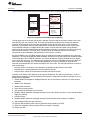
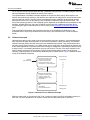
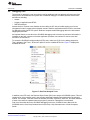
restoring of the SWI context is automatically handled by the SYS/BIOS kernel. Figure 9 shows how SWIs
fit into the SYS/BIOS architecture.
Hard Real-time
Interrupt
(from hardware)
Hardware Interrupts (Hwi)
> Urgent response time
> Often at “sample rate”
> Microseconds duty cycle
> Preemptive or non-preemptive
Foreground
Swi_post()
(from program)
Software Interrupts (Swi)
> Flexible processing time
> Often at “frame rate”
> Milliseconds duty cycle
> Preemptive
Idle
> Best Effort
> Sequential Execution
Soft Real-time
Background
Figure 9. Hardware Versus Software Interrupts
SWIs are made ready to run when the Swi_Post( ) function is called, typically by a hardware interrupt. A
SWI runs only once regardless of the number of times the SWI was posted prior to execution.
8
Using SYS/BIOS With Stellaris® ARM® Cortex™-M3 Microcontrollers
SPMA040A – January 2012 – Revised November 2012
Submit Documentation Feedback
Copyright © 2012, Texas Instruments Incorporated