1
tree is given attributes that specify the node layout. One example attribute set is presented in this
paper, but the layout can be tailored to suit different aesthetic criteria. CG then uses tree properties
and adapts the work of Suigyama [12], Warfield[ 13], Eens [7] and Farin [8] in routing the edges.
The objectives of the system are to provide an aesthetically pleasing visual layout for arbitrary
directed graphs. CG incorporates techniques to reduce edge crossings, guarantee few bends in
long arcs, and to shorten long arcs whenever possible.
CG is the first graph drawing tool to use a graph grammar as the fundamental structure that
describes the node layout. Brandenburg [1] defines a layout graph grammar as a graph grammar
together with a layout specification. The layout specification associates a finite set of layout
constraints with each production. Our approach is to classify the productions of the graph parse
and associate layout attributes with each production type in the parse tree of the graph.
2.0 Node Layout
The node layout is determined by the combination of (1) parsing of the graph into logically
cohesive subgraphs and (2) defining layout attributes to apply to the resulting parse tree. The parse
is based on a simple graph grammar, and the attributes that are now programmed into CG produce
a layout whose nodes are balanced both vertically and horizontally.
2.1 Graph Decomposition
Clan-based graph decomposition (CGD) is a parse of a directed acyclic graph (DAG) into
a hierarchy of subgraphs. The subgraphs defined by our graph grammar and parse are called clans.
Let G be a DAG. A subset X ! G is a clan iff for all x, y " X and all z " G - X, (a) z is an ancestor
of x iff z is an ancestor of y, and (b) z is a descendant of x iff z is a descendant of y. An alternate
description of a clan depicts it as a subset of vertices where every element not in the subset is
related in the same way (i.e. ancestor, descendant or neither) to each member in the subset. Trivial
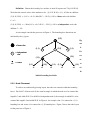
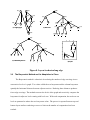
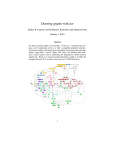
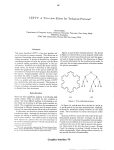
clans include singleton sets and the entire graph. In Figure 1, sets {2,3}, {2,3,4,5,6},