1
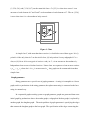
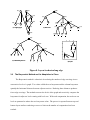
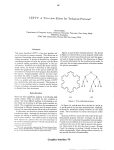
{1,2,3,4,5,6}, and {2,3,4,5,6,7} are the nontrivial clans. C={2,3} is a clan since vertex 1 is an
ancestor of each element of C and 5 and 7 are descendants of each element of C. The set {2,3,4}
is not a clan since 6 is a descendant of only vertex 4.
2
5
3
7
1
4
6
Figure 1. Clans
A simple clan C, with more than three vertices, is classified as one of three types. It is (i)
primitive if the only clans in C are the trivial clans; (ii) independent if every subgraph of C is a
clan; or (iii) linear if for every pair of vertices x and y in C, x is an ancestor or descendant of y.
Independent clans are sets of isolated vertices. Linear clans are sequences of one or more vertices
vi,vi+1,...,vj-1,vj where for i < k, vi is an ancestor of vk. Any graph can be constructed from these
simple clans.
Graph-grammars
String grammars are a special case of graph-grammars. A string is isomorphic to a linear
graph, and in a production of the string grammar, the replacement string is connected to the host
string in a natural way.
In a sequential graph rewriting system or graph-grammar, graphs are generated from some
initial graph by productions where the mother graph, a subgraph of the host graph, is replaced by
another graph, the daughter graph. The main problem of graph-grammars is specifying the edges
that connect the daughter graph to the host graph. The specification of the edges connecting the