1
APS011: Sources of error in TWR schemes
7 APPENDIX A: DERIVING THE ERROR IN RANGING ACCURACY DUE TO DRIFT
7.1
TWR with clock drift
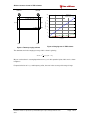
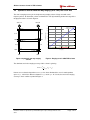
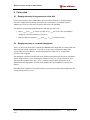
With the final response message device A can measure the round trip time of the transaction as
follows: = 2 + And extract the time of flight (TOF): 2 = − Because of the clock drift, device A actually measures an estimated TOF which is given by: 2 = (1 + ) − (1 + )
The difference between the true TOF and the estimated TOF gives the error in the ranging
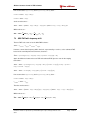
transaction: 2 − 2 = (1 + ) − (1 + ) − ( − )
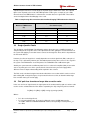
Substituting for yields the final error: (
" #$ − !#$ = !#$. &' + *+&,-./ (&' − &/ )
!
)
7.2
SDS-TWR with clock drift
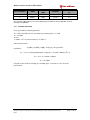
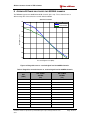
Now each device measures a round trip time as follows: = 2 + = 2 + We can extract the TOF by combining these two round trip times as follows: 4 = − + − As before due to clock drift, device A and device B measure estimated round trip times, so the
estimated TOF is given by: 4 = ( − )(1 + ) + ( − )(1 + )
The difference between the estimated TOF and the true TOF gives the error in the ranging transaction
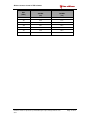
as: 4 − 4 = ( − )(1 + ) + ( − )(1 + ) − ( − + − )
4 − 4 = ( − ) + ( − )
© DecaWave 2014 This document is confidential and contains information which is proprietary to
DecaWave Limited. No reproduction is permitted without prior express written permission of the
author
Page 18 of 21