1
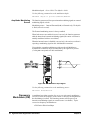
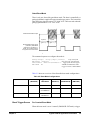
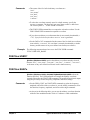
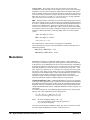
Keep in mind that the carrier frequency is different than the “burst rate”
which specifies the interval between bursts (triggered mode only).
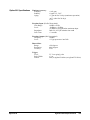
Burst Carrier frequency: 10 mHz to 5 MHz (100 kHz for triangle and
ramp). The default is 1 kHz. You can use sine, square, ramp, triangle, or
arbitrary waveforms for the carrier waveshape.
Be sure to note the restrictions for carrier frequency and burst count shown
on the following pages.
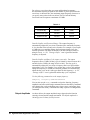
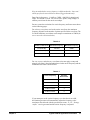
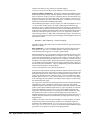
For arbitrary waveforms used as the carrier waveform, the maximum
frequency depends on the number of points specified in the waveform. The
five built-in arbitrary waveforms can be output at a maximum of 5 MHz (be
sure to note the restrictions below).
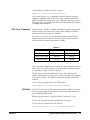
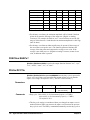
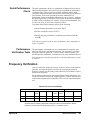
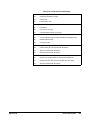
Table 2-6.
Number of Arb Points
Minimum Frequency
Maximum Frequency
8 to 8,192 (8k)
100 mHz
5 MHz
8,193 to 12,287 (12k)
100 mHz
2.5 MHz
12,288 to 16,000
100 mHz
200 kHz
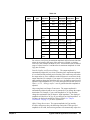
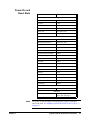
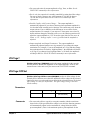
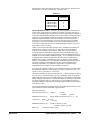
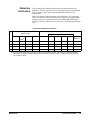
For sine, square, and arbitrary waveforms (does not apply to ramp and
triangle waveforms), the relationship between the carrier frequency and the
minimum burst count is shown below.
Table 2-7.
Carrier Frequency
Minimum
Burst Count
10 mHz to 1 MHz
1
>1 MHz to 2 MHz
2
>2 MHz to 3 MHz
3
>3 MHz to 4 MHz
4
>4 MHz to 5 MHz
5
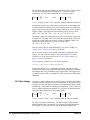
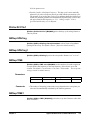
If you attempt to set the carrier frequency to a value that is not valid,
the function generator will automatically adjust the frequency to the
maximum value allowed with the present burst count. A -221, “Settings
conflict” error is generated and the carrier frequency is adjusted.
Chapter 2
Agilent E1441A Application Information
37