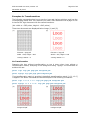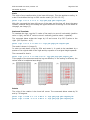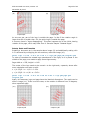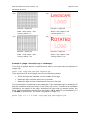
1
PDF Command Line Suite, Version 4.5
Page 22 of 63
November 26, 2015
Advanced Tip: The following information is slightly mathematical and assumes the
reader is familiar with matrix multiplication. It is not required to understand how to
apply transformation, it just adds some mathematical background.
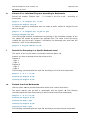
A transformation matrix to transform from one coordinate system to another is
represented by a 3 by 3 matrix as shown below:
a b 0
TM=
c
d 0
e
f
1
rd
The 3 column does not contain any relevant elements, which is why it is left away in
the simplified form [a b c d e f]. However it is required to multiply matrices and receive
a result which is a 3 by 3 matrix again.
In order to combine multiple operations, e.g. rotating and scaling, the corresponding
matrices are multiplied.
Example:
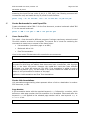
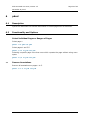
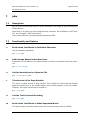
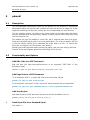
Matrix R to rotate by 90 degree, matrix S to scale by factor 2.
0 1 0
2
0
0
R= -1 0 0
S= 0
2
0
0 0 1
0
0
1
The transformation matrix that does both, rotate and scale is:
TM = R x S, which in the simplified version is [0 2 –2 0 0 0].
To gain a deeper knowledge about coordinate transformation please refer to the PDF
Reference chapter 4.2.
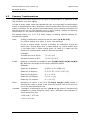
Page Sizes
When dealing with transformation matrices, specially with translation, it is a
requirement to know how large the pages are. The coordinate system of a PDF page is
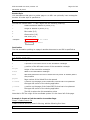
in points. 1 point corresponds to 1/72 inch, 1 inch is equal to 25.4mm. Below is a table
with the most frequently used paper sizes, and their size in PDF points.
Name
Size
PDF Points
A3
297 x 420 mm
842 x 1190
A4
210 x 297 mm
595 x 842
Letter
8.5 x 11 inch
612 x 792
Legal
8.5 x 14 inch
612 x 1008
© PDF Tools AG – Premium PDF Technology