1
Oasys LS-DYNA Environment Software
Section 2 – Oasys PRIMER
In addition there is now a 'fully locked' option which merges the child(ren) into the master, forming a
single rigid body.
• Case 11854
A very simple command-line syntax to refit seatbelts has been added, making it possible to refit
belts in batch mode.
• Case 11510
Auto vertical angle feature added to the auto build from CSV file for FHM models
• Case 11207
There have been requests that items in *INCLUDE_TRANSFORM definitions should be usable
inside mechanism or dummy positioning in such a way that the original (untransformed)
coordinates of the items are preserved, and the positioning transforms are added to the
*DEFINE_TRANSFORM definition instead.
This has been implemented as follows:
1.
PRIMER detects automatically that items within an assembly are in an
*INCLUDE_TRANSFORM definition.
2.
It assumes that this has been done intelligently: all the items are in a single assembly, and the
*DEFINE_TRANSFORM for these items is used uniquely by this *INCLUDE_TRANSFORM
definition.
3.
Positioning proceeds as normal, but when a revised position is ACCEPTed the transform is
appended to the end of the *DEFINE_TRANSFORM definition as a block of four
transformations:
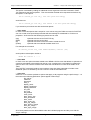
TRANSL [x,y,z] To shift to the new position
ROTATE [theta X] Rotation about global X axis
ROTATE [theta Y] Rotation about global Y axis
ROTATE [theta Z] Rotation about global Z axis
− Within a PRIMER run the location of this block of transforms is 'remembered', and any further
positioning causes the original set to be replaced by a new set of definitions giving the updated
position.
− There is no way to record in the input deck that a given block of 4 transforms apply to
positioning, so once a deck is written out (or copied to a new model) these become permanent,
and any positioning operations in the new model will create a new block of transforms.
Because the 'as transformed' coordinates will, when the inverse transforms are applied prior to
keyword output, go back (give or take a small error) to their original positions, the include file is
preserved in its original state.
• Case 11204
The following changes have been made to Mechanisms:
1.
The default initial angle of a mechanism assembly still starts as zero degrees (since a
new assembly has no intrinsic orientation). However as it is rotated these (notional)
angles about all three axes are now updated, and the values are 'remembered' both
across positioning runs and in the keyword output file.
2.
'LINE' and 'HINGE' connections between assemblies now compute and remember their
relative angles at all times. Previously this was only done if 'stop' angles were defined. In
addition the current angle (by default initialised to zero degrees) can be both set to some
other value initially, and also reset at any time.
Ove Arup & Partners Ltd
nd
2 April 2009
Pg. 42
Oasys Suite v9.3.1
Release Notes