1
SMART User Authentication
Background
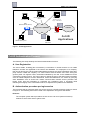
There are three fundamental concerns when users of computer-based systems, where these
systems consist of client and server computers, gain access to secure services:
A. Authentication of the user (and/or client computer) making use of the secure service. This
allows the server to confirm the identity of the user (and/or client computer).
B. Authentication of the server providing the secure service. This allows the user to confirm the
identity of the server.
C. Encryption (or secrecy) of the communication channel between the server and the client
computer. This may be necessary when a high degree of confidentiality is required such as
during a private transaction, or when messages need to be digitally signed.
For reasons identified and discussed later in this section, the first of these three concerns,
authentication of the user, is the most challenging.
Users may identify themselves to servers usually by providing a “username” or “user number”.
Since usernames and numbers are not secrets, it would be easy for an intruder to pose as
another person and gain access to that person’s secure services. To prevent this from
happening, the identity of the user must be authenticated. User authentication (proof of identity)
can commonly be done in three ways:
What you know: Secrets
If the user can show that he or she is in possession of a secret such as a password, PIN,
cryptographic key or certificate that only the real user is supposed to know, it may act as
proof of identity.
What you have: Hardware Tokens
If the user can show that he or she is in possession of a hardware device, such as a
magnetic card, smart card, cryptographic token or calculator, that only the real user is
supposed to have, it may act as proof of identity.
What you are: Bio-metric Measurements
If the user can show that a measurement of part of his or her body (such as a fingerprint,
retina scan, photograph, etc.) matches that of the real user, it may act as proof of identity.
User authentication based on a secret, particularly where this secret is a password or PIN that is
managed by the user, is generally considered a weak authentication mechanism because
•
users are known to choose weak (short, easy-to-guess) passwords that can easily be
remembered;
•
users may write down or share passwords;
•
passwords are static; users do not usually change their passwords on a frequent basis, and
if the secret “leaks out”, the user can never sure that his or her secret is not known by a
third party unless this is changed on a frequent basis.
Authentication based on a secret such as a suitably long cryptographic key (i.e. where
decipherment is infeasible) is considered a strong user authentication mechanism.
Page 4