1
Safety Information
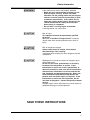
Refrigerant
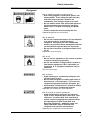
Risk of expelling refrigerant under pressure.
• Wear safety goggles and protective gloves, user
and bystander. If any refrigerant gets into eyes,
flush with water and seek a doctor's aid
immediately, even though irritation may cease.
• Do not remove master filter while under pressure.
Perform maintenance procedure for removing
master filter in Chapter 4–Changing the Master
Filter.
• Prevent refrigerant from contacting the skin.
Expelled refrigerate can cause injury.
Risk of explosion.
• Do not use compressed shop air for leak detection
or to pressure test a system containing
refrigerant. Refrigerant can form combustible
mixtures at pressures above atmospheric and with
air concentrations greater than 60% by volume.
• Do not heat a container of refrigerant above 125°F
(52°C).
Explosion can cause injury.
Risk of fire.
• Do not use this equipment in the vicinity of spilled
or opened containers of gasoline.
• Do not use KoolKare™ DiagnosTech™ system or
leak detector equipment if R-12 substitutes are
suspected. R-12 refrigerant substitutes may be
flammable.
Fire can cause injury.
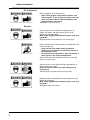
Risk of poison.
• Avoid breathing air conditioning refrigerant and
lubricant vapor or mist.
• Do not allow refrigerant to contact open flame or
be drawn into a running engine. This can cause
refrigerant to become poisonous phosgene gas.
• Use KoolKare™ DiagnosTech™ system to remove
refrigerant from air conditioning systems.
Exposure can irritate eyes, nose and throat.
Risk of irritation of mucous membranes.
• Avoid breathing A/C refrigerant and lubricant
vapor or mist. Exposure may irritate eyes, nose
and throat. To remove HFC-134a from the A/C
system, use service equipment certified to meet
the requirements of SAE J2210 (HFC-134a
Recycling Equipment). Additional health and
safety information may be obtained from
refrigerant and lubricant manufacturers.
Exposure can irritate eyes, nose and throat.
III