1
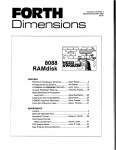
VOLUME IK NUMBER 1
$2.50
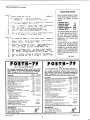
INSIDE:
flXED=POlNTMATH
Fixed-Point Trig by Table Lookup................ John James............... 6
J. Bumgarner............. 7
Fixed-Point Trig by Derivation ....................
Fixed-Point Square Root ........................... Klaxon Suralis ............ 9
Fractional Arithmetic ................................. Leo Brodie .................13
The Cordic Algorithm for
Fixed-Point Polar Geometry ................ Alan 7: furman............14
Quadruple Word Simple Arithmetic ............ David A. Beers ...........17
FLOAVNG-POINT MATH
High-Level Floating Point .......................... Michael Jesch ............23
26
Vendor Support of Floating Point ................................................
DEPARTMENTS
Letters .....................................................................................
Robert L. Smith..........
Standards Corner:....................................
New Proposals for Relationals
and Multiplication Operators
1
3
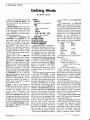
Techniques Tutorial: Defining Words ........... Henry Laxen.. ............. 4
New Product Announcements/Reviews.. .....................................
30
Now Available On
~
HEWLETT PACKARD DESKTOP COMPUTERS
HARDWARE
SOFTWARE
The HP 9826A and 9836A are two of Hewletl-Packard's
newest and most powerful desktop computers. Each Is based
on the Motorola MC68000 microprocessor. Both machines
have full graphics capability and up to 2 full megabytes of
user read/write memory. Both operate on 5%" flexible disc
drives (the 9836A has two) which feature 264K bytes of
mass storage. While the 9826A has an integral 7" (178mm)
CRT which makes it useful for computer-aided testing (CAT)
and control, the 9836A has a full 12.2" (310mm) CRT
which makes it ideal for computer-aided engineering (CAE)
applications. Each model features the following:
9
9
9
9
Seven levels of prioritized interrupt
Memory-mapped I/O
Built-in HP-IB interface
Standard ASCII keyboard with numeric keypad and
international language options
Ten (20 with shift) user-definable soft keys with soft labels
Rotary-control knob for cursor control, interrupt generation
and analog simulations
System clock and three timers
Powerfail recovery option for protection against power lapses
Seven additional interface cards
- DMA controller (up to 2.4 mb/sec)
- 8/16 bit bi-directional parallel
- Additional HPlB interface
- Serial RS232/449
- BCD
- Color video(RGB) 3 planes 512 x 512 8 color
HP 9826/36 Multi-FORTH
HP PRODUCT # 97030JA
Multi-FORTH was developed in 1979 by Creative Solutions,
Inc. The standard product has been substantially modified to
take full advantage of the 9826/36 hardware features.
Multi-FORTH features
79 standard programming environment
Multitasking
Full screen editor
In-line structured assembler
I/O and graphics extensions
Loadable H.P. floating point (IEEE format)
Extensive user manuals and documentation
Optional Features:
Meta compiler
Multi user
Data access methods library
This product is part of HP PLUS - a program for locating user software. It has been
developed by an independent software supplierto run on HPcomputer systems. It is
eligible for HP PLUS as determined by references from satisfied end users. Support
services are available only through the software supplier. Hewlett-Packard's
responsibilities are described in the Responsibilities Statement below.
Responsibilities Statement
HP PLUS software was developed by an independent softwaresupplier for operation
on HP computer systems. The supplier is solely responsible for its software and
support services. HPis not the manufacturer or developerof such software or support.
HPdisclaims any andall liabilities forandmakes no warranties, expressedorimplied.
with respect to this software. Distribution of this product or information concerning
this product does not constitute endorsement of the product, the supplier, or support
services. The customer is responsible for selection ot the r0ttW.m it punhsos.
For more information, please write
Marvel Ross, Hewlett Packard Company
3404 East Harmony Road, Ft. Collins, CO. 80525
Letters
...
Character Witness
Dear Fig,
Mr. Arthur Goldberg’s letter in your
February, 1982 issue is misleading. It implies that because only the first three
characters and length of names are
stored in headers, the user must type
FORTH source code in an abbreviated,
three character form. In fact, FORTH
was one of the earliest languages to abandon abbreviations and emphasize typing
fully spelled out words, for clarity, even
though the internal storage is compressed to save space.
The problems with the three character
system have to do only with its efficiency
as a data compression scheme. There are
two such problems. The first is the
failure to distinguish similarly spelled
names, forcing the user to select less
than optimal nomenclature to avoid
collisions.
The second is the inability to display
the original full name from the dictionary. A presumption that names are
used only in source code is thereby
implied. This is probably true when used
by a programmer, but when high-level,
job-oriented languages are developed in
FORTH, the nonprogrammer may be
putting new data structures into the dictionary interactively. He may then want
to see later what was put in, and abbreviations would not be acceptable. This
second objection, by the way, applies to
MMSFORTH’s extension of the three
character scheme to include a hash value
to improve discrimination among names
while conserving space.
Of course, keeping the full name
comes at the expense of space. This can
be very important, as illustrated by the
article on WORD in your Dec. issue,
where the programmers had to selectively delete headers in order to compile
a 48K of code.
George Lyons
Jersey City, New Jersey
De-California
Dear Fig,
I wholeheartedly applaude your efforts
to ”de-Californize” FORTH. I hope that
someday FORTH will replace BASIC as
the common language of computers.
FORTH won’t, as long as it remains a
local phenomena.
Eric Perrault
Seattle, Washington
Benchmark Ballyhoo
Dear Fig,
I’d like to shed some light on C.H.
Ting’s review of Timin FORTH. First,
my computer system has the ususal 4
MHz clock, not 6 MHz as reported.
Second, it was version 1.1 of Lab.
Microsystems FORTH that was compared with mine.
Dr. Ting was quite precise in his timings. They apply to a 4 MHz system
clock. At the time of the testing we did
not know that Lab. Microsystems was
releasing a version with improved execution speed. I have since run version 1.13
of their software and have found it to run
at approzimately the same speed as
Timin FORTH, except where disk block
I10 is involved. The Timin system of 8
interleaved sectors per block results in
much faster disk access. Here are two
comparison tests that I ran. One of these
does arithmetic and the other does disk
110:
Timin
2-80
FORTH FORTH
rel. 2
ver. 1.13
Test
1200 divides1
multiplies
4.3 sec.
4.2 sec.
CLEAR screens
1 2 thru 24
7.9 sec. 36.1 sec.
The disking results are system dependent.
Mitchell E . Tirnin
Timin Engineering Company
San Diego, California
Dear Fig,
Thank you for the opportunity to comment on Mr. Timin’s letter. As usual, Mr.
Timin’s timings are obsolete long before
they are published. We have been shipping 2-80 FORTH version 1.14 since July
of 1981; this revision executes about 20%
faster than the one Mr. Timin tested.
I t performs the Interface Age primes
benchmark in 108 seconds on a 4 MHz
CPU, while 8080 fig-FORTH completes
the same benchmark in 157 seconds at
the same clock speed.
It is quite true that disk access in a figFORTH system is much faster than in
2-80 FORTH. Fig-FORTH writes screens
directly to the diskette, while Z-80
FORTH maps screens onto a standard
operating system random access disk
file. The latter method permits the software to be completely independent of
the size and density of the disk media,
and allows FORTH programs to coexist
with other types of utilities and language
processors. If the number of systems sold
is any indication, our approach to disk
management has won vastly more user
acceptance than Timin’s FORTH. In
addition, Mr. Timin forgot to mention
that both his company and Micromotion
recently announced new FORTH packages that use operating system files for
screen storage just like 2-80 FORTH.
Although I felt obligated to answer the
points raised by Mr. Timin, I think that
interchanges of letters along these lines
could probably go on forever and do not
really serve any useful purpose. If Mr.
Timin wants publicity for his products,
he can pay for his advertising like the
rest of us. You might find it interesting
to know that although Mr. Timin has felt
quite free to publish timings and comments about Z-80 FORTH, he is not a
registered owner of any of our software.
Ray Duncan
Laboratory Microsystems
Los Angeles, California
From !he Editor
I’d like to thank all the authors who
contributed to this issue. The quality of
their work is outstanding. I’d also like
to thank Timothy Huang and Peter
Helmers who wrote excellent articles
for which there was simply no room.
(Their articles will eventually appear,
either here or in one of the conference
proceedings.)
Next issue’s theme is “Hardware
Control,” including process control,
robotics, etc. (See box on pg. 8 for
future themes.)
Keep writing!
Leo Brodie
FORTH Dimensions
Published by FORTH Interest Group
Volume IV, No. 1
May/June 1982
PrintinglCirculationlAdvertising
Roy C. Martens
EditoriallProduction
Leo Brodie
FORTH Dimensions solicits editorial
material, comments and letters. No
responsibility is assumed for accuracy
of material submitted. Unless noted
otherwise, material published by the
FORTH Interest Group is in the public
domain. Such material may be
reproduced with credit given to the
author and the FORTH Interest Group.
Subscription to FORTH Dimensions
is free with membership in the FORTH
Interest Group at $15.00 per year
($27.00foreign air). For membership,
change of address andlor to submit
material, the address is: FORTH
Interest Group, P.O. Box 1105, San
Carlos, CA 94070
~
FORTH Dimensions
1
Volume IV
No
1
GET IT UP
NOW
there’s a revolutionary new data
base manager and operating system with an easy to use conversational language.
This is the first truly relational system with full conversational JOIN
capabilities that is available on a
microcomputer.
FORTH BASED SYSTEM,
not only written in FORTH, but the
user programming language is an
extended subset of FORTH.
TRS/80 Models I or 111
Lists or quantity ONE prices are:
DATAACEdUser Guide
MMSFORTH
DATA A C E ~ D B M
database accesses, data
definition language, editor and catalog and User
Guide
Query language
-
-
-
$30.00
$125.00
$150.00
$100.00
(MMSFORTH is a prerequisite for
DATA ACE&DATA A C E ~ D B M
is a prerequisite for DATA
Query language.)
ACE^
EASY TO USE
interactivecommands to set up Data
files and Fields which may be
CHANGED without altering any application work.
Existing MMSFORTHusers may obtain the complete DATA A C E d
package for $250. Those using
MMSFORTH for the first time will be
investing $375.00.
QUERY LANGUAGE
to ADD, CHANGE, DELETE, LIST or
JOIN files or data. Reports, including analytical and exception reports,
can be generated immediately and
(MMSFORTH IS A TRADE MARK OF
MILLER COMPUTER SERVICES).
POWERFUL
Data Manipulation
language!an extended subset of FORTH, lets you
quickly write customized reports
and other programs.
FULL SCREEN EDITOR
which helps you store, write and
change programs or procedures for
use later or simply to store and
correct text for letters or memos.
AMAZING PERFORMANCE
AND FLEXIBILITY
because the system is written in
FORTH.
TRS/80 Model II
For $75 you get a User Guide and a
demonstration disk. Once you know
what you want, you may choose the
exact packa e for your needs.
DATA A C E ~ S
also available for
hard disk and with application start
up kits.
ACE^
DATA
IS a smart and completely integrated system operating system, relational data base
manager, query language, structured programming language, full
screen editor, catalog, application
packages and commitment to future development.
-
-I
@
YES- show m e more / send m e
u a n d demonstration disk $75.
the D ATA ACE - Model 1/1 II
User Guide $30.
m a copy of DATA ACE DBM $150
a copy of DATA ACE Query
Language $1 00.
0
0
Enclosed is my checkkredit card details. (We accept Visa or M I C )
card no-
NAME
COMPANY
ADDRESS
CITY
STATE
TELEPHONE
exp.
I I
ZIP
COMPUTER SOnrWARE
DESIGN Hc
FORMERLY AREGON SYSTEMS INC.
191 1 WRIGHT CIRCLE
ANAHEIM, CA., 92806
714/634 9012
FORTH Standards Corner
Proposals for Relationals and
Multiplication Operators
By ROBERT L. SMITH
Relationals.Traditionally FORTH has
had very simple primatives for comparing arithmetic values. Usually the
overflow conditions have been ignored, leading to occasional surprises.
Consider, for example, the traditional
definition of < (which is not 79-Standard):
: <
-o<;
In this example the top element on
the stack is subtracted from the second
element. The sign bit of the result is
examined to check for a negative
result. If the result is negative, the
result is replaced by the value 1,otherwise it is replaced by zero. Since the
arithmetic is done on a 16 bit basis,
with no regard for Carry or Overflow
bits, we find with the above definition
that
-20000 20000 <
will return the value 0, meaning false!
At the Rochester FORTH Standards
Conference, Brodie and Sanderson
demonstrated that this result is to be
expected if we consider numbers to lie
on a “number circle” which has no
ending point, but an overlapping of
numbers such that -16K is the same
as + 48K (K = 1024).
The FORTH Standard specifies that
the comparison on two numbers using
the word < is to be a true arithmetic
comparison. In this case the numbers
are considered to lie on a line from
-32768 to + 32767. The most obvious
way to accomplish the arithmetic test
is in a code definition, particularly if
the machine has testable bits for
Overflow, Zero, and Sign for arithmetic results. However, one of the
most popular microcomputers, the
8080, does not generate an Overflow
bit. It does however have a Carry bit,
and this may be used in a fairly clever
way. (This technique was recently
rediscovered by Klaxon Suralis and
presented at the Northern California
FIG meeting). Consider first the comparison of unsigned numbers. The
appropriate word is U < . In this case
FORTH Dimensions
numbers are considered to lie in the
range 0 to 65535. The best way to
implement U < is in a code word in
which the two numbers are subtracted
and the carry bit is examined, and the
final value of 0 or 1 is set accordingly.
Note that the actual state of a carry bit
depends on the machine being used.
Some machines use the carry bit to
mean “borrow” when a subtraction is
made. Others merely complement the
subtrahand and add, with the resulting
carry being the same as in normal
addition.
For the purposes of arithmetic comparison, one can make a translation
from the signed number line to the unsigned number line by reversing the
sign bits of the two operands. Suralis
suggests calling this operation 2FLIP.
This is best done in code, but a simple high level definition is as follows:
DECIMAL 16 BASE J
( Make the base
Hexadecimal )
: SFLIP 8000 XOR
SWAP 8000 XOR SWAP ;
The XOR operation could be replaced
by + if that is faster. The definition of
a 79-Standard < could then be:
: < 2FLlP U< ;
This is probably the best technique for
implementing < on the 8080. You
should try some examples to convince
yourself that this technique actually
works.
Suralis also suggests a related technique to convert unsigned address
parameters to signed values to be used
with the 79-Standard DO-LOOPS in a
transportable manner. The loop indices are then converted back to the
desired address value by applying an
additional FLIP. It is an interesting
method, but I think that it would be
best if the Standard could be changed
to reflect the need for unsigned loops
(See the previous Standards Corner for
one suggestion).
Signed and Unsigned Multiplication.
There may be some confusion over
“
”
3
signed and unsigned multiply operations. Consider first the simple multiply operator * . This takes two single
precision operands and produces a
single precision result. There is a
potential overflow problem in this
case since the product of two 16 bit
quantities potentially may produce a
32 bit result. However, if the result can
be represented properly in 16 bits, the
correct result will be obtained whether
we consider the operation to work on
signed or unsigned operands!
The FORTH-79 unsigned multiply
operator is U* . This is a mixed
mode operator which returns an unsigned double number product of two
unsigned single number operands.
There are some additional multiply
operators which are not in the Standard, but may be useful. If we wish the
product of two double precision
numbers, we can define a suitable
word as follows:
D* ( dl d2
d3 )
OVER 5 PICK U*
6 ROLL 4 ROLL
SSWAP
+;
The operands and results may be
considered as either signed or unsigned double precision quantities, provided that the product is representable
in 32 bits. In the above definition the
Double Number Word Set extensions
of FORTH-79 are assumed.
In fig-FORTH there is a mixed mode
M* . M*
multiplication named
takes 2 signed single precision
numbers and produces a signed double number product. There are a
number of ways of defining M* .
The following has the advantage of
defining another fig-FORTH word.
: S->D
( n
d )
DUP O<
IF -1 ELSE 0 THEN ;
: M* ( n l n2
d )
>R S->D R >
S->D
D*;
The purpose of the word S - > D
is to sign extend a single number to a
double number format.
---
+
---
---
Volume IV No 1
I
A Techniques Tutorial
Defining Words
By HENRY LAXEN
This time we will take a look at the
FORTH words CREATE DOES > and
try to clear up all of the confusion surrounding them.
CREATE DOES> live on the third
rung of the FORTH ladder. Let’s go up
it one step at a time. On the first rung
is the Assembler. It allows you to
create definitions out of the native
machine instructions.
:, CONSTANT, VARIABLE, VOCABULARY, and CREATE live on
the second rung. They allow you to
create new FORTH words. Most
systems, such as BASIC, FORTRAN,
and PASCAL stop there. But in
FORTH we are allowed to proceed to
the third rung of the ladder, namely
we have the ability to add new words
to FORTH which are capable of defining yet other words.
Words that contain CREATE
DOES > define other words. There is
nothing mysterious about this; words
that contain CONSTANT, VARIABLE, etc. do the same thing. The
difference is that the only thing CONSTANT can do is define things that
behave like constants; i.e., they push
their value onto the parameter stack.
Similarly the only thing words defined
by VARIABLE can do is push the
address of their data on the stack. With
CREATE DOES> we have control
over their run time behavior. We can
create new entities that behave in
totally unique ways both at compile
time and at run time.
Suppose I want a word similar to
SPACES, except that instead of spaces
it will print the given number of
asterisks. And suppose I also want
words to print backspaces and
underscores, etc. I could copy the
definition of SPACES, changing only
the name and the character to be emitted each time. But this would be painful. What I really want to do is define
a word that will define all these words.
That’s what CREATE DOES > is for.
Let’s define a defining word called
EMITTER like this:
FORTH Dimensions
: EMITTER
CREATE C,
(remember the character)
DOES >
C@
(fetch the character)
SWAP
7DUP IF
0 DO DUP EMIT LOOP
(Run Time behavior)
THEN DROP ;
32 EMITTER SPACES
42 EMITTER STARS
08 EMITTER BACKSPACES
95 EMITTER UNDERLINE
When EMITTER is executed, it
CREATES (compiles) a dictionary entry with that name. Next the C, takes
the number from the stack and adds
it to the dictionary as a single byte.
Next DOES> executes, and for the
time being just imagine that it stops
compiling and fixes the word that was
just defined, namely SPACES, STARS
or whatever, so that when it is executed, the words between the DOES >
and the ; are executed. Thus EMITTER has created a new word,
remembered the character to be sent,
and specified the run time behavior of
its child.
Now what happens when the child
is executed? Well, DOES> is even
trickier than we imagined. Besides
determining the run time behavior of
the child, it also manages to push the
parameter field address of the child on
the stack. IMPORTANT!! It pushes
the parameter field address of the
child, namely the pfa of SPACES or
STARS or BACKSPACES. Not the
parameter field address of EMITTER,
the parent. This is really convenient,
since we just happened to store the
character that we wanted to send in
the first byte of the parameter field
with C, above. So the first thing we do
is fetch it back with a C@. Now we
have the count, which was there
before, and the character, which we
just fetched, on the stack. The rest of
the code in the DOES> part is just
what we need to do to send that
character the right number of times.
Thus we have created a new class of
words in FORTH, namely EMITTER
words.
The applications of CREATE
DOES > are not necessarily so trivial.
We can define single and multidimensional arrays, trees, field and records;
virtually any kind of data structure.
Let’s do one more example, and please
imagine how you would attack the
problem in say FORTRAN o r
PASCAL. The problem is the following: I want the computer to recognize
some simple two word commands,
and respond accordingly.
Verbs
Nouns
TAKE
KEYS
GRAB
DROP
LAMP
DISCARD
EAT
FOOD
DRINK
WATER
The responses are to consist of the
following:
I’ve got the .....
I’ve thrown away the .....
Yummy, that was good .....
.....? Yuck, I think I’ve lost my
appetite.
You’re a little confused.
Before I proceed, I must add this
warning. The version of FORTH I am
using is the one described in the book
Starting Forth by Leo Brodie. My EXECUTE operates on pfa’s instead of
cfa’s, and my ’ is neither immediate
nor state dependent.
Each of the definitions in Fig. 1 is
called with the parameter field address
of the calling word on the stack. ID.
is a word that takes a name field
address and prints the name. Next we
must classify the verbs. The easiest
way to do this is to make constants out
of them, as we did in Fig. 2.
Now we define KEYS LAMP FOOD
and WATER to print out the appropriate message (Figure 3).
Clearly we could duplicate this with
LAMP FOOD and WATER, but there
is an easier way. Suppose we define
a defining word called ACTS-ON
which expects four words to follow
the word it is defining, namely the
thing to do for taking, dropping,
eating, or drinking. Figure 4 shows
Volume IV, No. 1
Fig. 1
:
how we could do this.
Now if we type TAKE FOOD it
should respond with “I’ve got the
FOOD,” and if we say EAT KEYS it
should respond “KEYS? Yuck, I think
I’ve lost my appetite.”
The above approach has many
benefits over the previous infinite IF
ELSE TH EN approach. If we decide
to add more verbs or objects, it will be
much easier to change the above
definitions than to go back and change
all of those nested IF statements. Furthermore, the CREATE D OE S > approach will be much more compact,
and in this case much faster as well.
’Ti1 next time, good luck, and may
the FORTH be with you.
0 Laxen & Harris Inc.
.NAME
: GOT-EM
: GIVE-EM
: YUMMY
: Yuck.
: ALMOST
NFA I D ;
CR
I’ve got t h e “
.NAME
;
CR
I’ve thrown away t h e
.NAME
;
CR
Yummy, that w a s good
.NAME
;
CR .NAME
3
Y u c k , I thlnk I’ve lost my appetite." ;
CR
You’re a llttle confused.“
DROP
;
.“
.“
. I ’
.“
.‘I
0 CONSTANT TAKE
0 CONSTANT GRAB
1 CONSTANT DROP
1 CONSTANT DISCARD
2 CONSTANT E A T
3 CONSTANT D R I N K
Fig. 3
:
--
kEYS
( n
)
C LATEST PFA 1 L I T E R A L SWAP
DROP
GOT-EM
DUP 0 = I F
DUP 1 = I F
DROP
GIVE-EM
DUP 2 = I F
DROP
YUCK
DUP 3 = IF
DROP
Yuck
DROP ALMOST
THEN THEN THEN THEN
:
ELSE
ELSE
ELSE
ELSE
Fig. 4
ACTS-ON
CREATE
9
Henry Laxen is part of Laxen b Harris
Inc., a FORTH teaching and consulting company based in Hayward,
California.
1
2
9
DOES :
OVER 0 5 W I T H I N I F
kLSE
XTS-ON
SCTS-ON
SCTS-ON
SCTS-ON
KEYS
LAMP
FOOD
WATER
GOT-EM
GOT-EM
GOT-EM
GOT-EM
SWAP 2t OVER + 3 EXECUTE
ALMOST
DROP
THEN
;
GIVE-EM
GIVE-EM
GIVE-EM
GIVE-EM
YUCK
YUCK
YUMMY
ALMOST
YUCK
Yuck
ALMOST
YUMMY
proFORTH COMPILER
8080/8085,280 VERSIONS
SUPPORTS DEVELOPMENT FOR DEDICATED APPLICATIONS
INTERACTIVELY TEST HEADERLESS CODE
IN-PLACE COMPILATION OF ROMABLE TARGET CODE
MULTIPLE, PURGABLE DICTIONARIES
FORTH-79 SUPERSET
AVAILABLE NOW FOR TEKTRONIX DEVELOPMENT SYSTEMS - $2250
MICROPROCESSOR-BASED PRODUCT DESIGN
SOFTWARE ENGINEERING
DESIGN STUDIES - COST ANALYSIS
ELECTRONICS AND PRINTED CIRCUIT DESIGN
PROTOTYPE FABRICATION AND TEST
REAL-TIME ASSEMBLY LANGUAGE/proFORTH
MULTITASKING
DIVERSIFIED STAFF
FORTH Dimensions
5
Volume IV, No 1
-I
Fixed-Point Trig by Table-Lookup
By JOHN S. JAMES
Colon Systems . San Jose, California
Here is an easy way to get sine and
cosine on your FORTH system, even
if it does not have floating point. The
precision is good enough for graphics
and many other applications, and the
routines are fast.
The principle is to use table lookup
to return the sine of 0 through 90
degrees. Simple compuations can
express the sine or cosine of any
integer number of degrees, positive or
negative, in terms of the sine of 0-90.
Since only integers are available, the
values returned are sine or cosine
multiplied by 10,000.
Because the results are scaled up,
you can use the FORTH scaling operation * / (multiply and then divide)
to get the results you want. For example, to multiply a number on the stack
by the sine of 15 degrees, use
15 SIN 10000 */
The word TABLE (defined in
Block 32) is a general-purpose tool for
creating singly-indexed tables of constants. The values to be compiled into
the table are placed on the stack,
followed by the number of those
values; then TABLE is executed to
create a table with the name which
follows. In this example, we created
the sine table in two parts, the sine of
51-90 degrees ( SINTABLEA ), and
the sine of 0-50 degrees ( SINTABLEB ), because some FORTH
systems have stack sizes less than 90
in order to take advantage of “zero
page” for faster execution in some
microprocessors, e.g. 6502. (If your
system has a larger stack, as most do,
making SINTABLE a table of all 91
values will both simplify the code and
make it run faster.)
[Another way to fill a table is to use
a comma after each value. This approach eliminates the stack size problem, the need for a defining word with
a DO ... LOOP, and the need to list the
table arguments in reverse order. -Ed.]
The code is believed to be
FORTH-79 Standard (it was tested on
a system still being developed, however). If you have fig-FORTH, change
CREATE to BUILDS > , change
NEGATE to M I N U S , and remove
79-STANDARD .
FORTH Dimensions
Screen 32
0
(
T R I G LOOKUP ROUTINES
-
WITH S I N E S 1 0 0 0 0 TABLE)
1 79-STANDARD
2 : TABLE ( VALUES N---.
CREATE A TABLE)
3
CREATE ( HEADER FOR THE TABLE)
4
( NUMBER OF VALUES) 0 DO
LOOP ( COMPILE THE VALUES)
5
DOES:, SWAP 2 S + 3 ;
( RETURN A VALUE)
,
6
7
(
8
9
CREATE A TABLE OF S I N E OF 0-90 DEGREES.
THE TABLE I S
CREATED I N TWO PARTS, ‘SINTABLEA’ AND ’SINTABLEB’,
SINCE SOME FORTH SYSTEMS ON 6502 HAVE L I M I T E D STACK.)
10
1 1 10000 9998 9994 9986 9976 9962 9945 9925 9903 9877
1 2 9848 9816 9781 9744 9703 9659 9613 9563 9511 9455
13 9397 9336 9272 9205 913’5 9063 8988 8910 8829 8746
14 8660 8572 8480 8387 8290 8192 8090 7986 7880 7771
15 40 TABLE SINTABLEA
Screen 33
0 ( T R I G LO0C:UP ROUTINES)
1
2 7660 7547 7431 7314 7193 7071 6947
3 6428 6293 6157 6018 5878 5736 5592
4 5000 4848 4695 4540 4384 4226 4067
5 3420 3256 3090 2924 2756 2588 2419
6 1736 1564 1392 1219 1045 0872 0698
51 TABLE SINTABLEB
7 0000
6820
5446
5907
2250
0523
6691
5299
3746
2079
0349
6561
5150
3584
1908
0175
8 : SINTABLE ( O - 9 0 - - - S I N E $ 1 ~ : ~ 0 0 0 )
9
( COMBINE THE TWO SMALL S I N E TABLES)
113
DUP 50 :.
11
I F 51 - SINTABLEA ELSE SINTABLER THEN ;
12 : S18(3 ( DEGREES---SINEt10000.
S I N E OF 0 - 1 8 0 )
13
DUP 90 >: ( 91-180 DEGREES?)
14
I F 180 SWAP - THEN ( REFLECT)
15
SINTABLE :
Screen 34
1:)
< TR IG LOOKUP ROUT INES)
1
2 : S I N ( DEGREES---SINE$lOOOO)
3
360 MOD ( DOESN’T CHANGE S I N E VALUE)
4
DUP 0.: I F 360 + THEN ( HANDLE NEGATIVE ARGUMENT)
DUP 180 >:
5
6
I F ( 181-359 DEGREES)
7
1 8 0 - Sl80 NEGATE
ELSE
8
9
s180
10
THEN :
11
12 : COS ( DEGREES---COSINEX10000)
13
360 MOD 90 + S I N :
14
15
The output of WAVE is featured on our cover.
Screen 35
0
1
(
EXAMPLE OF USE O F THE T R I G LOOKUP ROUTINES)
2 : PLOT
3
4
( ARG---.
P R I N T A L I N E OF ASTERISKS)
CR
( ARG) 0 DO 42 E M I T ( ’ * ’ )
LOOP ;
c
---.
6 : WAVE (
PLOT A S I N E WAVE)
7
360 0 DO
8
I S I N 300 / 40 + ( SCALE I T ) PLOT
9
5 +LOOP ( PLOT EVERY F I F T H DEGREE)
10
CR ;
6
Volume IV, No I
Fixed-Point Trig by Derivation
By J. BUMGARNER
Colon Systems San Jose, California
Trigonometric functions are not a part of most FORTH
systems and they are necessary to do any really useful
graphics routines. I considered table lookup trig functions
but while they are fast for the values stored in the table
they are not general enough for my purposes. I chose to
use a method to generate the desired trig function directly
from an input angle. The method chosen is called the
Taylor-Maclaurin Series.
All necessary trig functions can be derived from any
one. I chose to implement the sine because the input angles
that cause the sine function to generate outputs over its
entire range are plus and minus numbers that fit well in
scaled 16-bit signed integer arithmetic. The TaylorMaclaurin Series for the sine is:
x3
sin x = x - 3!
x5 - x7 + x9 +5!
7!
91
-
*
This nested form of the truncated series is convenient to
use with scaled integer arithmetic, since the highest power
of x is 2 and the nasty factorials are hidden. The form also
is very nice for factoring in FORTH.
For a scaling factor I chose to use 10,000.This fits my needs
and is nice for humans. Larger scaling factors can be used
to improve precision with 16-bit signed arithmetic. A scale
factor that is a power of 2 could be used to make the binary
arithmetic more efficient. [See “Fractional Arithmetic” in this
issue.] I was willing to sacrifice a little precision and speed
to gain clarity and transportability.
The code for the sine series is shown in Block 36 (next page).
The scaling factor and the square of x are used by name and
not passed on the stack. The word L evaluates each nested
term in the series and accumulates the result. Before using
L in (SIN) I put a scaled 1 on the stack to start the accumulation. The final term in the series is explicitly evaluated last
and uses the x value saved on the stack at the start of (SIN).
In using scaled integer arithmetic you must remove a scale
factor when you multiply two scaled values together. This is
made very easy by FORTH’s incredibly powerful word * / .
The word (SIN) in this block can be used by itself if the input angles are scaled and restricted to the values shown in
the comment on line 8. The compiled code occupies 99 bytes
and takes on average of 61 ms to evaluate the sine on a 1 MHz
6502 system.
The words in Block 37 use (SIN) to obtain the three most
useful trig functions for whole degree angles. REDUCE
reduces any integer degree angle to a range acceptable to
(SIN). The words COS and TAN use trigonometric identities to develop the functions from SIN but are quite
straightforward.
The tangent is infinite at plus or minus 90 degrees where
the cosine is zero. Anything one does here is wrong, so I chose
to do a simple thing ( SIN 3 * ) that at least tries and also
preserves the sign of the tangent.
This block takes 185 bytes for a total of 284 bytes for the
entire package. The average times of execution are 76 ms for
SIN, 81 ms for COS and 164 ms for TAN - not fast
but versatile and small. The words in Block 37 can be made
to operate on fractions of a degree by multiplying the constants in REDUCE , ?MIRROR and COS and the
denominator only in SIN . For tenths of a degree multiply
by 10, for 0.02 deg multiply by 50, etc. The limit is 91 (91*360
= 32760) but could be increased by clever programming in
REDUCE, etc.
The accuracy of these functions is good even without any
special precautions about rounding. The peak mror of
SIN as shown below is 0.02%. The test identity of SINZ
+ COS’ should always be exactly one (10000 when scaled)
and so shows the square of the error directly.
.
where x is some angle in radians (180 degrees = 3.14159
or pi radians). This series will generate increasingly
accurate approximations for the sine when more terms
are used. To get an idea of the errors here are some values
for the series truncated at various terms and for an angle
of pi12 radians (90 degrees). The value of the sine at pi/2
radians is exactly one.
Term
sin x (approx.)
Error
X
1.57
5 7%
-x 3/3!
0.92
-8O/o
+ x 5/5!
1.005
.5%
-x 7/7!
0.9998
-,02%
+ x 9/9!
1.000004
.0004%
It’s easy to see that the maximum error goes down fairly
quickly when you add terms. One problem is that the terms
of the series are hard to compute with integer arithmetic
as there are high powers of x and the factorials (5! is read
‘five factorial’ and is equal to 5.4.3.2.1 = 120) in the
denominator get big fast. Perhaps doing some algebra will
help.
If we factor out an x and expand the powers and factorials w e see a pattern develop that looks promising:
x2.xz.xz
sinx=x
1 - - +X2- xz*x2
.
2.3
2.345
2.3-4.5-6-7
+
(
...)
By factoring out -x2/2.3 from all but the first term we get:
sinx = x ( I - &
(1
-4.5XZ + 4.5.6.7x*.xz
...)
and finally if we carry out this scheme two more steps and
truncate the series at the x 9/9! term we have
sinx=x (I-:
(1-5
(1-5
(I-$)))).
(Source screens on next page)
FORTH Dimensions
7
Volume IV. No 1
I
Trig by Derivation (continued)
Upcoming Issues
RLOCK 36
0
( Scaled i n t e g e r SIN f u n c t i o n .
jobBZmar31)
1
2 10000 CONSTANT 10C:
( The s c a l l n g constant. )
VARIABLE XS
( The square o f t h e scaled angle.)
4
5
( a b --- m
I m=10000-a>:te/b
a common term i n t h e s e r i e s )
6 : L
XS 3 SWAP / NEGATE
10C: I/ 10C; + ;
7
B
( t h e t a --- 10000tSIN
I -15706 < t h e t a < 15708 r a d i m s t 1 0 0 0 0 )
9 : (SIN)
DUP ( save x7
DUP 1OC: I / XS ! ( save X l x )
10
10C: ( Put l t l 0 0 0 0 on s t a c k t o s t a r t s e r i e s . )
< Compute t h e s e r i e s terms.)
11
72 L 42 L 20 L 6 L
( F i n a l y m u l t i p l y by t h e saved x . )
8
;S
12
10K t /
13
14
Note: l/l1)000 o f a r a d l a n is c l o s e t o 0.0097 degree or about
15
21 arc seconds
a very small angle.
-
...
...
RLOCE 37
0
( SIN.
COSINE and TANGENT f o r whole degree angles.
job8Zmar31)
1
( theta
theta
I Reduce Y - a x i s symmetry. 0-180 t o 0-90-0)
2
3 : ?MIRROR
DUP 90 >
I F 160 SWAP
THEN ;
4
5
( t h e t a Cany>
t h e t a C-90 t o 90) I Angle r a n q r r e d u c t i o n . )
6 : REDUCE
360 MOD DUP O<, I F 360 +
THEN DUP 180 <
7
I F ( 0-180) 7MIRROR ELSE 180
?MIRROR NEGATE THEN I
8
9
( theta
1000OtSIN o r COS
; Any a n g l e i n whole degrres.)
10 : S I N
REDUCE
17453 100 t / ( deq. t o radt10000)
(SIN) 3
11 I COS
360 MOD ( p r e v e n t s p o s s l b l r o v e r f l o w ) 90 SWAP
SIN I
D
12
13
( theta
100STFIN ; TAN s e t t o +-30000 f o r +-90 degrees.)
14 : TAN
DUP SIN SWAP COS ?DUP I F 100 SWAP t / ELSE 3 8
THEN I
15
is
---
-
---
-
---
-
---
Ver. 2 For your APPLE II/II+
OURS
79-Standard system gives source portability.
YES
Professionally written tutorial & user manual 200 PG.
Screen editor w i t h userdefinable controls.
YES
Macro-assembler with local labels.
YES
Virtual memory.
YES
Both 1 3 & 16-sector format.
YES
Multiple disk drives.
YES
Double-number Standard & String extensions.
YES
Upper/lower case keyboard input.
YES
LO-Res graphics.
YES
80 column display capability
YES
2-80 CP/M Ver. 2.x & Northstar also available
YES
Affordable!
$99.95
Low cost enhancement option:
Hi-Res turtle-graphics.
YES
Floating-point mathematics.
YES
Powerful package w i t h own manual,
50 functions in all.
AM951 1 compatible.
FORTH-79 V.2 (requires 48K & 1 disk drive)
ENHANCEMENT PACKAGE FOR V.2
Floating point & Hi-Res turtlegraphics
COMBINATION PACKAGE
(CA
add 6% tax C O D accepted)
A.
The projected themes for Volume V
are: Project Management, FORTH in
the Arts, Serial Communications,
Laboratory Workstations, The FORTH
Environment, and Looking Back
(FORTH History).
We need articles for the “Operating
Systems” issue. Possibilities include:
o/s comparisons, writing FORTH on top
of another o/s, writing other operating
systems in FORTH, and adding useful
features of other operating systems to
FORTH. Please get in touch if you’re
interested.
Leo Brodie
Ver. 2
For 2-80 CP/M Ver. 2.x & Northstar DOS Users.
The complete professional software system, that meets
ALL provisions of the FORTH-79 Standard (adopted Oct.
1980). Compare the many advanced features of FORTH79 with the FORTH you are now using, or plan to buy!
FEATURES
Here’s the planned schedule of themes
for the remaining issues of Volume IV,
including the deadline for theme
articles:
2 Hardware Control
3 Operating Systems
7115
9101
4 Coding for ROM
5 Business Applications 10115
6 Teaching FORTH
12115
The complete professional software system, that meets
ALL provisions of the FORTH-79 Standard (adopted Oct.
1980). Compare the many advanced features of FORTH79 with the FORTH you are now using, or plan to buy!
OTHERS
-
FEATURES
OURS
79-Standard system gives source portability.
YES
Professionally written tutorial & user manual. 200 PG.
Screen editor w i t h userdefinable controls.
YES
Macro-assembler w i t h local labels.
YES
Virtual memory.
YES
BDOS, BlOS & cbnsole control functions (CP/M). YES
FORTH screen files use standard resident
file format.
YES
Double-number Standard & String extensions.
YES
Upper/lower case keyboard input.
YES
APPLE ll/ll+ version also available.
YES
Affordable!
$99.95
Low cost enhancement options.
Floating-point mathematics
YES
Tutorial reference manual
50 functions (AM9511 compatible format)
Hi-Res turtle-graphics (NoStar Adv only)
YES
OTHERS
-
-
-
-
-
FORTH-79 V.2 (requires CP/M Ver. 2 . x )
$99.95
ENHANCEMENT PACKAGE FOR V.2:
Floating point
$ 49.95
COMBINATION PACKAGE (Base & Floating point)
$139.95
(advantage users add $49.95 for Hi-Res)
(CA. res. add 6% tax, COD &dealer inquiries welcome)
$ 99.95
$ 49.95
$139.95
-
MicroMotion
MicroMotion
12077 Wtlshtre Blvd. # 506
L.A., CA 90025 (213) 821-4340
Specify APPLE, CP/M or Northstar
Dealer inquiries invited.
12077 Wilshire B l d # 506
L A , CA 90025 (213) 8 2 1 4 3 4 0
Specify APPLE CP/M or Northstar
Dealer inquiries invited
FORTH Dimensions
8
v
y
b
Volume IV. No. 1
Fixed Point Square Roots
By KLAXON SURALIS
As you learn the FORTH approach
to problem solving, you are sold on the
virtues of fixed-point arithmetic. Confidently armed with the neat little
techniques for adapting integers to
nearly any application, you set out to
write a numeric-type program.
While translating the requisite formulae into postfix notation, however,
you run into a radical sign - a square
root. In vain, you try to sneak around
it or tunnel underneath; there’s no way
to avoid it. What can you do? Pile K
upon K of floating point routines into
your dictionary, just so you can use the
SQRT function? Give up and go back
to BASIC?
This can happen to you, whether
your field is statistics, electronics,
graphics, or special relativity. Square
roots are everywhere, in all kinds of
famous equations. Of all the “irrational” functions in mathematics, this
is the most common - and the
simplest to implement.
Loading the Screens.
The program is listed as screens 222
through 224. Of course, you may put
them anywhere your mass storage
allows. All three screens load in base
ten; all are FORTH-79 Standard.
If your FORTH system is nonstandard, the source code will require only
minor modification. The FORTH-79
word R@ must be replaced by R (in
fig-FORTH) or I (in polyFORTH). You
may have to code 1- as a separate 1
and -.
Additionally, some systems may
omit the FORTH-79 required words
D < and U < . If yours is one of them,
just define (with BASE set to DECIMAL):
: D< ROT 2DUP =
IF ROT ROT DNEGATE D t O <
ELSE SWAP < SWAP DROP
THEN SWAP DROP ;
: U< 32760
t
SWAP 32768
t
SWAP < ;
Make SURE 32000 -32000 <
returns 0 on your system. If not,
demand a refund.
Trying it Out.
With all screens loaded, enter:
169 0 SQRT
This should print 13, which is the
.
square root of 169. Note that we had
to put an 0 on top of 169, since SQRT
demands a double-precision operand.
Most systems would have accepted
169. , taking the decimal point as a
signal to extend the value to 32 bits.
Thus, you could try:
400249. SQRT .
and see the result: 693. Omitting the
decimal point from 480249 , however,
would print a garbage value and
possibly a “stack empty” message.
SQRT works only for integers, d r o p
ping any fractional component in the
root. So, if you type:
3. SQRT .
the system will respond with 1 , even
though you know the answer should
be something like 1.7320508... . But
after all, this is fixed point arithmetic.
However, you can take the square
root of 3 million:
3000000. SQRT
and sneak a peek at three more root
digits: 1732 . This is the principle embodied in the word XX defined on
screen 224. Type:
3 xx
and there you have 1.732 . XX will
type the square root of any integer up
to 4095 . Since it takes a singleprecision argument, you don’t have to
type a decimal point. Try a few roots
of your own.
If you compare XX’s results to a
scientific calculator’s, vou’ll see that
.
SQRT’s 32-bit radicand
makes it perfect for finding
hypotenuses, standard
deviations, RMS values,
and lots of other “root-ofsum-of-squares” procedures.
XX is always accurate to three decimal
places, although it never rounds upward. Round-to-nearest, while possible, usually does not justify the added
complexity.
Now look at the definition of XX.
Right off, it multiplies n by one
million. Then, after calling SQRT, it
performs a special numeric conversion, which puts the three low-order
root digits on the fraction side of a
decimal point (ASCII code 46).
This combination of scaling and output formatting is the standard FORTH
technique for ersatz floating point.
The only wrinkle with SQRT is:
If you multiply SQRT’s radicand by a scale factor s, the
root will emerge scaled by the
square root of s.
More concretely, you’ve seen how
XX shifts the radicand left six decimal digits, while the root is offset by
only three places. Square root of
1,000,000 = 1,000. Get it?
Using SQRT in Your Application.
XX is included merely for demonstration purposes. In normal use, SQRT is
the only word the rest of your application will need to know. It will work for
any double number you feed it, and
harbors no surprises or special cases
(as far as I can tell).
SQRT’s Bz-bit radicand makes it
perfect for finding hypotenuses, standard deviations, RMS values, and lots
of other “root-of-sum-of-squares” procedures. If the input data are all likescaled 16-bit integers, simply square
them with M * or U * and accumulate
them using D + (or D- if you need
subtractions). Apply SQRT to this
double-precision sum, and the root
will be a 16-bit integer with the same
scale factor as your original data.
Of course, it’s up to you to ensure
that D + won’t overflow and that
D- doesn’t hand SQRT a negative
number.
Since SQRT takes an unsigned radicand, your application is free to handle imaginary roots as appropriate. If
you like, you may install simple error
checking for negative radicands, or
integrate SQRT into a complete fixedpoint (!) complex numbers package.
But How Does It Work?
On big machines, square roots are
extracted by a technique from calculus
called “Newton’s Method.” It is best
suited to CPUs with full floating-point
arithmetic hardware.
The alternative approach, used in this
SQRT, works by addition, subtraction,
and shifting. The result is constructed
bit by bit, in a fashion quite similar to
classical binary long division.
As in quotient generation, we set up
Continued on next page
FORTH Dimensions
9
Volume IV No 1
I
Fixed Point Square Roots (continued)
a partial remainder (initially equal to
the radicand) and proceed to chip
away at it. If we take away too much,
we put it back and shift a “0”into the
root; otherwise, the root gets a “1”.
Sixteen such trials take place, one for
each bit of the root.
What’s different is the quantity subtractedladded to that remainder. Instead of an unchanging divisor, we
must use the root itself - as many bits
of it as are already determined - with
a binary “01” stuck on the end. As the
calculation advances, this subtrahend
gets wider and wider.
For all but the last two trials, 16-bit
addition and subtraction are wide
enough to cover the action. This 87.5%
share of the job is done by EASY-BITS
(screen 223). As it churns along,
EASY-BITSuses left shifts to keep root
and remainder aligned under the
optimal 16-bit window.
Within EASY-BITS, the phrases
2* 1- ” and “ 2’ 3 + may bewilder you. They are sneaky, optimized
equivalents for “ 1- 2 * 1+ ” and
1 + 2* 1+ ”, respectively. In two
brief steps, they shift a new bit into the
root and reestablish the “01” suffix.
Now, if you look at the definition of
SQRT (screen 224), you’ll see the 14
easy bits extracted in two chunks: first
eight bits, then six more. There is a
very good reason for this: it saves us
from defining and using a 48-bit shifting operator, which would run slow
as molasses.
You see, we needn’t look at the radicand’s low-order 16 bits until the root
is half finished. At that point, the
“ROT DROP” throws away a cell
cleared to zeroes by “8 EASY-BITS”.
With the rest of the radicand thus
exposed, we’re ready to crank out six
more root bits.
The last two bits are coaxed out by
2’s-BIT (screen 223) and 1’s-BIT
“
“
FORTH Dimenslons
”
8cRozp
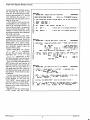
0 ( BOUCUIE ROOT s i m p l e a u x i l i a r y f u n c t i o n s
8uR24cIcIR82)
1
2 FORTH D E F I N I T I M DECIryY
( t h i r is a 79-8TIINDcYu) program )
3
4
(
Y o u r system may a l r r r d y i n c l u d r some or a11 of t h e f o l 1 w i n g 1 )
5
DROPDROP;
617 , -
OVERoIlERt
e
9 I W<
10
32760
11128
WP+
+
ROT
32760 +
;
D<
ROT ROT
;
(
s h i f t l e f t 1 b i t s i n g l e precision
)
(
s h i f t ldt 1 b i t double p r e c i s i on
)
12
13 I D 2 8
14
15
D+
2DUP
8cRI 223
0
1
(
8owRE ROOT
;
f i g u r i n g easy b i t s I 1 h a r d me
2 : €MY-BITS (
3
OD0
d r m l p u t i a l r o o t l count
4
M
-
5
Ra
o< I F
THEN
9
10 : 2’s-BIT
11
M D2t
12
(
(
R > 28
R > 2t
1-
(
3 +
proot s h i f t e d f o r next g a o u n d
(
drm2
proat2
W P O< IF
USE
)
LOOP
--D2Sd R&l
r d proot3 ; g r t
- R > 1+
D2t
R3 2-
u( I F
13
14
15
partialroot2
)
s h i f t &em t w i c e )
s u b t r . p a r t i a l root 1
restore drem C 8et 0 )
(
DlR
R3 +
ELSE
e
-- d r m 2
D 2 t D28
6
7
8uR;L4tlm82)
THENTHEN
ELSE
;
DROP
-
R>
R>
11+
( O r K t l )
;
pmult. bit)
( . c t l )
(-to)
(
set 1
)
224
0
1
(
88LwIRE ROOT
g e t last b i t I p u t i t a11 t o g e t h e r
--
2 x 1’5-BIT
( drem3 p r o o t 3
fullroot
3
M WP O< I F
2DROP R> l +
4
ELSE D28
32760 Fta
5
W < 0 - R > + THEN
;
suR26ryIR82)
; remainder lost
)
6
7 x 8PRT
(
udl
u2
;32-4it unsigned r a d i c m d - - > 1 6 - b i t root)
e
0 1
8 EASY-BITS
ROT DROP
6 EASY-BITS
9
2’s-BIT
1’s-BIT $
10
11 ( m d nou, t h e SCENIC ROOT-- p u r e f u n m d e a s y t o t y p e )
--
12
--
13 I X X
( n
; p r i n t s q r t of n t o 3 d a c i m l p l a c e r . n <=4095
14
16 8
62500 U8
( mtlt. n by me m i l l i o n i n 2 s t a g e s
15
SORT 0 <#
* # *
46HOl-D
#S
*> TYPE SPACE ;
10
)
)
Volume IV. No. I
(screen 224). As usual in computer
arithmetic, it’s the down-to-the-last-bit
accuracy that really costs. The p r o
blem here is that the remainder and
root become too wide for plain old
+ , - , and Oc. We have to worry
about overflow.
Both 2’s-BIT and 1’s-BIT use
DUP O c I F
to test a high bit
before D2* shifts it into oblivion.
Moreover, since
- Oc” can no
longer be trusted, we must resort to
unsigned comparisons ( U < and
DU < ). These definitions wouldn’t be
so ugly if FORTH had the “carry bit”
found on most microprocessors.
The principles of SQRT may be
applied to roots of greater precision 32 bits, frinstance. In fact, you could
use this technique in a program to
extract the square roots of floating
point numbers!
You Demand Proof?
A formal derivation of SQRT’s algorithm would waste a lot of FIG’Spaper
on something nobody would read. So,
I’ll supply a hint, if you supply your
own paper. Let:
N = the 32-bit radicand
r = the 16-bit root under construction, initially zero
b = the binary place value of the
root bit to be found (initially
32768, always a power of 2)
Then, for each value of b from 32768
down to 1, DO:
IF (r+b)? c = N
THEN add b to r ;
In this approach, b is the only quantity
that gets shifted. Now, simple algebra
rewrites the condition as:
b (2r+b) < = N - rz
The changing value N - rz is our
partial remainder. Note that the comparison is 32 bits wide, remember that
multiplying by 2 and b are simple
binary left shifts, and the rest is mere
optimization.
“
”
“
Alternatively, you may find this
algorithm described in any thorough
treatment of computer arithmetic.
Not Fast Enough?
If SQRT runs too slow for your application, there’s not much you can do
without delving into machine CODE.
If you don’t need full 16-bit accuracy
in your roots, you can substitute:
> R 2DROP R > 1for the final 2’s-BIT 1’s-BIT ” in
the definition of SQRT. The two loworder root bits will then always be
zero. The payoff: roughly 10% faster
execution, depending on your system.
Perhaps more importantly, you can
throw out D U < , 2’S-BIT, and
1’s-BIT, cutting the program size in
half.
If you have a FORTH assembler, the
first thing you should try is defining
2* and D2* in low level. On my
homebrew 6809 FORTH, this, by
itself, nearly doubles execution speed.
Actual mileage may vary, yours will
probably be less.
Beyond this, all you can do is
translate the whole mess into CODE.
This task is straightforward, but, of
course, CPU dependent.
Of those high-level programming
languages which give you a choice,
most make you accept a lot of unnecessary garbage just to get one function
you really want. Floating point
arithmetic and function packages
serve as cases in point.
FORTH exhibits the opposite attitude. It lets you order a la carte, as this
fixed-point square root program
demonstrates. Such freedom and efficiency, however, cannot be divorced
from the added responsibility of knowing exactly what you’re doing and
exactly what you want.
Good night and good luck.
“
look to
TIMIN
t ngineering
for FORTH
software of
professional qua1ity.
*ready to-run
FORTH development
systems
*application programs
in FORTH
*Consulting services,
including custom
program development
Our Iatest product:
DUAL TASKING
FORTH
Now you can run your
process control programs
in background while still
using your FORTH
system in the normal way.
Background and
foreground tasks may
each be written in high
level FORTH. They can
execute simu Itaneously
and exchange data. The
foreground task can
control the background
task.
(currently available as a
custom installation only)
Write for our FORTH
information booklet
0 QTirnin
EngineeringCo.
____
(714) 455-9008
FORTH Dimensions
11
Volume IV. No 1
a
Fractional Arithmetic
By LEO BRODIE
The choice of fixed-point arithmetic
over floating point arithmetic does not
mean you’re stuck with nothing but
integers. There are good ways to
express fractional values without paying the penalty for floating them.
One way to express a non-integer
value is as the ratio of two integers;
e.g., .66666 can be represented by the
integers 2 and 3, where 2 is divided by
three. You can express any fraction
with very good accuracy by picking
the right two integers. This kind of
representation is called “rational
approximation” (Chapter 5 of Starting
FORTH).
You can also express fractions as
single integers. All you have to do is
assume that the integer has been
scaled by some constant value. In John
Bumgarner’s article on fixed-point trig
in this issue, he represents sines and
cosines (which lie in the range between one and negative one) as integers scaled by 10,000. Another method
that allows greater accuracy and the
potential for greater execution speed
scales the integer by 16,384.
In the listing below, we first define
+ 1as a constant with the value 16384.
In our scale, the integer 16384 represents the positive integer one. Remember that in binary, 16384 looks like
this:
0100000000000000
In other words, the “1”is scaled up
in binary such that there’s an implied
binary point just after the second most
significant bit. Using 16384 as the scaling factor allows greater accuracy
within 16 bits than does 10,000 (by a
ratio of 16 to 10).
The next two words in the listing, *.
and 1. , are the fractional math multiply and divide operators, written in
high-level. Finally we have two words
for input and output. D- > F converts
a decimal number entered in the form
x.xxxx (the digit left of the decimal
point is optional) into our fractional
representation. .F outputs a fraction in
the form x.xxxx.
We could, for instance, multiply .75
by .5 in this fashion:
.7500 D->F M
. OO D->F
.F
<ret> .3750 ok
Interestingly, if we *. a fraction
times an integer, the result is an integer. For example:
28 .5000 D->F
<ret> 14
With I* we can divide, say, -.3 by .95
like this:
-.3000 D->F
.9500 D->F 1. .F
< ret > -0.3157
We can also get a fraction result by
using 1. on two integers. Thus
22 44 1. .F <ret> .5000
And we get an integer result if we 1.
O.
O.
.
an integer by a fraction. To summarize, using the letter f for fraction and “ i for integer, here are the
possible inputloutput combinations for
*. and I. :
f f * . f
f i * . i
i f * . i
ff1.f
ii1.f
if1.i
It’s no trick at all to add or subtract
fractions - we just use + and - . For
example, to solve this equation:
7/34 23/99
we can execute
7 34 1. 23 99 1.
.F
<ret> 0.4381
Besides allowing greater accuracy,
using 16384 as the scale value allows
you to define *. and 1. in assembler
code extremely efficiently. (FORTH,
Inc. uses this technique in their
optional trig packages, and of course
they use code-level definitions.)
Thanks to Greg Bailey for his
thoughts on this topic.
Screen # 97
0 ( fractional arithmetic)
1 16384 CONSTANT +1
2 :
( n n
n)
+l t / ;
3 :
t n n -- n )
+1 SWAP a/ ;
4 : D->F
( d
f r a c t i o n ) DROP 10000 /. ;
5 : #.####
DUP ABS 0 < # # # # # 46 HOLD #
6 : .F
( fraction
1 10000
#.+### ;
*./.
“
”
”
+
+
--
--
--
*.
SIGN # > TYPE SPfiCE ;
13
Volume IV. No
7
8
9
10
11
12
13
14
15
FORTH Dimensions
1
The Cordic Algorithm for
Fixed-Point Polar Geometry*
By ALAN T. FURMAN
A host of interesting shapes (circles,
polygons, spoke patterns, rose curves, ALGORITHM
pinwheels) are most easily described
Given: n - b i t i n t e g e r s X, Y, and ANGLE, i n twos-complement (MSB i s sigrl)
in polar coordinates, whereas graphics
Find: new X and Y, t h e o r i g i n a l v e c t o r r o t a t e d CCW by ANGLE
devices (CRTs, plotters) are generally
addressed via rectangular coordinates. b e g i n
X+X/Kn;
Y+Y/Kn
Polar-to-rectangular conversion then
is the key to many new possibilities.
i f ANGLE.0 then
The CORDIC algorithm (Coordinate
b e g i n ANGLEtANGLE-2"';
XLAST-Y;
YLAST+-X
end
Rotation DIgital Computer) was origielse
nally invented in the 1950's for hardb e g i n ARGLE+ANGLE+2"';
XLAST+Y; YLASTt-X
end;
wired implementation in a specialpurpose navigation computer polder,
f o r i + O s t e p 1 u n t i l n-3
J., IRE Trans. Electron. Comput.
do b e g i n
EC-8:330-334 (1959)l.It comes in two
i f AXGLE>O then
A host of interesting shapes are most
easily described in polar coordinates,
whereas graphics devices are generally
addressed via rectangular coordinates.
Polar-to-rectangular conversion then is
the kev to manv new oossibilities.
beqin
Y+YLAST+XlAST/(2i);
X+XLAST-YLAST/(Z~);
AIIGLE+ANGLE-ai
end
else
flavors: rectangular-to-polar conversion, and vector rotation by a given
angle. The latter algorithm, which will
be discussed here, will also do polarto-rectangular conversion as a special
case. I have found it quite handy for
both CRT and plotter graphics.
I present the algorithm here (see
box) in generalized form, both because
begin
Y-VLA:T-XLAST/(Z');
X-XLAST+YLAST/(
zi ;
AtIGLE+AtJGLE+u
end ;
XLAST-X;
YLAST-Y
end
end
NOTES FOR THE ALGORITHM
1.
The angle
i s represented by t h e i n t e g e r o d e f i n e d
( i n radians)
as f o l l o w s :
k)
,$=-(-'"-1
For example, a s t r a i g h t a:gle
2.
The a ' s a r e :
3.
The e l o n g a t i o n f a c t o r K,
Kn= /
J
'Based on the author's presentation at the
March 1982 meeting of FIGGRAPH.
FORTH Dimensions
i s -2"',
90'
i s 2"',
-90'
i s -2"'.
is
/i=n-2
n
(I+z-~~)
i=O
4. Loop l i m i t s a r e i n c l u s i v e p e r ALGOL usage; t h a t i s , t h e l o o p i s
executed f o r i=n-3.
14
Volume IV. No I
the original reference never actually
does so, and because the fancy stack
footwork (look, Ma - no variables) in
my FORTH routine makes it hard to
follow.
The main idea of the algorithm is
this: we have an X,Y pair and an angle
(let us assume it to be positive) by
which the vector is to be rotated. The
first go around the loop, we rotate the
vector by a specially chosen angle a 0.
The resulting vector is not the exact
rotated vector we seek, but is closer to
it than the original vector. If we now
subtract a from the given angle, we
have the angle by which t& new vec-
S c r m # 28
0
1
tor remains to be rotated. Similarly,
we rotate by i a i on the ith iteration.
By the last iteration, the running angle
converges to zero, and X and Y converge to the new vector.
What makes the algorithm efficient
(especially when hardwired) is the way
the angles a j are chosen. Each rotation consists of adding to or subtracting from each component (X or Y )the
other component divided by a power
of 2 (that is, shifted). When this is
done, the "rotations" also alter (increase) the vector's length - an unsolicited side effect. This alteration is not
a problem, however, since the overall
--
ROTVECTOR
W R D I C VECTOR ROTATION
ATF
79-STCYJDCIRD FORTH )
2 CREATE IILPHM
8192
3
2555,
1297,
651,
326.
163 s
4
4 1 ,
20.
10.
5 ,
3 .
(
(
,
5
6 CREATE Z T O T N
HEX
7
1 .
2 .
4 .
8 .
10.
e
4 0 .
80.
100.
200,
400,
9
1 o O 0 . z o o o . 4 o O 0 . ~ .
10
11 : RVSUBl
12
M ROT ROT WER OVER R > 2 1 PTOTHE + 3 /
13
14 : RVSUBZ
15
M ROT ROT SWAP R> 2 1 2TOTHE + a / i
-.
.
20.
DECIML
--
--
-
FORTH Dimensions
-
1
HEX
: PIRADIANS
( num denom
16bitANGLE )
( corresponding to 7?num/denom radians )
MINUS 8000 ROT ROT ' I ; DECIMAL
--
: DEGREES
( angle
16bitANGLE )
( angle in integral degrees )
180 PIRADIANS ;
--
S c r l r n 0 29
0 ( ROTVECTOR
U R D I C VECTOR ROTATION
Z O F Z )
1 : RVSUBS
2
MROTR>21CILPMS+?i
3
4 : ROTVECTOR ( y < o l d > x < o l d > a n g l e
y<nmu> x < n w > )
5
ROT 1002 1650 t / ROT 1002 1650 $1 ROT
D I P 0 > I F 16384
ROT ROT SYCIP MESEBCITE ROT
6
ELSE 1-4
+ ROT ROT MSEBCITE SWP ROT THEN
7
1 4 0 DO
8
I OVER 0 > I F
9
RVSUB! + I RVSUBZ
I RVSUBS
10
ELSE RVSUBl
I RVSUB2 + I RVSlJB3 + THEN
11
12
Loop DROP:
13
14 ( For FigFORTH. define CREATE as 0 VARIA6l-E
-2 &LOT
15
m d NEWTE as MINUS )
-
elongation factor Kn is a constant for
a given n.
In my Forth routine, I prescale the
vector components by 1/Kn, thereby
allowing arguments over the full
f32767 range without risk of overflow.
The algorithm correctly handles
twos-complement arguments and
results automatically. The angle notation looks complicated, but it does
have the nice property that overflows
that occur when performing computations on these angles cause no actual
errors. Example (16-bit arithmetic): the
integer representing 120" is 21845.
Doubling this number gives -21846,
which represents -120O.
Some related routines:
: POLAR- > RECTANGULAR
( radius 16bitANGLE -- Y X )
0 ROT ROT ROTVECTOR ;
-
15
The apparent clumsiness of the
16-bit angle notation disappears
through the magic of */. For example,
to find the Cartesian coordinates of a
point 1500 units from the origin on a
ray rotated id3 radians counterclockwise from the X-axis, one says
1500 1 3 PIRADIANS
POLAR- > RECTANGULAR .
748 1298 OK
and so forth.
.
Volume IV.
No
1
I
2-80@
and 8086 FORTH
FORTH App Iicat io n DeveIop ment Systems including interpreter-compiler with virtual memory management, assembler, full screen editor, line
editor, decompiler, demonstration programs, and utilities. Standard random
access disk files used for screen storage. Extensions provided for access
to all operating system functions. 120 page manual.
2-80 FORTH for CP/[email protected] or MP/M ..........................
$ 50.00
8086 FORTH for CP/M-86.. ................................... $100.00
PC/FORTH for lBM@Personal Computer ...................... $1 00.00
Floating point extensions for above systems. Specify software floating
point,AMD 951 1 ,AMD 951 2,or Intel 8087 support.. .. additional $1 00.00
Nautilus Cross Compiler systems allow you to expand or modify the
FORTH nucleus, recompile on a host computer for a different target
computer, generate headerless code, and generate ROMable code with
initialized variables. Supports forward referencing to any word or label.
Produces load map, list of unresolved symbols, and executable image in
RAM or disk file. (Prerequisite: one of the application development
packages above for your host system)
2-80 host: 8080 or 2-80 target.. ..............................
$200.00
$300.00
2-80 host: 8080, 2-80, or 8086 target.. .......................
8086 or PC/FORTH host: 8080, 2-80, or 8086 target.. ........
5s
$300.00
FORTH Programming Aids by Curry Associates. Includes Translator,
Callfinder, Decompiler, and Subroutine Decompiler. 40 page manual.
Used with Cross-Compiler to generate minimum size target applications.
Specify 2-80 or 8086 FORTH screen file or fig-FORTH style
diskette ..................................................... $1 50.00
2-80 Machine Tests. Memory, disk, console, and printer tests with all
.................$ 50.00
source code. Specify CP/M 2.2 or CP/M 1.4..
AMD-9511 arithmetic processor S-lo0interface board.
Assembled and tested, without AMD 951 1 ....................
$200.00
Assembled and tested, with AMD 951 1.. ......................
$350.00
PC/FORTH distributed on 5% inch soft sectored double density diskettes.
All other software distributed on eight inch soft sectored single density
diskettes. North Star and Micropolis formats available at extra charge.
Prices include shipping by UPS or first class mail within USAand Canada.
Overseas orders add US $10.00 per package for air mail. California
residents add appropriate sales tax. Purchase orders accepted at our
discretion. No credit card orders.
Z-80 is a trademark of Zilog, Inc. IBM is a trademark of International
Business Machines Corp. CP/M is a trademark of Digital Research, Inc.
Laboratory Microsystems
41 47 Beethoven Street
Los Angeles, CA 90066
(213)306-7412
Quadruple Word Simple Arithmetic
By DAVID A. BEERS
Aregon Systems, Inc.
I
1I
Introduction
During the development of a property management application for the
relational database system, DATA
ACE, it became apparent that double
word arithmetic with triple word
intermediate products was occasionally giving incorrect answers. The
incredible prices of California real
estate necessitated ranges of millions
to tens of millions of dollars and cents,
and quite often a percentage return on
these amounts was desired. This
required more than a triple word
intermediate product to retain all of
the significant digits. The three possible solutions to our problem were
quadruple word intermediate results,
floating point, and prescaling. We felt
that an unsophisticated programmer
should be able to use DATA ACE
without having to worry about the
accuracy of intermediate results and
this eliminated prescaling. Since we
were dealing with money, we decided
that the inaccuracy of floating point
operations would not be tolerated.
Thus Aregon decided that the answer
for our particular situation was
quadruple-word intermediate results.
The first crucial milestone of any
project is that it work. This paper
describes one method of implementing quadruple word simple arithmetic, though far from optimized, in highlevel FORTH.
Algorithm
My first attempt at quadruple word
arithmetic followed the traditional
BFBI approach (Brute Force and
Bloody Ignorance). I implemented the
addition and subtraction algorithms
for the 280 fairly well the first time.
Once I had those, I merely did repetitive addition for the multiplication and
repetitive subtraction for the division.
Unfortunately, on values which actually utilized the range of a quadruple
word number a single multiplication
or division took as long as 5 seconds.
This, obviously, was not satisfactory.
I then discussed the algorithm possibilities with Kim Harris, who has done
a considerable amount of work with
large parallel processor design, and
Dr. Jon Bentley, whose specialty is
FORTH Dimensions
concrete complexity and algorithm
design, and re-read the multi-word
arithmetic sections of Knuth. The
following algorithms are the result.
The addition and subtraction routines are merely multiple iterations of
singIe word “add with carry” and
“subtract with borrow” sequences to
provide the full quadruple word range
desired. Since the typical “add with
carry” and “subtract with borrow”
machine operations are not available
0
1
2
3
4
5
6
7
8
9
10
(
-
)
Q1
)
( Q# ADDR
DUP 8 + SWAP 00
I !
2 +LOOP
;
-
: Q@
13
Q+ Q- SUPPORT WORDS
)
Q+ Q- SUPPORT WORDS
1
8 ALLOT
8 ALLOT
: Q!
12
Continued on next page
QUADRUPLE WORD ARITHMETIC
CREATE l T E W
CREATE 2TEMP
11
in high level FORTH, the routines
actually do two adds per iteration. The
first addition adds the carry created by
the previous loop iteration’s addition,
while the second addition actually
adds the second operand. Since only
one of the additions can result in a
carry of one, the carries from these
two additions are ORed together to
provide the carry for the next
iteration.
( ADDR
DUP 6 + 00
I @
-2 +LOOP ;
14
15
O ( QUADRUPLE WORD ARITHMETIC
1
2 :
3
4
5
6
7
8
-
?CARRY
( #I #2 RESULT#
BOOLEAN 1
-32768 AND ROT -32768 AND ROT -32768 AND ROT
IF
AND
ELSE
OR
THEN O= NOT ;
9
1 0 : ?eORROW
11
ROT ?CARRY
12
13
14
15
#1 # 2 RESULT#
(
-
BOOLEAN
)
;
0 ( QUADRUPLE WORD ARITHMETIC
Q+ Q- ALGORITHM WORDS 1
1
2 : Q+TEMP
(
1
( ALL OPERANDS I N TEMP VARIABLES 1
3
0
06DO
4
lTEMP I + @ ZDUP + DUP 2SWAP ROT ?CARRY SWAP
5
2TEMP I + @ ZDUP + DUP 2SWAP ROT ?CARRY
OR
6
SWAP 2TEMP I + !
7
-2 +LOOP
DROP
;
8
9 : Q-TEMP
(
1
( ALL OPERANDS I N TEMP VARIABLES )
10
0
0600
11
lTEMP I + @ SWAP ZDUP
DUP 2SWAP ROT ?BORROW SWAP
DUP 2SWAP ROT ?BORROW
12
STEMP I + @ 2DUP
OR
13
SWAP 2TEMP I + !
14
-2 +LOOP
DROP
;
15
Listing continued on next page
-
-
-
17
-
Volume IV, No 1
I
Quadruple Word Simple Arithmetic (continued)
The multiplication routine examines
from left to right each of the bits of the
first operand. For each bit examined
the accumulating result is first shifted
left one bit. When a one bit is detected
by the examination process, the current value of the second operand is
added into the accumulating result. If
the bit is zero, no addition is performed. When all of the bits have been
examined, the accumulating result is
complete.
Like the multiplication algorithm,
the division algorithm uses powers
of two to increase the speed by
decreasing the number of iterative
subtractions necessary to compute the
quotient. It first multiplies the divisor
by increasing powers of two until the
resultant divisor is larger than the dividend. As it is doing this, it keeps track
of the power of two involved. It then
repetitively divides that resultant
divisor and its associated power of two
by two, and checks to see if the new
resultant divisor is smaller than the
current remainder (which on the first
iteration is set equal to the dividend).
If it is smaller, then the current divisor
is subtracted from the current remainder and the current power is added to
the current quotient. If the divisor is
not smaller, then the subtraction from
the remainder and the addition to the
quotient are not done. When the
power of two reaches zero the current
value in the quotient and the remainder are the final results.
Both the multiplication and division
routines initially compute the sign of
the result and from then on work with
the absolute values of the input
operands. When a final absolute value
result is arrived at, that computed sign
is attached to the result and left on the
stack.
The quadruple word numbers are
stored in memory with the most
significant word first and the least
significant word last. The numbers,
when placed on the stack, are placed
with the least significant word deepest
on the stack and the most significant
word on the top of the stack. None of
FORTH Dimensions
0
1
(
QUADRUPLE WORD ARITHMETIC
z:Q+
( Q#l Q # Z
3
1TFAP Q! ZTEMP QI
4
5 : Q( Q#l Q#Z
6
ZTEMP Q1 lTEMP Q1
7
- QlRESULT
1
Q+TEMP ZTEMP Q@
-
1
Q+ Q- DRIVING WORDS
:
QIRESULT )
Q-TEMP
ZTEMP Q@ ;
8
9
10
11
12
13
14
15
0
(
QUADRUPLE WORD ARITHMETIC
1
Z : QZ*TEMP
0
3
4
06DO
ZTEMP I
- 2 +MOP
5
+
DUP O< SWAP
@
-
(
ZTEHP @ O<
8
9
2'
ROT
+
ZTEMP I
+
)
I
;
)
(
ALL OPERANDS I N TEMP VARIABLES 1
80Do
ZTEMP I + @ DUP 1 AND
32767 AND ROT I F
-32768 OR
THEN
ZTEMP I + !
Z +MOP
DROP :
10
11
12
13
14
15
(
QUADRUPLE WORD ARITHMETIC
-
2 : QZ*
( Q#
Q#
3
ZTEMP Q!
QZ*TEMP
4
5 : QZ/
( QX
Q#
6
ZTEMP Q!
QZ/TEMP
-
7
8 : QC
9
.Q-
(
Q* Q/ SUPPORT WORDS
)
)
2TEMP Q@
)
:
ZTEMP Q@ :
QXl QXZ - BOOLEAN 1
SWAP DROP SWAP DROP SWAP DROP
-
( QY1
BOOLEAN )
ROT ROT OR ROT OR ROT OR O=
QUADRUPLE WORD ARITHMETIC
2 CREATE
3 CREATE
4 CREATE
5 CREATE
SWAP Z /
(
10
11 : QO>
12
DUP O <
13
14
15
0
1
1
Q* Q/ SUPPORT WORDS
4 ALL OPERANDS IN TEMP VARIABLES
DROP
6
7 : QZ/TEMP
0
1
-
(
O<
:
OR
NOT
;
Q* Q/ TEMPORARY VARIABLES
)
DIVISOR 8 ALLOT
REMAINDER 8 ALLOT
QUOTIENT 8 ALLOT
POWER 8 ALLOT
6
7 CREATE RESULT
8 CREATE OPZ
9
8 ALLOT
8 ALLOT
10
11
12
13
14
15
18
Volume IV. No
1
O ( QUADRUPLE WDRD ARITHMETIC
( - )
1 : @POWER
2
BEG I N
POWER Q@ Q 2 * POWER Q!
3
4
5
-
(
1
( ALL OPERANDS I N TEMP VARIABLES
BEGIN
REMAINDER Q@ D I V I S O R Q@ Q < NOT I F
REMAINDER Q@ D I V I S O R Q@ Q- REMAINDER Q!
QUOTIENT Q@ POWER Q@ Q+ QUOTIENT Q!
THEN
POWER Q@ Q 2 / POWER Q!
D I V I S O R Q@ Q 2 / D I V I S O R Q!
POWER Q@ QO> NOT END :
7 : @QUOTIENT
9
10
11
12
13
14
UNSIGNED Q/ SUPPORT WORDS )
ALL OPERANDS I N TEMP V A R I A B L E S 1
D I V I S O R Q@ Q2* D I V I S O R Q l
Q < END
D I V I S O R Q@ Q2/ D I V I S O R Q!
;
REMAINDER Q@ D I V I S O R Q@
POWER Q@ Q 2 / POWER Q!
6
8
(
)
15
0
1
QUADRUPLE WORD ARITHMETIC
2
( 1Q.dividendl
(Q.divisor1
(Q.rernainder1
D I V I S O R Q!
REMAINDER Q!
0 0 0 0 QUOTIENT Q!
1 0 0 0 POWER Q!
@POWER
@QUOTIENT
REMAINDER Q@ QUOTIENT Q@ ;
3
4
5
6
7
UNSIGNED Q/
-
IQ/I
)
1Q.quotientl)
8
9
E
10
11
12
13
14
15
O ( QUADRUPLE WORD ARITHMETIC
UNSIGNED Q*
(Glossary on page 22)
1
2 : lQ* I
( D # 1 D # 2 - 011 )
3
0 0 OPZ Q! 0 0
0 0 0 0 RESULT Q!
4
63 0 DO
5
RESULT Q@ Q2’ RESULT Q!
Q 2 * DUP O< I F
6
7
O P 2 Q@ RESULT Q@ Q+ RESULT Q!
8
9
10
11
12
13
14
15
TEEN
LOOP
ZDROP 2DROP
REFERENCES
Knuth, Donald E.. The Art of Computer Programming Volume 2 Seminumerical
Algorithms, Addison-Wesley Publishing Co..
1969, Chapter 4 . 3 . 1 .
:
RESULT Q@
Mark Your Calendar!
0 ( QUADRUPLE WORD ARITHMETIC
Q* Q/ SUPPORT WORDS
1
1
2 : ?DSIGN-ABS
( D#1 D#2
I D 1 1 1 I D 1 2 1 BOOLEAN )
3
>R >R >R I DABS R > O < R > SWAP I SWAP >R DABS R > R > O <
-
4
5 : ?WINUS
6
7
8
the operations check for overflow.
Since most of the routines use temporary local variables to store intermediate results, most of the routines are not
reentrant, but all of the routines are
serially reusable. This means that in a
multitasking environment, two tasks
cannot use these routines at the same
time, but two tasks can use the
routines one after the other. This
restriction was tolerated to avoid a
complete dominance of the implementations by return stack manipulation.
Although these routines are not
parameterized for quadruple word
lengths, they are all obviously generalizable to “n” word length arithmetic.
In some of these routines double word
operators could significantly reduce
complexity, size and execution time.
They have been avoided in this implementation in favor of the obvious
enhancement to larger word lengths.
I would like to thank Dr. Jon Louis
Bentley of Carnegie-Mellon University
for suggesting this particular division
algorithm and Kim Harris for his aid
in the multiplication algorithm.
(
Q# BOOLEAN
IF
>R >R >R >R
TEEN
;
0 0 0 0
-
Q#
XOR :
)
R> R> R> R>
Q-
9
10 : ?QSIGN-ABS
( QY1 Q 1 2 - ( Q X 1 1 (Q121 BOOLEAN )
11
>R >R >R >R >R I O< R > SWAP DUP >R ?QMINUS R >
12
R > SWAP R > SWAP R > SWAP R > SWAP >R DUP O < DUP >R ?QMINUS
13
R > R > XOR
:
14
Listing continued on page 20
15
FORTH Dimensions
FIG
NATIONAL
CONVENTION
October 9, 1982
Red Lion Convention Center
San Jose, California
Exhibits Conferences
Workshops
Volume IV. No 1
19
Quadruple Word Simple Arithmetic (continued)
0
1
(
QUADRUPLE W R D ARITHMETIC
1
Q* Q/
-
2 : Q/
( QllQ l 2
QXRESULT 1
3
7 Q S I G N - A B S >R
1Q/1
4
>R >R >R >R 2DROP ZDROP R> R> R > R>
5
6 : Q*
( DX1 D X 2
QXRESULT )
7
7 D S I G N - A B S >R
IQ*I
R > PQMINUS
R> 7QMINUS
;
-
;
8
9
10
11
12
13
14
15
MVP-FORTH
PROGRAMMER ’S KIT
The FORTH Solution
0 ( QUADRUPLE WORD ARITHMETIC
D*/
1
1
2 : D*/
( DX1 DYMULTIPLIER DIIDIVISOR
3
>R >R
Q*
4
R > R> DUP O < I F
5
-1 -1
6
ELSE
7
8
9
THEN
Q/
2DROP
-
DXRESULT 1
0 0
FORTH-79.COM contains
the FORTH-79 STANDARD
Required Word Set.
MVP-FORTH.COM is the
kernal, FORTH-79.COM
primitives and some very
useful routines.
FORTH+++.COM has the
kernal, extensions for
STARTING FORTH, editor
assembler and utilities.
. . . ALL ABOUT FORTH by Glen
Haydon,
a
complete,
annotated glossary of FORTH
including MVP-FORTH.
. . . STARTING FORTH by Leo
Brodie, the instructional
manual used by thousands to
learn FORTH
In the spirit of Charles Moore’s
placing FORTH in the public
domain and the FORTH Interest
Group’s p r o m o t i o n of t h e
language, MVP-FORTH and ALL
ABOUT FORTH are public domain
products and may be used freely
without restriction.
MVP-FORTH is available, or soon
will be, on a number of Computers
80801280 under CP1M . . .
H891Z89 . . . IBM PC . . .
Osborne . . . Apple . . .
Northstar . . . Atari . . .
more coming ! ! !
Order
your
MVP-FORTH
Programmer’s Kit including disk
with documentation, ALL ABOUT
FORTH and STARTING FORTH for
only $100.00.
Disk with documentation available
separately for $75.00
;
10
11
12
13
14
15
Now you can learn and use
FORTH easily and freely. MVPFORTH Programmer’s Kit is the
answer . . .
. . . MVP-FORTH Disk and
documentation with three
versions of this powerful
language:
End of Listing
F
z
u
Mountah VIew Press Cnc.
PO Box 4656
Mountain View, CA 94040
(415) 961-4103
~
~~
FORTH Dimensions
Volume IV, No
20
1
THE FORTH
F
*
FORTH DISKS WITH DOCUMENTATlON
figFORTH Model and Source Listing, with printed
Installation Manual and Source Listing.
C APPLE I1 5%
0 8080IZ80@ 8
0 H89IZ89 5%
L 808618088 8
Li APPLE 11/11 + by MicroMotion. Version 2. FORTH-79
Standard, editor, assembier, 200 pg manual, 5%
0 APPLE 11/11 + COMBO 1 by MicroMotion. Version 2.
All of the above plus floating point and HiRes Turtle
graphics
C APPLE II by Kuntze. fig-FORTH editor, assembler,
source listing and screens, 5%
0 ATARV by Pink Noise Studio. fig-FORTH, editor,
assembler, missile graphics, sound and handle
drivers, 5%
0 CPlM by MicroMotion. Version 2.x. FORTH-79
Standard, editor, assembler. 200 pg manual, 8
Li CPIM Combo 1 by MicroMotion. 2.x. All of the above
plus floating point.
D CROMEMCO” by Inner Access fig-FORTH editor,
assembler, 5%or 8
0 H89rZ89 by Haydon. fig-FORTH Stand Alone, source,
editor, assembler & tutorial on disk. 5%
0 H89rZ89 by Haydon. fig-FORTH, CPIM” , source,
editor,assembler, & tutorial on disk, 5%
0 HP-85 by Lange. fig-FORTH, editor and assembler,
5%
0 IBM@ PCIFORTH by Laboratory Microsystems. figFORTH, editor and assembler. Manual, 5%
IBM-Floating Point by Laboratory Microsystems.
Requires PCIFORTH. Specify software or for AMD
9511, AMD 9512 or Intel 8087
D IBM-Cross Compiler by Laboratory Microsystems.
Requires PCIFORTH. (Nautilus Systems Model)
U PET@ by FSS. fig-FORTH editor and assembler, 5%
0 PET@ with floating point, strings, disk 110
0 TRS-8011 by Nautilus Systems. fig-FORTH, editor and
assembler, 5%
TRS-8OII or 111 by Miller Microcomputer Services.
MMSFORTH, FORTH-79 subset, editor, assembler,
dbl-precision, arrays, utilities & applications. 210 pg.
manual, 5%
3 6800 by Talbot Microsystems. fig-FORTH, editor,
assembler, disk 110, FLEX@ 5% or 8
0 6809 by Talbot Microsystems. fig-FORTH, editor,
assembler, disk 110, FLEX@ 5%or 8
0 6809 Enhanced 2nd screen
editor,
macroassembler,tutorial,
tools and utilities, FLEX
D 280 by Laboratory Microsystems. Editor and
assembler, CPIM, 8
Li 280, floating point, requires Z80 above
0 280, AMD 9511 support, requires Z80 above
G 280 by Inner Access. Editor, assembler and manual,
CPIM, 8
u 8080 by lnner Access. Editor, assembler, and manual,
CP/M, 8
0 8086I88 by Laboratory Microsystems. Editor,
assembler, CPIM-86% , 8
8086I88 with floating point, CPIM-86
D 8086188 with AMD 9511 support CPIM-86
PRICE
SOURCE^^
FORTH PROGRAMMING DlSKS
PRICE
0 “MVP-FORTH” by Haydon & Boutelle. An extended
$65.00
100.00
140.00
90.00
90.00
100.00
140.00
100.00
250.00
175.00
90.00
100.00
100.00
300.00
90.00
150.00
90.00
130.00
100.00
100.00
250.00
50.00
150.00
150.00
100.00
100.00
100.00
200.00
200.00
program development system. Based on “All About
FORTH” and optimized for CPIM and 808OIZ80.
$ 75.00
A public domain product. 8 inch
0 “FORTH PROGRAMMING AIDS” by Curry Assoc.
Decompiler, Subroutine Decompiler, Callfinder and
Translator requires fig-FORTH nucleus.
150.00
Specify CPIM, 8” or Apple 3.3, 5%
FORTH MANUALS, GUIDES, B DOCUMENTS
[ 1 “All About FORTH” by Haydon. Ideograms (words) of
fig-FORTH, FORTH-79, Starting FORTH and much
$20.00
more. A MUST! A public domain product.
C “FORTH Encyclopedia” by Baker and Derick. A
complete programmer’s manual to fig-FORTH with
FORTH-79 references. Flow Charted
25.00
U “Starting FORTH” by Brodie. Prentice Hall. Best
user’s manual available. (soft cover)
16.00
0 “Starting FORTH” (hard cover)
20.00
U “METAFORTH” by Cassady. Cross compiler with
8080 code.
30.00
Proceedings of Technical Conferences
n “1980 FORML” (FORTH Modification Laboratory) 25.00
G “1981 FORML” Two Volume Set
40.00
C “1981 Rochester University”
25.00
MORE FORTH BOOKS B MANUALS
0 “Systems Guide
0 “APPLE@
to fig.FORTH”
25.00
(MicroMotion)
0 “Using FORTH” 25.00
User’s Manual” 20.00
0 “CPIMO
0 “A FORTH
25.00
(MicroMotion)
Primer”
0 “Caltech FORTH
User’s Manual” 20.00
12.00
0 “TRS-OW
Manual”
MMSFORTH
0 “Threaded
Interpretive
User’s Manual” 18.50
20.00
C “FORTH-79
Languages”
0 “Invitation to
Standard”
15.00
FORTH”
20.00
0 “Tiny Pascal in
U “PDP-11 FORTH
fig.FORTH”
10.00
User’s Manual’’ 20.00
0 “FORTH-79
Standard
C “AIM FORTH
Conversion”
10.00
User’s Manual” 12.00
lNSTALLATlON DOCUMENTS
0 ln,stallation Manual for fig.FORTH, contains FORTH
$15.00
model, glossery, memory map, and instructions
Source Listings of fig-FORTH, for specific CPU’s and
computers.
The above installation manual is required for
implementation. Each
15.00
1802
fl 8080
0 PACE
0 6800
L 6502
L 8086188 C 9900
L 6809
_11 NOVA
3 AlphaMicro
3 APPLE (I@
0 PDP-111LSIIl1
CROSS COMPlLER DlSKS
Allows extending, modifying and compiling for speed
and memory savings, can also produce ROMable
code.
Nautilus (NS), Talbot Microsystems (TM), Laboratory
Microsystems (LM) and lnner Access (IA).
0 IBM (LM)’ 300.00
C CPIM (NS) 200.00
0 8086 (LM)‘ 300.00
0 H89R89 (NS) 200.00
0 280 (LM)’ 200.00
C: TRSBOIl (NS) 200.00
0 CPIM (/A) 450.00
C Northstar (NS) 200.00
0 Cromemco (/A) 450.00
U 6809 (TM) 350.00
Requires FORTH disk
DEALER & AUTHOR INQUIRIES INVITED
ORDERS ONLY (415) 861-4103
0rd.ting Infonnatlon: Check. Money Order (payable to MOUNTAINVIEW PRESS, INC.). VISA or MasterCardaccepted. No COD’Sor unpaid PO’S.
California residents add 8% YOsales tax. Shipping costs in US included in price. Foreign orders. pay in US funds on US bank, include for handling
and shipping by Air: $5.00 for each item under $25.00.$10.00 for each item between $25.00 and $99.00 and $20.00 for each item over $100.00.
Minimum order $10.00. All prices and products subject to change or withdrawal without notice. Single system andlor single user license
agreement required on some products.
Specializing in the FORTH language
MOUNTAIN VIEW PRESS, INC.
PO BOX 4656
MOUNTAIN VIEW, CA 94040
(415) 961-4103
(Continued from page 19)
Quadruple Word Arithmetic Glossary
1TEMP
2TEMP
These quadruple word variables aid in the elimination of
much of the return stack manipulation which otherwise
would be required. They temporarily hold quadruple word
numbers during the calculations of Q + TEMP and Q-TEMP.
Their usage does prevent the algorithms from being reentrant.
DIVISOR
REMAINDER
QUOTIENT
POWER
These quadruple word variables are used to store temporary
intermediate results during QI. These variables aid in the
elimination of much of the return stack manipulation which
otherwise would be required. Their usage prevents the
algorithms from being reentrant.
RESULT
OP2
These quadruple word variables are used to store temporary
intermediate results during Q*. These variables aid in the
elimination of much of the return stack manipulation which
otherwise would be required. Their usage prevents the
algorithms from being reentrant.
@POWER ( - )
The inputs are passed in DIVISOR, REMAINDER and
POWER. This word multiplies the divisor by two until it
exceeds the dividend. It then backs up one multiplication.
@QUOTIENT ( - )
The inputs are passed in DIVISOR, REMAINDER,
OUOTIENT and POWER. This word renetitivelv subtracts
dl lower multiples of two of the DIVISOR accumulating a
quotient and obtaining a remainder.
IQ// ( IQ.dividend1 IQ.divisorl IQ.remainder1 lQ.quotientl )
Using the absolute value of the dividend and the divisor, the
absolute value of quotient and remainder are computed.
1Q.I ( J D # l / JD#2/- 1Q.resultI )
The absolute values of the two double word operands are
multiplied iving an absolute value quadru le word result.
The algoritfm merely looks at each bit o f t e first operand
and for every one bit adds an appropriately shifted second
operand to the accumulating result. This algorithm could be
speeded up in many ways. The first is by looking at the
counter operand two bits at a time (suggested by Kim Harris).
A second is by initially examining the o erands for the one
with the least number of ones to use as t i e counter. A third
way is to examine the remaining counter at each iteration
for a zero value and allowing the loop to terminate early.
?DSIGN-ABS ( D#l D#2 - ID#ll ID#21 boolean )
This word computes the absolute value of the two double
word numbers input on the stack and in addition to them
leaves a one if the two numbers were of differing sign or a
zero if the numbers were of the same si n. This word is used
to calculate the sign of the result of mu tiplication as well as
taking the absolute values of the operands which the multiply
algorithm requires.
?QMINUS ( Q# boolean - Q.result )
If the boolean on the top of the stack is a one, the quadruple
word number is two's complemented. This word is used to
correct the sign of the result of a multiply or divide.
?QSIGN-ABS ( Q#l Q#2 - IWll IQ#21 boolean )
This word computes the absolute value of the two quadruple
word numbers input on the stack and in addition to them
leaves a one if the two numbers were of differing sign or a
zero if the numbers were of the same sign. This word is used
to calculate the sign of the result of division as well as taking
the absolute values of the operands which the divide algorithm
requires.
Q/ ( QUdividend Wdivisor
Q#quotient )
The quadruple word quotient resulting from the division of
Q#1 by Q#2 is left on the stack.
Q' ( D#1 D#2 - Q#result
The quadruple word result o f t e multiplication of Q#1 and
Q#2 is left on the stack.
D'I ( D#l D#multiplier D#divisor
D#result )
This is the typical * I but with double word inputs and outputs. A full quadruple word intermediate result is used.
Q! ( Q# addr - )
Stores a quadruple word number at the address given. The
most significant word is stored at the address and the least
significant word is stored at the address + 6.
Q @ ( addr - Q# )
Fetches the quadruple word number from the address given.
The most significant word ends up on the top of stack.
?CARRY ( W#l W#2 Result - boolean )
Accepts the two inputs to an addition and the result of the
addition and leaves a one if a carry occurred and a zero otherwise. It does this by comparing the signs of the inputs and
the sign of the result using the following truth table.
W#l
0
0
0
0
1
1
1
1
w
#
2
Result
0
boolean 0
0
1
0
0
0
1
1
1
0
0
0
1
0
1
1
0
1
0
1
1
1
1
?BORROW ( W#l W#2 Result - boolean )
Accepts the two inputs to a subtraction and the result of the
subtraction and leaves a one if a borrow occurred and a zero
otherwise. Because of the identity, if A-B = C then A = B + C,
?CARRY is used to compute the borrow.
Q+TEMP ( - )
The two inputs are passed in 1TEMP and 2TEMP. The result
of the quadruple word addition is left in 2TEMP.
i
Q-TEMP ( - )
The two inputs are assumed to be in lTEMP and 2TEMP.
The result of the quadruple word stubtraction of 2TEMP from
1TEMP is left in 2TEMP.
Q + ( Q#l Q#2 - Q#sum )
Accepts two quadruple word operands on the stack and
returns the result of their addition on the stack.
Q- ( Q#l Q#2 - Q#difference )
Accepts two quadru le word operands on the stack and
returns the result o f t e subtraction of Q#2 from Q#1 on the
stack.
E
*
P
QP'TEMP ( - )
The input is passed in 2TEMP. The result of it being
mulitplied by two is left in 2TEMP.
Q2lTEMP ( - )
The input is passed in 2TEMP. The result of it being divided
by two is left in 2TEMP.
Q2' ( IQ#l - IQ#l )
Accepts a quadruple word number on the stack and multiplies
it by two. Note that since the number is an absolute value the
high order bit will always be zero thus preventing overflow
from occurring.
Q21 ( IQ#l - 1Q#/ )
Accepts a quadruple word number on the stack and divides
it b two. Note that since the number is an absolute value the
hig order bit can always be made a zero without consideration of a possible sign bit on the number.
i
b
-
Q c ( Q#1 Q#2 - boolean )
Compares the two quadruple word operands and leaves a one
if Q#1 is less than Q#2 and a zero otherwise.
b
QO>
( Q#l - boolean )
Com ares the quadruple word number on the stack with zero
and eaves a one if it is greater than zero and a zero if the
number is less than or equal to zero.
-
P
FORTH Dimensions
'L
22
Volume IV. No 1
m
L
Floating Point FORTH?
By MICHAEL JESCH
Aregon Systems, Inc.
.
*
One of the first things most programmers find missing in FORTH is
floating point arithmetic. While most
implementers of FORTH probably
weigh the advantages and adversities
of floating point for their version, they
usually decide to forego it for various
reasons. On the other hand, some
excellent floating point systems have
been developed in FORTH. This article overviews some major problems
with floating point numbers, and
examines a very rudimentary floating
point system, written entirely in high
level FORTH.
The first major problem with floating point numbers is that no computer
can work with numbers that are truly
floating point. Instead, quite often they
are stored as two separate numbers,
mantissa and exponent. This leads to
The greatest advantage of a
floating point math system
comes in ease of use
the second major problem, that of
speed. Because each floating point
number is stored as two separate
numbers, each function requires that
two numbers be dealt with, costing
quite a bit in speed. One of the most
common solutions for speed problems
is to buy a dedicated processor chip to
do all the arithmetic. This is impossible on some computers, and costly on
others.
Another problem, that of accuracy,
is a prime consideration. While floating point numbers can have a greater
range, their precision suffers a little.
The system outlined in this article has
precision to only six full decimal
digits, but the decimal point can be
moved 1 2 7 places in either direction.
This compared to a normal 32 bit double length number, where the range
and accuracy are + 1-2,147,483,647.
The greatest advantage of a floating
point math system comes in ease of
use: there is no need for the programmer to worry about where the decimal
point should be, as it is handled internally by the floating point operators
themselves. This saves time programming and debugging, and usually
saves some memory too.
I
cell 1
cell 2
seee eeee smmm mmmm I I mmmm mmmm mmmm mmmm
mantissa and sign
I scaler and sign
~
Figure 1: Floating Point Representation. “s” is the sign bit; “e” is a
scaler, or exponent, bit; “m” is a mantissa bit.
LIST
1000
MCJ
Floating point
0
(
2
3
VARIABLE
4
FPSW I + CONSTANT FBASE
FPSW
S
6
7
8
3
10
: FRESET
(
(
--
0 FPSW C I
:
11
12
13
14
FINIT
(
FRESET
BASE B
11/02/81
)
floating point status word 1
(
bare 1
)
(
clear condition coder
1
(
initialize orocersor
1
i
--
FBASE
1
)
;
:5
LIST
1301
3
Floating coin?
I
I
2
3
: FER
I
: FZE
(
FER
FNE
:
11
:
14
:5
8
3
n )
--
n
F3V
1
--
n
(
0.
)
2 AND
FER
retdrns s u m o f
c o n d i t i o n codes
I
)
4 AtuD
trtue i f
!ast Ft was :ero
1
NOT :
( true 1 9 last F I w a s
O = NOT :
t
zero
)
(
true i f last c c e - a t i m w a 5 z , e L 2 :u
O = NOT :
C C ‘ S 8 , 16. 32, 64, and 128 a r e available
(
1332
0
1
2
3
4
5
6
7
I
FER
12
--
(
)
1 AhD
7
8
9
:3
n
11/02/El
FPSW CB :
4
5
6
--
MCJ
’
)
L:57
I
F l o a t : ~ q point
“ICJ
11102/81 I
HEX
--
:
SFZ
( F)
FI : Z )
( s e t 5 Z a c c o r d i n g t o FX ’
FER FFFE AND FPSU Ci
( reset Z )
2DUP OOFF AND DO=
FER Gi?
FPSW C i ;
:
5FN
(
FER
DUP
--
FI
Ft : N )
( sets N aicsrdlng t o F I
( reset N )
FFFD AND FPSW CI
0080 AND 40 / FEP OR FPSkl C ‘ :
J
10
11
12
13
14
15
DEC I MAL
Listing continued on next page
Continued on next page
FORTH Dimensions
23
Volume IV. No 1
Floating Point FORTH? (continued)
LIST
1003
This floating point system is written
in high level FORTH as an educational
tool. Once the machine language of the
target machine is understood, it
should be rewritten in low level to
capitalize on speed. One important
side effectladvantage of this approach
is transportability: It has since been
implemented on two other computers,
under different FORTH systems
(polyFORTH and MMSFORTH); one
with a different CPU (an LS1-11/23).
This approach does, however, cost a
lot of execution time.
As can be seen in Figure One, the
floating point number is represented
in two 16-bit cells on the stack. The
high cell (cell 1) contains the 8-bit
exponent (containing one sign bit) and
the high 8 bits of the mantissa, including the mantissa sign, while the low
cell (cell 2) contains the lower 16 bits
of the mantissa. In this manner, the
existing double length stack and
memory operators can be used to
manipulate the values.
The error detection is handled by the
system, but the recovery is left up to
the programmer. A special condition
code 'register' is used to return information about the last operation. Currently, three of these bits are used: One
each to indicate the occurrence of a
zero value, a negative value, and most
overflowlunderflow conditions. These
flags can be tested, as in a FORTH IF
. . . THEN structure, with words
defined in the package (FZE FNE and
FOV). The word FER will return a
true if any error existed.
The scaler is used to tell where the
decimal point is, relative to the ones'
column of the mantissa, during all
math operations and output. A
positive value indicates that the radix
point is actually to the right of the
ones' column and by how many digits,
while a negative value means to move
it to the left. It could be considered a
'times BASE to the SCALER' type of
suffix to a number. For addition and
subtraction, the scalers must be made
equal (the word ALIGN does this).
This means shifting the mantissa the
number of places equal to the difference of the exponents, which
(
1
HEX
2
F#
SFZ
- SFNM E
FFOO AND
LOO /
3
: REXPONENT
4
5
6
FRESET
DUP
-
FNE IF
8
ELSE
9
OOFF AND
THEN R > :
1
:
5
-
6
9
9
10
11
7
13
14
!5
MCJ
( Floating ~ ~ i n t . MCJ
:
F.
2
3
4
5
6
( F I - - : Z N )
@EXPONENT :,R
SWAP OVER DABS
.I)
I O< IF
I ABS 0 DO
#
ELSE
obt8in exponent 1
sign extend m8ntissa 1
11/02/81 )
11/02/91
)
LOOP
46 HOLD
HOLD
7
46
9
I IF
I 0 DO
4 8 HOLD
LOOP
ThEN
THEN
R > DROP
S I G N 1))
TlPE SPACE ;
13
9
13
11
12
:
E.
i
F
t
-
@EXPCNENT
-
Z N )
'ROT (D. 1 TYPE
. . E' .
MCJ
1
;
''
;
L;;T
1006
(
F l ~ a t i r gpoint
:
F*
:
F
1
2
3
(
LIST
1
0
remove exponent 1
sot f l a g s 1
'EXPONENT
( M E -- F
: ; V Z N 1
( restores exoonent )
DUP 1 0 0 t
DUP 1 0 0 /
ROT 0 IF
4
FPSW CI
( e x p m e n t overflow )
TMEN
SWAP CUP FFOO AND DUP I F
DUP FFCC < > IF
( mantissa overflow )
4 FPSW C'
THEN
THEN DROP
COFF AND
OR
SFZ SFN ;
O
:r
>R
, (
(
DECIYAL
1OL75
13
i4
1
(
( Floatinq point
HEX
4
I
Z N
LIST
L
3
;
DEC I MAL
1034
0
I -
11/02/81 1
FFOO OR
I
10
11
12
13
14
15
MCJ
Floating point
0
4
5
6
11/02/81
( FII FX2 - - F I ; N Z
ZSLIAP @EXPONENT > R
2SUAP BEXPaNENT : R
DPJP 1 M I /
P . R, +
'EXPONENT ;
V
)
(
multiply
)
(
m~ltlply1
1
-7
3
J
!?
..
1
,
12
.3
( Fll F I 2 - - FI : N 2 V
7SUAP IEXPONEFJT > R
Z5bPP SEXPOkENT , R
r P w i sbap
P
P +
'E(P3PuEYT ;
i-1
!5
FORTH Dimensions
24
Volume IV. No 1
LIST
1907
O
( Floating ooint
1
1
11/02/81
( mi E I
~2 EZ - - mi mz E )
BEC I N
? R P'JT 'R
I'
I i)WHILE
I
1:IF
(
I ' is E,7 )
ZSMIP FBASE ce 1 m t /
zswap
ELSE
R > <ROT FBASE C9 1 Pit/ R > 1 +
THEN
FEPEAT
P:
R) 2ROP :
4
5
5
7
9
3
10
!1
12
;3
14
IS
0
1
(
Floatinq ~ o i n t
1
:
F+
( FII
FI2
FSUM ; N V 2
2SWAP @EXPONENT ,R
ZSWAP R> <ROT @EXPONENT
ALIGN
>R
D+
R > 'EXPONENT 4
:
F-
( FI1
F#2
FDIFF : N V 2
ZSWAP @EXPONENT > R
2SWAP R > <ROT @EXPONENT
ALIGN
>R
DR > IEXPONENT ;
4
5
13
11
12
13
14
MCJ
11/02/81 1
--
3
MCJ
11/02/81
( Floating point
1
FI - - FI : N 2 V 1
2 : RSCALE
3
@EXPONENT I t <ROT
4
FBASE C@ 1 M + / ROT
5
)
--
O
)
)
IEXPONENT ;
6
7
R > !+ :ROT
LIST
1008
6
7
8
9
)
: ALIGN
3
I
MCJ
: LSCALE
--
( F#
@EXPONENT 1 1 FBASE ce
IEXPONENT :
8
9
10
FI ; N 2
:ROT
V
1
ROT
11
12
13
14
15
1010
0
1
-3
9
4
5
6
7
9
9
10
11
1'
13
14
15
LIST
( Floating point
MCJ
11/02/31 1
:FIX
( F I - - D I : V Z N )
EEYPOPvENT
BEGIY
'CUP
WHILE
DUP O \ IF
I+
PCT
FSASE ce i m t !
ELSE
I(ROT
1 FBASE C @ M + /
ZDUP DO= IF
5 FPSW C I
POT DROP 0 P9T
THEN
THEN
P3T
REPEAT ;
Listing continued on next page
FORTH Dimensions
25
Rj
causes most of the imprecision problems present in this system. Furthermore, if one number was entered in
hexadecimal (base 16) and the other in
decimal, the scalers would be incompatible. To help circumvent this, a
floating point base value is kept
separate from the FORTH base value,
and all internal scaling oprations use
this value for the number base. The
floating point base is set to the current
FORTH base when the floating point
system is initialized (with FINIT). It
can also be explicitly set by the programmer, but be careful with this; if
you output a number in a different
base than you did arithmetic, the
results will not be correct.
Number formatting is left up to the
programmer, as it is in most FORTH
systems. A double length number may
be converted to floating point by inserting the desired scaler (number scaler
!EXPONENT). To change a number
from floating point to integer, the
word FIX will scale the mantissa to
zero. The scaler of the top floating
point number can be extracted with
the word @EXPONENT, which
leaves the double precision mantissa
below, unmodified. F. and E. are used
to output the top floating point
number. F. prints in floating point format (i.e., 123.45), while E. prints in
scientific notation (i,e., 12345 E -2).
The four basic arithmetic functions,
add, subtract, multiply and divide, are
called F + , F-, F* and F/, respectively.
RSCALE and LSCALE are used to
change the position of the least significant digit in the mantissa. RSCALE
decrements the scaler and multiplies
the mantissa by base (changes 12.3 to
12.30),while LSCALE increments the
scaler and divides the mantissa by
base (changes 12.34 to.12.3). Be careful
with these words, however. If the
number is close to the limit of precision, the number will probably lose
accuracy.
Other miscellaneous words are
FABS, FNEGATE, FMIN, F > , and
FMAX; these are the floating point
counterparts to ABS, NEGATE, MIN,
> , and MAX, respectively.
Volume IV.
No
1
~~
Vendor Support of Floating Point
Here are descriptions of the two
floating point packages mentioned
earlier, as representative of what’s currently available on the market:
Not everyone feels the same about
the need for floating point arithmetic
in a FORTH system. This variance of
opinion is reflected in FORTH products. Some vendors, such as FORTH,
Inc., generally don’t support floating
point at all, for philosophical reasons.
Full floating point FORTH systems,
designed to support floating point processors, are available from other vendors. While these systems can be fast,
they are usually expensive.
Other vendors have written complete floating point packages from
scratch, with low-level arithmetic
functions written in assembler for
speed, and the higher-lever FORTH
words built upon them. MicroMotion
is one vendor that has taken this
approach.
Yet another way to provide floating
point arithmetic is by supporting calls
to ROM-resident subroutines for the
particular micro. This is the method
used by MMSFORTH’s Floating Point
Utility, for example.
MMSFORTH Floating
Point Utility
MMSFORTH offers an optional
floating point package that uses the
TRS-80’s ROM-resident subroutines.
The expected mathematical primitives: add, subtract, multiply, divide,
change sign, and literal operators are
present for the 24-bit mantissa, 8-bit
exponent single-precision numbers,
the 56-bit mantissa, 8-bit exponent
double-precision numbers, and the
complex numbers (consisting of a
single-precision real part, and a singleprecision imaginary part).
Single precision arithmetic includes log, trig and floating point
random number functions. Complex
numbers are enhanced with the
magnitude, phase (radians or degrees),
conjugate, rectangular-to-polar, and
Floating Point FORTH? (continued)
LIST
:91:
0
t
=Iiat,rlc
:
FPES
1
z
3
1
FX - - LFX, ; N Z
)
@EXPONENT ‘POT C A R S RCT ‘EXPCFUEnJrT :
4
5
6
: FNESATE
3
: FMIY
--
-FX : N Z V )
GNE;ATE
ROT ‘EXPOhE4T :
I
FI
@EXPONENT ROT
-
11/32(,91
fiCJ
~oint
I
1
FX1 F X 2
--
m:FLsl
: N Z V
)
ZSWAP eEXPGkENT bR
ZSWaF I?,>
<PCT FEXPONEN?
ALIGN ,R
Dfl!Y
R: IEXP”YEYT ;
9
13
11
12
13
14
15
I
2
3
4
5
6
: F
i: FMAX
( F X l F I Z - - b :
ZDROP F k E ;
(
ZOVEP
N Z V )
F I 1 FX2 - - MtFII : N Z V
2OJER FMIN F - F + ;
)
-P
e
.9
!5
11
11
polar-to-rectangular
functions.
MMSFORTH user Jim Gerow
reports: “As far as the performance
aspects of the floating point package,
it is just a little faster than Basic when
it comes to solving floating point equations, When compared with FORTH’s
integer and double-integer (i.e.,fixedpoint) operations, it is no contest - the
extra housekeeping that the floating
point operations have to perform really slow it down. Nevertheless, the
floating point package has allowed me
to solve some pretty detailed engineering equations. I’ve found the
MMSFORTH package to be very complete and accurate.”
MicroMotion
FORTH079
Floating Point
Arithmetic Package
MicroMotion offers what they call
“the most comprehensive Forth floating point arithmetic package on the
market, fifty functions in all.” According to MicroMotion’s Phil Wasson,
the Floating Point Package consists of
an 11 page manual and disk. The
system is available for Apple 11, CPIM,
NorthStar DOS, and Cromemco
CDOS, in a wide variety of disk formats. The price is $49 (the FORTH-79
system is $99).
The manual includes a glossary summarizing each of the fifty functions.
Besides the usual four functions,
words are included to convert between strings, single-numbers, doublenumbers and floating point numbers.
Twenty-four trigonometric and hyperbolic functions are also included.
The low-level arithmetic functions
are written in assembler (6502 and
Z-80) for speed, with the higher-level
words built upon them. Output conversion works in any BASE. Source
code is provided.
The floating point format is that
used by the AMD 9511 and the Intel
8231. The internal format is 32-bits:
24-bit mantissa, 6-bit exponent, and a
sign bit for each. Numbers can range
from (decimal) plus or minus 2.7 times
10 to the -20th power, up to 9.2 times
10 to the 18th power. Numbers have
seven significant digits of precision.
:3
FORTH Dimensions
26
Volume IV. No 1
FPA
FORTH PROGRAMMING AIDS
by curry Associates
the word to disk editing, and recompiling.
FORTH PROGRAMMING AIDS is a software
.
package containing high level FORTH routines
which allow the FORTH programmer to write
Build on previous work by transferring
debugged FORTH routines (including
constants and variables) from one application to another.
more efficient programs more quickly, and they
are especially useful for those who are using
a metacompiler or cross compiler.
FORTH PROGRAMMING AIDS allow the progammer to
Minimize memory requirements for target
systems by finding only those words used
in the target application.
* Speed program loops by finding all words
called from the loop for possible merging
or recoding to assembler.
Patch changes into compiled words in
seconds.
Tailor existing words (including nucleus
words) to specific needs by decompiling
FORTH PROGRAMMING AIDS comes with complete source code a n d a 40-page manual. FPA
contains the following modules:
DECOMPILER This is a true decompiler which
converts the FORTH words in RAM into compilable,
structured FORTH source code, including program
control words such a s IF, ELSE, THEN, BEGIN: etc.
If you ask FPA to DECOMPILE the nucleus word
INTERPRET, you get the following output displayed
on your terminal within 3 seconds:
(
N F A W F A : 4094 4108 )
: INTERPRET
HEGIN -FIND
I F S T A T E 3 ::
I F CFA ,
E L S E C F A EXECUTE
'THEN 3STACk
E L S E HERE NUMBER D P L *3 1+
I F LCOMF'ILEI DLITERAL
ELSE DROP [ C O M P I L E ] L I T E R A L
THEN '?STACK
THEN
PlGAIN :
You may DECOMPILE one word, or a range of words at one time - even the whole FORTH system!
T ~ decompliled
E
output may be sent by FPA options to the console, printer, or to disk. DECOMPILE is
useful for loolung up words, or for obtaining variations of words by decompiling to disk editing. and
recompiling.
either within the context vocabulary or across all
SUBROUTINE DECOMPILER The subroutine
vocabularies. Useful to locate and merge infredecompiler finds words called by a specified
quently called words, or to see which words will
word to all nesting levels. This makes FORTH
be affected by changing the specified word.
PROGRAMMING AIDS especially useful for
metacompilers or cross compilers and for finding TRANSLATOR
This program provides a one-towords called within a loop. The found words
one translation of the high level FORTH words in
may be DECOMPILEd to disk.
RAM. (This is sometimes called decompilation,
but the output is not suitable input for a FORTH
CALLFINDER Th~sset of routines is designed to
find the calls to a specified word or set of words, compiler). Useful for debugging, patching into
compiled words, etc.
System Requirements FORTH nucleus based on the fig-FORTHmodel or 79-STANDARD; a minimum
of 3 K bytes and a recommended 13K bytes of free dictionary space. FORTH PROGRAMMING AIDS
can be used on itself to generate minimum size modules.
-___________________--------------------------Yes, send m e a copy of FORTH PROGRAMMING AIDS,including all source code a n d the 40-page manual.
0 fig-FORTH model
$150
Calif. residents add 6.5%tax.
Foreign air shipments add $15.
0 FORTH-79 STANDARD (specify system)
$150
Manual alone (credit toward program purchase)
$25
0 Send more information
0 Master Charge
Visa
Exp.Date
Account Number
Name
Indicate &k format
Company
Street
City
Send to: Cuny Associates
State
PO.Box 11324
Zip
Palo Alto, CA 94306
0
0
0
0
0
8" ss/sd flg-FORTH screens
8" ss/sd CPIM'" 2 2 file
Apple 3 3
PCFORTH
Other
Develop FORTH code for any target
8080/280 system on your current 8080/280
or Cromemco CDOS based system
No downloading - No trial PROM burning.
This port-addressed RAM on your S-lo0 host
is the ROM of your target system
P
8080/280 METAFORTH CROSS-COMPILER
0
0
0
0
0
0
Produces code that may be downloaded to any 280 or
8080 processor
Includes 8080 and Z80 assemblers
Can produce code without headers and link words for up to
30% space savings
Can produce ROMable code
79 Standard FORTH
Price $450
WORD/BYTE WIDE ROM SIMULATOR
0
0
0
0
0
0
Simulates 16K bytes of memory (8K bytes for 2708 and 2758)
Simulates 2708, 2758, 2516, 2716, 2532, 2732, 2564
and 2764 PROMS
The simulated memory may be either byte or 16-bit
word organized
No S-100 memory is needed to hold ROM data
Driver program verifies simulated PROM contents
Price $495 each
CONSULTING SERVICES
Inner Access provides you with Custom Software Design. We have supplied many clients with
both Systems and Application Software tailored to their specific needs. Contact us for your
special programming requirements.
FORTH WORKSHOPS
ONE-WEEK WORKSHOPS - ENROLLMENT LIMITED TO 8 STUDENTS
FORTH
Fundamentals
Advanced FORTH
Applications
Program Design
Program Documentation
0 FORTH Architecture
0 FORTH Arithmetic
0 Control Structures
0 Input/Output
0 The Vocabulary Mechanism
0 Meta-Defining Words
0
0
0
0
0
0
0
0
Advanced FORTH
Systems
FORTH Tools
Engineering Applications
Floating Point
Communications
Sorting & Searching
Project Accounting System
0
0
0
0
0
FORTH lnternals
Assemblers and Editors
Other Compilers
Cross-CompilationTheory
Romability, Multitasking,
Timesharing
File Systems/
Database Systems
JUNE 7-11 JULY 12-16
AUG. 9-13 SEPT. 13-17
JUNE 14-18
AUG. 16-20
JULY 19-23
SEPT. 20-24
$395 Incl. Text
$495 Incl. Text
$495 Incl. Text
Instructors: LEO BRODIE, GARY FEIERBACH and P A L THOMAS
(For further information, please send for our complete FORTH Workshop Catalog.)
Inner Access Corporation
P.O. BOX 888
BELMONT, CALIFORNIA 94002
(415) 591-8295
FORTHBy83
Preview
JOHN S. JAMES
Colon Systems
The FORTH Standards Team met
May 11 - 15,1982 near Washington, D.C.
to decide on changes to the FORTH-79
Standard. Eleven voting members of
the team were present, and a two-thirds
vote was required to alter the standard.
The result of the meeting will be published a s the FORTH-83 Proposed
Standard, Draft 1; and a meeting tentatively scheduled for October 1982
will consider further changes. This article, based on the author’s personal
notes and recollection, is an unofficial
summary of the changes from the point
of view of the user; those which affect
only the system implementer are not
covered.
In brief, the meeting was highly successful. We went into it with the
FORTH-79 standard, which is good in
most respects but has a handful of
serious deficiencies, a s well a s numerous minor errors in the published standards document. We came out with a
more flexible and efficient language.
Only a few of the changes will affect
existing programs, and those changes
were made for good reasops.
Vocabularies
The most vehement criticism of
FORTH-79 concerns vocabularies. All
of them had to chain to FORTH, so
sealed vocabularies and multi-level
trees were apparently forbidden.
FORTH-79 clarifies the wording to
permit arbitrary vocabulary structures
in a standard system, but the defaylt
search order is CONTEXT, then
FORTH.
Strictly speaking, a standard program has no more freedom than before,
because any vocabulary structure outside of the default is unspecified and
therefore nonstandard. (And vocabulary usage in FORTH-79 programs will
not need to be changed to run under
FORTH-83.1 The proposed FORTH-83,
however, allows experimentation with
more powerful structures, such a s
vocabulary stacks, a s nonstandard
structures within standard systems.
There was a widespread feeling in the
team that we do not understand vocabularies well enough to specify an
adequate standard completely. In the
future, one or more of the experimental
structures, which are allowed by the
new standard, will probably become
FORTH Dimensions
/
predominant and made official.
Loops
LOOP and +LOOP in FORTH-79
are inefficient, and prone to error because of irregularities concerning data
structures which cross the 32K boundary. Two desirable alternatives were
considered at the meeting, and the most
efficient of them was accepted. The
new loop has a range of 64K,and terminates when the index crosses the
boundary between ‘limit’ and ‘limit’
minus one. Except in unusual cases
such a s -10 0 DO LOOP, it behaves
a s the current loop does, for signed
or unsigned loop limits. There is no
singularity at the 32K address point.
LEAVE leaves immediately, a s it probably should, although the change will
require modification of some FORTH79 programs if they are converted to
FORTH-83.
Mono-addressing
Another important change is monoaddressing. In FORTH-79, some words
use the pfa (parameter-field address],
and others use cfa [code-field address)
to refer to dictionary entries. Having
both addresses causes unnecessary
complication. The proposed FORTH-83
draft requires a single address, which
after much controversy was specified
a s the pfa. (The cfa was also considered and it is possible that the final
standard will specify only the behavior
of the address and leave the actual
choice to the implementer; in this case,
another means of addressing into
DOES> words would be required.]
...
FIND, while being changed to return
the pfa instead of the cfa, was also
changed to return ‘‘true’’ if found and
“false” if not. EXECUTE was changed
to accept the pfa. A rule of usage was
added to prevent the pfa from being
used to store into constants. Some
modification of existing programs, especially those using advanced or tricky
coding techniques, will be necessary.
TIC, etc.
The remaining change which in this
author’s opinion is a major one is the
elimination of “state-smart” words
from the standard. The words affected
are “tic”, LITERAL, .“,and new words
“bracket-tic’’and .(. [Note- the punctuation convention used in this article
29
to distinguish FORTH from English
words is to boldface each FORTH
word, unless the word contains the
single-quote character. In that case,
the standard pronunciation is spelled
out, and enclosed in double quotes.)
The major consequence of this
change is that “tic” now conforms to
the FORTH, Inc. usage [which is described in Starting FORTH]; it is compiled a s a regular word, and later looks
ahead in the input stream when the
new word which contains the “tic” is
executed. In FORTH-79, a s in the FIG
model, “tic” inside a colon definition
would look ahead immediately and
compile the address of the next word
in the input stream a s a literal (the
“smart tic”]. This function inside a colon definition will now be handled by
“bracket tic” in the FORTH-83 draft.
There is much history behind this issue, but support for the change was
so strong that the “smart tic” is probably gone for good.
.”
In a related change, can no longer
be used outside of a colon definition
(otherwise, it would have been the
only state-smart word required in the
standard). A word .( was added a s a
substitute for those uncommon cases,
such a s load screens or some menu
techniques, where the function might
be wanted. It types the following text
immediately, and may be used inside
or outside a colon definition.
Although all state-smart words have
been eliminated from the standard,
STATE itself is still included so that
standard programs can define such
words if they want to.
Block I10
One other change is likely to affect
existing programs: block 110. BUFFER,
seldom used and full of hidden problems, was removed from the required
standard [and put into the reference
word set]. The name SAVE-BUFFERS
was changed to FLUSH. And programs
are no longer allowed to put garbage
into block buffers on the assumption
that they will never be written to disk
if they are not UPDATE’d; this restriction allows efficient use of disks with
physical track sizes greater that 1024
bytes.
(Contmued next page)
Volume IV. NO 1
NEW PRODUCT ANNOUNCEMENTS
COLORFORTH for TRS-80 Color Computer
10K of 6809 FORTH in TRS-80 Color Computer ROM PAC. Runs on 4K, 16K, 32K or 64K
models. Consists of Fig FORTH with most of FORTH-79 a la Starting FORTH book. Mass
storage via cassette interface. Words to interface to high-res color graphics, joy sticks, sound.
Enhanced Starting FORTH editor included in ROM PAC. Split screen display. Contains
dissassembler and other debugging aids. Assembler and execution simulator available on
cassette.
112-page manual describes hardware features of the implementation, including a glossary
and full source code listing. Manual available separately for $20; credit toward later product purchase.
Price: $109.95, includes manual and shipping. CA residents add 6% sales tax. Hardware
warranted.
The Micro Works P.O. Box 1110 Del Mar, CA 92014
Contact Ray Talbot, 213/376-9941 eves.
I
FORTH FOR PET
Fig-FORTH adapted for the CornmodorelPET and the CBM Disk Drives, on one 5” floppy.
Each block is stored in four consecutive disk sectors, beginning at track 1. Access is by
track and sector number. Capacity is 750 screens on the 2040 or 4040 CMB drive; 480
screens on the 8050. The FORTH program, or an individualized FORTH, may be saved
to disk.
Includes lineediting features of the Fig-FORTH model editor, screen editor, a full FORTH
assembler, optional screens to conform to 79-Standard. printer interface, string and array
functions. PET file IIO utilities, and clock and calendar functions.
A 79-page beginner’s tutorial on how to use FORTH FOR PET is included, or may be
purchased separately for $10, creditable to later purchase of system.
Price: $50. Shipping adds $1.25 to prepaid orders.
A B Computers Inc. 252 Bethlehem Pike Colmar PA 18915 215/822-7727
Contact Gene Beals
I
OmniFORTH for TRS-80 Model 111’
OmniFORTH, based on Fig-FORTH and the %-Standard, contains the interactive OmniFORTH compiler, 280 assembler, file system and full screen video editor. Requires 32K
memory and one disk drive.
The package comes on disk complete with user’s manual for $130 postpaid. Florida
residents add sales tax. Foreign orders include additional postage and U.S. funds.
Interactive Computer Systems, Inc. 6403 DiMarco Road Tampa, FL 33614
‘TRS-80 IS a trademark of the Tondy Corporation.
8131884-5270
proFORTH
proFORTH is designed specifically for developing dedicated and real-time applications.
Software development is done on the “target processor emulator” in the host development
system. When testing is completed a ROM image of the target code memory is installed
in the target hardware for execution.
Multiple target ROM, target RAM and dictionary (system) memory areas allow interactive symbolic testing throughout the development cycle.
With few exceptions, proFORTH is a compatible superset of the FORTH-79 Standard,
including a unique name compression algorithm (%characters, length, and hash code in
4 bytes]; purgable dictionaries to conserve memory in applications over 32K; positional,
keyed and conditional case statements: and a forward reference capability.
The 498-page manual is available separately for $100 (credited towards purchase).
The host system is the Tektronix Microprocessor Development Lab Models 8002 and
8550 with minimum 32K. Target processors are the 8080, 8085 and 280.
Price: $2250 plus tax, including manual, shipping, six-month limited warranty and four
hours telephone consultation.
Microsystems, Inc. 2500 E. Foothill Blvd., Suite 102 Pasadena, CA 91107
213/577-1471 Contact Robert H. Hertel
I
OGI Fig-FORTH
OG1 Fig-FORTH is an inexpensive version of Fig-FORTH for the Apple I1 and Apple I1 +
computers with DOS 3.3. It includes sample screens, 6502 assembler, editor, decompiler.
and APPLE cursor and printer control, on a 5” diskette. The 50-page manual includes release
notes. installation guide, and glossary, and is available separately for $20, creditable towrard
purchase of a system.
Price: $40. includes U.S. postage.
On-Going Ideas RD #1, Box 810 Starksboro, VT 05487 802/453-4442
Contact Hal Clark
I
DISK’FIX
DISK*FIX is a disk editor for Marx FORTH for use with Northstar single or double density
disk systems. It allows complete editing of any byte of any sector displayed in either ASCII
or hex, to rebuild crashed disks, etc. Includes automatic rewrite and verify modes that
track down and fix problem sectors. Density switching allows editing of mixed density
diskettes.
Also includes utilities to sort directories, rename files, and catalogue disks on a printer.
Requires Z-80 and addressable cursor functions.
DISK’FIX is sold separately for $75; with Mark FORTH $130.
Perkel Software Systems 1636 N. Sherman Springfield, MO 65803 417/862-9830
Marc Perkel
FORTH Dimensions
30
Byte moves
CMOVE, etc. were greatly improved,
but in a way which will not normally
affect existing programs. A backwards
CMOVE, named CMOVE> and pronounced “cmove-up”, will be a standard word. The confusing MOVE of
FORTH-79 w a s eliminated, and a new
MOVE, which i s smart enough to
transfer bytes in all cases and avoid
propagation, w a s added to the reference word set only. FILL and the move
words now take unsigned arguments.
b
Other changes
In other changes, the definition of
WORD was clarified, and changed so
that it returns a blank, not the actual
delimiter found, at the end of the
word- the traditional FORTH behavior before FORTH-79. WORD will get
more attention at the October meeting.
The word A B O R T is required, for easy
error halts. 2 / was also added to the
Standard. And many typos, consistency errors, and unspecified conditions
such a s math errors, were fixed.
A change important for the future
is the addition of a “system extension
word set”. Now words can be provided for the system programmer
without being required in all standard
systems shipped. A set of control
primitives, which allow users to create
new control structures comparable
to IF and WHILE, is included in the
new category.
There is also an experimental proposal section, but the May meeting did
not have time to deal with experimental proposals except in a few cases.
How to Submit Proposals
The draft of the proposed FORTH-83
standard will be published a s soon a s
possible. New proposals, which can
be considered at the October meeting,
or possibly later by mail vote of the
team, should be submitted on forms
available from John Bumgarner, FORTH
Standards Team, P.O. Box 4545, Mountain View,
94040. Your proposal
can be distributed to team members
prior to the October meeting if it is
received by September 15, 1982.
a
Volume IV, No 1
3
.-
Fig Chapters
U.S.
Arizona
Phoenix Chapter
Peter Bates at 602/996-8398
California
Los Angeles Chapter
Monthly, 4th Sat., 11 a.m., Allstate
Savings, 8800 So. Sepulveda Blvd.,
L.A. Philip Wasson 213/649-1428
Northern California Chapter
Monthly, 4th Sat., 1 p.m., FORML
Workshop at 10 a.m. Palo Alto area.
Contact FIG Hotline 415/962-8653
Orange County Chapter
Monthly, 3rd Sat., 1 2 noon, Fullerton Savings, 18020 Brockhorst,
Fountain Valley. 7141896-2016
San Diego Chapter
Weekly, Thurs., 1 2 noon. Call Guy
Kelly, 714/268-3100 x4784
Massachusetts
Boston Chapter
Monthly, 1st Wed., 7 p.m. Mitre
Corp. Cafeteria, Bedford, MA. Bob
Demrow. 617/688-5661 x198
Michigan
Detroit Chapter
Call Dean Vieau, 313/493-5105
Minnesota
MNFIG Chapter
Monthly, 1st Mon. Call Mark Abbot
(days) 6121854-8776 or Fred Olson,
6121588-9532, or write to: MNFIG,
1156 Lincoln Ave., St. Paul, MN
55105
New Jersey
New Jersey Chapter
Call George Lyons, 201/451-2905
e\.es.
New York
New York Chapter
Call Tom Jung, 212/746-4062
Oklahoma
FORElGN
Tulsa Chapter
Monthly, 3rd Tues., 7:30 p.m., The
Computer Store, 4343 So. Peoria,
Tulsa, OK. Call Bob Giles,
918/599-9304 or Art Gorski,
9181743-0113
Australia
Australia Chapter
Contact Lance Collins, 65 Martin
Rd., Glen Iris, Victoria 3146, or
phone (03) 292600
Oregon
Portland Chapter
New Chapter! Call Timothy Huang,
9529 Northeast Gertz Circle,
Portland, OR 97211, 503/289-9135
Pennsylvania
Philadelphia Chapter
New Chapter! Call Barry Greebel,
Continental Data Systems, 1 Bala
Plaza, Suite 212, Bala Cynwid, PA
19004
Texas
Austin Chapter
Call John Hastings, 512/327-5864
DalladFt. Worth Chapter
Monthly, 4th Thurs. 7 p.m., Software Automation, 1005 Business
Parkway, Richardson, TX. Call
Marvin Elder, 214/231-9142 or Bill
Drissel, 214/264-9680
Utah
Salt Lake City Chapter
Call Bill Haygood, 8011942-8000
Vermont
ACE Fig Chapter
New Chapter! Monthly, 4th Thur.,
7:30 p.m., The Isley Library, 3rd
Floor Meeting Rm., Main St., Middlebury, VT 05753. Contact Hal
Clark, RD #1 Box 810, Starksboro,
VT 05487, 8021877-2911 days;
802/453-4442 eves.
Virginia
Potomac Chapter
Monthly, 1st Tues. 7p.m., Lee
Center, Lee Highway at Lexington
St., Arlington, Virginia. Call Joel
Shprentz, 703/437-9218 eves.
Washington
Seattle Chapter
Call Chuck Pliske or Dwight
Vandenburg, 206/542-7611
FORTH Dimensions
31
Canada
Southern Ontario Chapter
Contact Dr. N. Solnseff, Unit for
Computer Science, McMaster
University, Hamilton, Ontario L8S
4K1, 416/525-9140 ~ 2 0 6 5
Quebec Chapter
Call Gilles Paillard, 418/871-1960 or
643-2561
England
English Chapter
Write to FORTH Interest Group, 38
Worsley Rd., Frimley, Camberley,
Surrey, GUl6 5AU, England
Japan
Japanese Chapter
Contact Masa Tasaki, Baba-Bldg.
8F, 3-23-8 Nishi-Shimbashi, Minatoku, Tokyo, 105 Japan
Netherlands
HCC-FORTH Interest Group
Chapter
Contact F.J. Meijer, Digicos, Aart
V.D. Neerweg 31, Ouderkerk A.D.
Amstel, The Netherlands
West Germany
West German Chapter
Contact Wolf Gervert, Roter Hahn
29, D-2 Hamburg 72, West Germany, (040) 644-3985
SPECIAL GROUPS
Apple Corps FORTH Users
Chapter
Twice monthly, 1st & 3rd Tues.,
7:30 p.m., 1515 Sloat Blvd., #2, San
Francisco, CA. Call Robert Dudley
Ackerman. 415/626-6295
Nova Group Chapter
Contact Mr. Francis Saint, 2218
Lulu, Witchita, KS 67211,
316/261-6280 (days)
MMSFORTH Users Chapter
Monthly, 3rd Wed., 7 p.m.,
Cochituate, MA. Dick Miller,
61 71653-6136
Volume IV, No. 1
I
FORM M M O R S
The following vendors have versions o f
FORTH available or are consultants. (FIG
makes no judgment on any products.)
ALPHA MICRO
Professional Management Services
724 Arastradero Rd. 1109
Palo Alto, C A 94306
(408) 252-2218
Sierra Computer Co.
617 Mark NE
Albuquerque, N M 87123
APPLE
IDPC Company
P. 0. Box 11594
Philadelphia, PA 19116
(215) 676-3235
Technical Products Co.
P. 0. Box 12983
Gainsville, FL 32604
(904) 372-8439
Tom Zimmer
292 Falcato Dr.
Milpitas, C A 95035
1802
FSS
P. 0. Box 8403
Austin, TX 78712
(512) 477-2207
a m dr a09
Talbot Microsystems
1927 Curtis Avenue
Redondo Beach, C A 90278
(213) 376-9941
Firmware, Eloards and Machines
Datricon
7911 NE 33rd Dr.
Portland, OR 97211
(503) 284-8277
Forward Technology
2595 Martin Avenue
Santa Clara, CA 95050
(408) 293-8993
Rockwell International
Microelectronics Devices
P.O. Box 3669
Anaheim, C A 92803
(714) 632-2862
Zendex Corp.
6398 Dougherty Rd.
Dublin, C A 94566
IUS (Cap'n Software)
281 Arlington Avenue
Berkeley, C A 94704
(415) 525-9452
George Lyons
280 Henderson St.
Jersey City, NJ 07302
(201) 451-2905
MicroMotion
12077 Wilshire Blvd. 1506
Los Angeles, C A 90025
(213) 821-4340
CROSS COMphms
Nautilus Systems
P.O. Box 1098
Santa Cruz, C A 95061
(408) 475-7461
p0lyFORTI-I
FORTH, Inc.
2309 Pacific Coest Hwy.
Hermosa Beach, C A 90254
(213) 372-8493
LYNX
3301 Ocean Park 1301
Santa Monica, C A 90405
(213) 450-2466
M & B Design
820 Sweetbay Drive
Sunnyvale, C A 94086
WcropoU.
Shew Labs, Ltd.
P. 0. Box 3471
Hayward, C A 94540
(415) 276-6050
TRSBO
The Micro Works (Color Computer)
P. 0. Box 1110
D e l Mar, C A 92014
(714) 942-2400
Miller Microcomputer Services
61 Lake Shore Rd.
Natick, M A 01760
(617) 653-6136
The Software Farm
P. 0. Box 2304
Reston, VA 22090
Sirius Systems
7528 Oak Ridge Hwy.
Knoxville, TN 37921
(615) 693-6583
6502
Eric C. Rehnke
1067 Jadestone Lane
Corona, C A 91720
(714) 371-4548
Saturn Software, Ltd.
P. 0. Box 397
New Westminister, BC
V3L 4Y7 CANADA
molmlcPfM
Laboratory Microsystems
4147 Beethoven St.
Los Angeles, C A 90066
(213) 390-9292
Timin Engineering Co.
9575 Genesse Ave. I E - 2
San Diego, C A 92121
(714) 455-9008
Narth Star
The Software Works, Inc.
P. 0. Box 4386
Mountain View, C A 94040
(408) 736-4938
PDP-11
Laboratory Software Systems, Inc.
3634 Mandeville Canyon Rd.
Los Angeles, C A 90049
(213) 472-6995
OSI
Consumer Computers
8907 LaMesa Blvd.
LaMesa, C A 92041
(714) 698-8088
Software Federation
44 University Or.
Arlington Heights, IL 60004
(312) 259-1355
PoIyMorphic S y s t s m
Abstract Systems
Lower Prospect Hill
Chester, M A 01011
(413) 354-7750
Variety of FORTH Roducts
Curry Assoc.
P.O. Box 11324
Palo Alto, CA 94306
(415) 322-1463
Global Data Aregon
1911 Wright Circle
Anaheim, C A 92806
Interactive Computer Systems, Inc.
6403 Di Marco Rd.
Tampa, FL 33614
Mountain View Press, Inc.
P. 0. Box 4656
Mountain View, CA 94040
(415) 961-4103
Supersoft Associates
P.O. Box 1628
Champaign, IL 61820
(217) 359-2112
CmUltMts
Creative Solutions, Inc.
4801 Randolph Rd.
Rockville, MD 20852
Dave Boulton
P.O. Box 1385
Redwood City, CA 94064
(415) 363-8208
Leo Brodie
9720 Baden Avenue
Chatsworth, C A 91311
(213) 341-4313
Go FORTH
504 Lakemead Way
Redwood City, C A 94062
(415) 366-6124
Inner Access
517K Marine View
Belmont, CA 94002
(415) 591-8295
Application Peagas
J
InnoSys
2150 Shattuck Avenue
Berkeley, CA 94704
(415) 843-8114
Laxen & Harris, Inc.
24301 Southland Drive, 1303
Hayward, CA 94545
(415) 887-2894
Decision Resources Corp.
28203 Ridgefern Ct.
Rancho Palo Verde, CA 90274
(213) 377-3533
Microsystems, Inc.
2500 E. Foothill Blvd., 1102
Pasadena, CA 91107
(213) 577-1471
68ooo
Emperical Res. Grp.
P. 0. Box 1176
Milton, WA 98354
(206) 631-4855
MNWRS: FORTH DIMENSlDNSwill go to a pmduct matrix in Volume lV. Send in a list of your pmduct. and aervicea as nuan as possible.
FORTH Dimensions
32
Volume IV, No 1
IMPORTANT A"OUNCEMENT...1982
FOWL CONFERENCE. . . h i l o m a r ,
California...October
6-8,
1982...IMPORTANT
The 1982 FORML (FORTH M o d i f i c a t i o n L a b o r a t o r y ) i s an advanced seminar f o r t h e p r e s e n t a t i o n and d i s c u s s i o n of FORTH language t o p i c s . I t i s n o t i n t e n d e d f o r b e g i n n i n g o r c a s u a l FORTH programmers. T o p i c s
f o r p r e s e n t a t i o n i n c l u d e : Programming Methodology, V i r t u a l Machine Implementation, Concurrency, Language
and Compiler, and A p p l i c a t i o n s .
Attendance t o t h e FORML Conference i s l i m i t e d . The p r i o r i t y f o r s e l e c t i o n is: I s t , Paper p r e s e n t o r s
who send i n t h e i r 100 word a b s t r a c t by t h e d e a d l i n e of August 2, 1982. Znd, P o s t e r p r e s e n t o r s who send
i n t h e i r 100 word a b s t r a c t by t h e d e a d l i n e of August 2, 1982. 3 r d , FORTH programmers who wish t o a t t e n d
o n l y . Depending upon t h e r e s p o n s e f o r p a p e r and p o s t e r s e s s i o n s , t h e r e may o r may n o t b e room f o r nonpresentors.
_-_-_--__________________________________________---_--_-_--------------
REGISTRATION FORM
Complete and r e t u r n w i t h a check t o FORML t o : (Check must be i n US f u n d s on a US bank.) FORML, PO BOX
51351, P a l o A l t o , CA 94303. DEADLINE FOR REGISTRATION: J u l y 15, 1982.
NAME
COMPANY
ADDRESS
zIP
STATE
CITY
PHONE (Day)
COUNTRY
(Evening)
Accommodations: P r i c e s i n c l u d e room, meals, workbook, f a c i l i t i e s u s e and F O W f u n c t i o n s .
-Myself
be with me
i n a D o u b l e ( 2 P e r s o n s ) room, $175,000;
-,
$150.00 room and meals o n l y .
r e s e r v e a room f o r : d-
I w i l l a r r i v e t h e day b e f o r e , Tuesday, O c t 5, p l e a s e
on Tuesday and b r e a k f a s t and l u n c h on Wednesday i n c l u d e d . )
-P r e s e n t
My Wife/Husband/Friend w i l l
S i n g l e , $225.00.
a t $50.00 e a c h double o r $60.06, s i n g l e f o r a t o t a l of $
I have been programming i n FORTH f o r :
I want:
(Years)
.
(Months)
a poster session, C h a i r a section, B
.
(Dinner
I expect to: P r e s e n t a paper,
My t o p i c w i l l b e
e a non-presentor.
OmniFORTH is a high-level com uter
language and operating system of ering:
P
Pro ramming Aids, Utilities,
an Examples Illustrated with
Listings and Source on Disk
Full Screen Video EDITOR
for 16x64 and 24x80 Displays
Complete with 150. pages of
easy to understand manual
FORTH-79 Standard with
Double-Number Standard
Extensions
Full 31-Character Uni ue
Names (based on fig-F RTH)
ASSEMBLER for the 8080/280
Processors
8
8
OmniFORTH 3.0
for the TRSdO Model ill
(Requires 1 Drive & 32K)
$1 30
OmniFORTH 3.0
for the North Star DOS
8080, 8085 and Z80 Compatible
(Requires 1 Drive & 32K) $1
OmniEOlT
full screen Video EDITOR for
cursor addressable displays
(Included in OmniFORTH 3.0)
$30
OmniEOlTand OmniCROSS both require
fig-FORTH or FORTH-79. Packages
come with documentation and
source on disk.
NOTE Please specify your system and
disk density with each order
-
30
OmniCROSS
Prints a cross reference of your
FORTH application. Identifies
each word that you use.
$30
C O M I N G SOON
OmniFORTH 3.0 for the North Star
ADVANTAGE
INTERACTIVE COMPUTER
SYSTEMS, INC.
I
~
FORM INTEREST GRWP MAIL ORDER
0 Membership in FORTH INTEREST GROUP and Volume I V of
FORTH DIMENSIONS (6 issues)
0 Volume XI of FORTH DIMENSIONS (6 issues)
15
0 Volume I1 of FORTH DIMENSIONS (6 issues)
0 Volume I of FORTH DIMENSIONS (6 issues)
0 figFORTH Installation Manual, containing the language model of
15
18
15
18
15
18
15
18
0 "Starting FORTH' by Brodie. BEST book on FORTH. (Paperback)
0 "Starting FORTH' by Brodie. (Hard Cover)
16
20
20
25
17 PROCEEDINGS 1980 FORML (FORTH Modification Lab) Confemnce
25
35
0 PROCEEDINGS 1981 FORTH University of Rochester Conference
25
35
0 PROCEEDINGS 1981 FORML Conference, Both Volumes
40
55
25
25
35
35
0 FORTH-79 Standard, a publication of the FORTH Standards Team
15
18
0
0
0
0
0
Kitt Peak Primer, by Stevens. An indepth self-study primer
25
35
BYTE Magazine Reprints of FORTH articles, 8/80 to 4/81
FIG T-shirts:
0 Small
0 Medium 0 Large
0 X-Large
Poster, Aug. 1980 BYTE cover, 16 x 22"
FORTH Programmer Reference Card. If ordered separately, send a
stamped, addressed envelope.
TOTAL
5
10
3
10
12
5
18
fig-FORTH, a complete glossary, memory map and installation instructions
0 Assembly Language Source Listing of fig-FORTH for specific C W ' S
and machines. The above manual i s required for installation.
Check appropriate boxes. R i c e per each.
0 1802
0 6502
0 6800
0 6809
17 8080
n aoss/soas
9900
0 APPLE 11
0 PACE
0 NOVA
0 POP-11
0 ALPHA MICRO
0 Volume I, Language Structure
0 Volume LI, Systems and Applications
NAME
ORGANIZATION
ADDRESS
CITY
VISA #
EXPIRATION DATE
FREE
MAIL STOP/APT
(if company address)
STATE
ZIP
MASTERCARD
COUNTRY
(Minimum of $10.00 on charge cards)
Make check or money order in U S Funds on U S bank, payable to: FIG. All prices include
postage. No pmchase orden without check. California residents add sales tax.
ORDER PHONE NUMBER: (415) 962-8653
FORTH INTEREST GROUP
W BOX 1105
SAN CARLOS, CA 940m
FORTH INTEREST GROUP
PO. Box 1105
San Carlos, CA 94070
BULK RATE
US. POSTAGE
PA1D
Permit No. 261
Mt. View, CA
Address Correction Requested