1
HE WLETTPACKARD JOURNAL
Technical information from the Laboratories of Hewlett-Packard Company
Contents: JANUARY 1983 Volume 34 • Number 1
HP-IL: and Low-Cost Digital Interface for Portable Applications, by Roger D. Quick and
Steven briefcase. Harper This loop interface allows you to carry a computer system in your briefcase.
HP-IL Interconnect System, by James H. Fleming Clever plugs and connectors and
inexpensive two-wire cords connect HP-IL devices.
The Electronics Interface for the Hewlett-Packard Interface Loop, by Carl J.
Landsness Three-level coding, a custom 1C, and small pulse transformers are key elements.
A CMOS Integrated Circuit for the HP-IL Interface, by Steven L Harper This 1C, available
to OEM designers, makes it easy to add HP-IL capability to a product.
CMOSC: Nor Technology for Personal Computers, by David E. Hackleman, Nor
man L Johnson, Craig S. Lage, John J. Vietor, and Robert L Tillman More functions and less
power are the goals for this refinement of a standard CMOS process.
Advanced Oven Design Assures Repeatability in New Gas Chromatograph, by Paul C.
Dryden, even R. Johnson, Jr., and Douglas H. Smith Results are highly reproducible even
without thermal conditioning before the first runs.
What information for Chromatography?, by Fred W. Rowland Here's some basic information for
vnchemists.
Electronic Flow Control: A New Level of Automation for Gas Chromatography, by Kurt
B. Augenblick, Michael A. Cásale, J. Edwin Cusack, and Andrew J. Murphy Now the
chromatographer can have precise control of either pressure or mass flow rate.
In this Issue:
¡tÃ- Portable, low-cost, battery powered, plug-together systems, some small enough to fit in a
briefcase, others larger and augmented with more conventional products such as personal
computers and plotters — we can expect to see more and more of these systems, because
thanks they're a new interface system called the Hewlett-Packard Interface Loop, or HP-IL, they're
going to be much easier to put together. When instruments, computers, and peripheral
devices data, designed according to the specifications of the HP-IL, they can exchange data,
commands, and other messages using only two wires. The HP-IL is called a loop because
that's the way the wires are connected — out of one device and into the second, then out of the
second and into the third, and so on back to the first device.
The design of the HP-IL is based on the Hewlett-Packard Interface Bus, or HP-IB, an industrywide standard
interface and higher-performance systems, also known as Standard 488 of the Institute of Electrical and
Electronics Engineers. Because the HP-IB makes automated measurement and control so much more avail
able, The of on the ways such things are done has been tremendous. The HP-IL's impact is likely to be of
similar magnitude. What the devices on the HP-IL do is similar to what the devices on the HP-IB do, but how they
do it is details different. The differences between the HP-IL and the HP-IB and the details of the design and
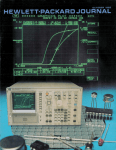
operation of the HP-IL are discussed on pages 3 through 22 of this issue. Our cover photograph shows our art
director's the of an HP-IL system in a briefcase. A little artistic license has been taken — while all of the
devices shown can operate on the HP-IL, not all are battery powered and briefcase portable.
Another in page series of articles on processes used at HP to produce custom integrated circuits begins on page
23. This used is called CMOSC, for complementary metal-oxide-semiconductor version C. It's used by HP's
Corvallis, Oregon Division to produce ICs for HP Series 10 handheld calculators.
This HP's also carries two articles on gas chromatographs from HP's analytical instruments division in
Avondale, of When a sample is injected into one of these instruments, it is mixed with a stream of
carrier results, and transported through a heated tube called a column. To ensure accurate results, the column
temperature and the carrier gas flow rate and pressure all have to be accurately controlled. The article on page
30 describes a new gas Chromatograph, Model 5790A, that gives much better control of column temperature
than high-volume instruments. While the 5790A is designed for high-volume industrial and clinical use, the 5880A
Gas Chromatograph is HP's top-of-the-line research-quality instrument. The article on page 35 discusses the
design Fred gives precise new electronic flow and pressure controller for the 5880A. On page 32, Fred Rowland gives
us some basic information about gas Chromatography.
-R. P. Do/an
Editor, Richard P. Dolan • Associate Editor, Kenneth A. Shaw • Art Director, Photographer, Arvid A. Danielson • Illustrator, Nancy S. Vanderbloom
Administrative Services, Typography, Anne S. LoPresti, Susan E. Wright • European Production Supervisor, Henk Van Lammeren
2
H E W L E T T - P A C K A R D
J O U R N A L
J A N U A R Y
1 9 8 3
H e w l e t t - P a c k a r d
© Copr. 1949-1998 Hewlett-Packard Co.
C o m p a n y
1 9 8 3
P r i n t e d
i n
U . S . A .