1
Compton scattering using a scintillation counter
Purpose
To introduce the scintillation counter as a tool of γ ray spectroscopy.
To calibrate a scintillation counter using standard γ sources; to study Compton
scattering and to determine the mass of the electron.
Key concepts
Scintillation
Photomultiplier
Compton effect
Photoelectric effect
Multichannel analyzer
Introduction
1. Scintillation counter and the multichannel analyzer
The scintillation counter is a widely used detector of charged particles. It
consists of a scintillating medium coupled to a photomultiplier tube (PMT). The
passage of a charged particle through the scintillator excites and ionizes the
material which then emits small flashes of visible light, or scintillations, as it deexcites. This visible light is, in turn, detected in the photomultiplier tube where the
flash of light is turned into a burst of electrons and amplified by a very large
factor. In this experiment the charged particles which are detected are actually
secondary electrons produced in the scintillator by the interaction of γ rays
through Compton scattering, the photoelectric effect, or pair production.
Several materials scintillate. The first use of a scintillation counter was by
Rutherford in his classic experiments which demonstrated the existence of the
atomic nucleus: α particles scattered from gold foils were detected by their
scintillations produced in a zinc sulphide screen. In those days, the scintillations
were actually detected by eye by looking at the screen with a microscope.
Nowadays, scintillators come in many forms, from inorganic crystals to plastics,
and also as liquids and gases. They are used in many fields, from medicine to
oil-prospecting to particle physics.
The scintillation process is relatively
inefficient: in the most efficient scintillators, only one visible photon (∼3 eV) is
emitted for every 100 eV of primary energy deposited, approximately.
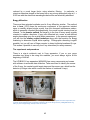
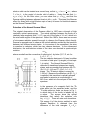
A schematic diagram of a scintillation counter is shown in figure 1. The scintillator
in our experiment is a 2 in. diameter by 2 in. long crystal of sodium iodide (NaI)
containing about 0.1% Thallium (Tl). One side of the crystal is placed against the
glass face of the photomultiplier tube while the other sides of the crystal are
surrounded by a light-tight seal to keep out room light (and also to keep out
moisture, since NaI is highly hygroscopic).
65