1
4.0 MATH Functions (cont.)
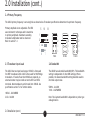
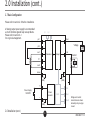
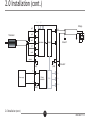
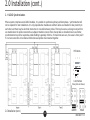
4.2 MATH Set-up Procedure
1
2
3
4
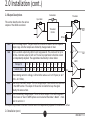
A+B A-B
LINK FOR
(X)/2
A+B
1
2
1
2
1
2
1
2
1
2
3
4
3
4
3
4
3
4
3
4
Mout=Vout
A-B
(A+B)/2
(A-B)/2
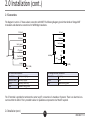
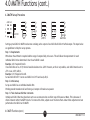
Setting up two LDX-D for MATH can become confusing as the output of each LDX-D will affect the final output. The steps below
are guidelines to help the set-up process.
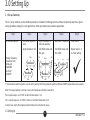
Step 1 - Requirements
Write down the arithmetic required and the range of outputs likely to be seen. This will allow the requirement for each
individual LDX-D to be determined. Vout of each LDX-D is used.
Example: ±10 V required for A-B.
If each LDX-D is set to ±10 V, then A-B would calculate to be ±20 V. However, as this is not possible, each LDX-D must be set to
±5 V or use ±10 V (A-B)/2.
Example: 0-10 V required for A+B.
Set each LDX-D for 0-5 V or set each LDX-D to 0-10 V and use (A+B)/2.
Step 2 - Initial set-up
Set up each LDX-D as an individual module first.
Working around transducer null and having a ±V output will make set-up easier.
Step 3 - Final checks and further comments
Initially each LDX-D Vout may have been set to an accurate zero but an offset may still be seen at Mout. This is because of
offsets inherent within the MATH circuits. To remove this offset, adjust one of the Vout offsets. Mout offset adjustment is best
performed on the LDX-D set for MATH.
4.0 MATH Functions (cont.)
19
M-4346/1113