1
Chapter 5: Advanced Topics
40
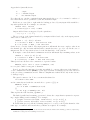
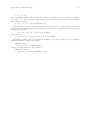
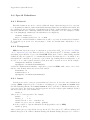
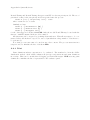
but for the entire normal form it has to be seeded with {τ ∗ (N )|N ∈ T }), — usually as many
sets as there are nodes in T 4 . As with ordinary normalisation, there are two phases: the
first (pre-normalisation) computing the subsets of T that are reachable under any trace (of
visible actions) from any of the seed nodes, with a unique-branching transition structure over
it. Because of this unique branching structure, the second phase, which is simply a strong nodelabelled bisimulation over it, guarantees to compute a normal form where all the nodes have
distinct semantic values. We distinguish between the three semantic models as follows:
• For the traces model, neither minimal acceptance nor divergence labelling is used for the
bisimulation.
• For the stable failures model, only minimal acceptance labelling is used.
• For the failures-divergences model, both sorts of labelling are used and in the prenormalisation phase there is no need to search beyond a divergent node.
The map from T to the normal form is then just the composition of that which takes N to the
pre-normal form node τ ∗ (N ), and the final bisimulation.
The equivalence relation is then simply that induced by the map: two nodes are equivalent
if and only if they are mapped to the same node in the normal form.
5.2.2.2 Diamond elimination
This procedure assumes that the relation of τ -reachibility is a partial order on nodes. If
the input transition system is known to be divergence free then this is true, otherwise τ -loop
elimination is required first (since this procedure guarantees to achieve the desired state).
Under this assumption, diamond reduction can be described as follows, where the input statemachine is S (in which nodes can be marked with information such as minimal acceptances),
and we are creating a new state-machine T from all nodes explored in the search:
• Begin a search through the nodes of S starting from its root N0 . At any time there will be
a set of unexplored nodes of S; the search is complete when this is empty.
• To explore node N , collect the following information:
− The set τ ∗ (N ) of all nodes reachable from N under a (possibly empty) sequence of τ
actions.
− Where relevant (based on the equivalence being used), divergence and minimal acceptance information for N : it is divergent if any member of τ ∗ (N ) is either marked as
divergent or has a τ to itself. The minimal acceptances are the union of those of the
members of τ ∗ (N ) with non-minimal sets removed. This information is used to mark
N in T.
− The set V (N ) of initial visible actions: the union of the set of all non-τ actions possible
for any member of τ ∗ (N ).
− For each a ∈ V (N ), the set Na = N after a of all nodes reachable under a from any
member of τ ∗ (N ).
− For each a ∈ V (N ), the set min(Na ) which is the set of all τ -minimal elements of Na
(i.e., those nodes not reachable under τ from any other in Na ).
• A transition (labelled a) is added to T from N to each N 0 in min(Na ), for all a ∈ V (N ).
Any nodes not already explored are added to the search.
This creates a transition system where there are no τ -actions but where there can be ambiguous
branching under visible actions, and where nodes might be labelled as divergent. The reason
why this compresses is that we do not include in the search nodes where there is another node
4
The convention is that T is the set of nodes of the GTLS T.